What is a non-conformance? Definition and how to handle it

Definition of non-conformity in quality. Causes, impacts and 5 steps to handle and prevent non-conformities.
Non-conformance, that word which makes everyone in quality departments grit their teeth 😬
And yet, every non-conformance is glaring evidence that a process, an organisation or a tool did not work as planned.
Whether it is a defective part, a procedural discrepancy or a failed audit, non-conformance is never trivial. It is costly.
Hidden costs, wasted time, impact on customer satisfaction, stress for teams… But above all, it prevents organisations from making progress.
The real question is therefore not how to avoid it at all costs, but how to turn it into a moment of learning and performance.
Are you looking to better understand how to control non-conformances in your company?
In this article, you will understand how to set up a structured framework to take action at every stage — from detection to resolution, including cause analysis.
And how to implement a smarter, data-driven approach. And also through the contribution of artificial intelligence.
It is time to stop suffering from non-conformances.
And start taking advantage of them.
What is a non-conformance?
The ISO 9001 standard defines a non-conformance as a deviation from a requirement.
This can concern the quality of a product, adherence to a process or the compliance of a system with the applicable framework.
In other words, as soon as an element does not meet the criteria defined beforehand, whether internal or regulatory, it is a non-conformance.
There are several levels of non-conformances:
A product non-conformance concerns a defect in a finished product or a part: incorrect dimension, unsuitable material…
A process non-conformance reveals a malfunction in a production step or a non-compliant operating procedure.
The system non-conformance, on the other hand, affects the overall functioning of the quality system. Example of a system non-conformance: lack of evidence of regular management reviews.
We also distinguish between
minor non-conformances: low impact, easily correctable
major non-conformances: non-compliance with critical requirements, repetitive deviations, impact on regulatory compliance or safety
Understanding these nuances is essential for adapting its treatment and avoiding disproportionate consequences.

Types and origins of non-conformances
Effective non-conformance management starts with good categorisation.
We generally distinguish four types of non-conformance according to their origin.
Internal non-conformances are detected in production by operators or during intermediate quality controls.
External non-conformances are often revealed by customers — in the form of complaints, product returns or expressed dissatisfaction.
Supplier non-conformances concern non-compliant components or services delivered to the company, affecting the value chain.
Finally, audit non-conformances, identified by an internal or external auditor, signal a deviation from the reference standard such as ISO 9001, IATF 16949, etc.
But what is the cause? 🕵️
Often, the origin stems from a accumulation of elements: human error, incomplete procedure, insufficient training, faulty equipment or even poorly analysed data.
Let's look at a concrete case: a discrepancy in tightening torque in an automotive workshop can come from an untrained operator or a poorly calibrated torque screwdriver.
Precise cause analysis will allow you to act on the right levers to prevent recurrence.
How to handle a non-conformance?
Handling a non-conformance is not just about fixing it quickly.
It involves following a rigorous process, in four main steps.
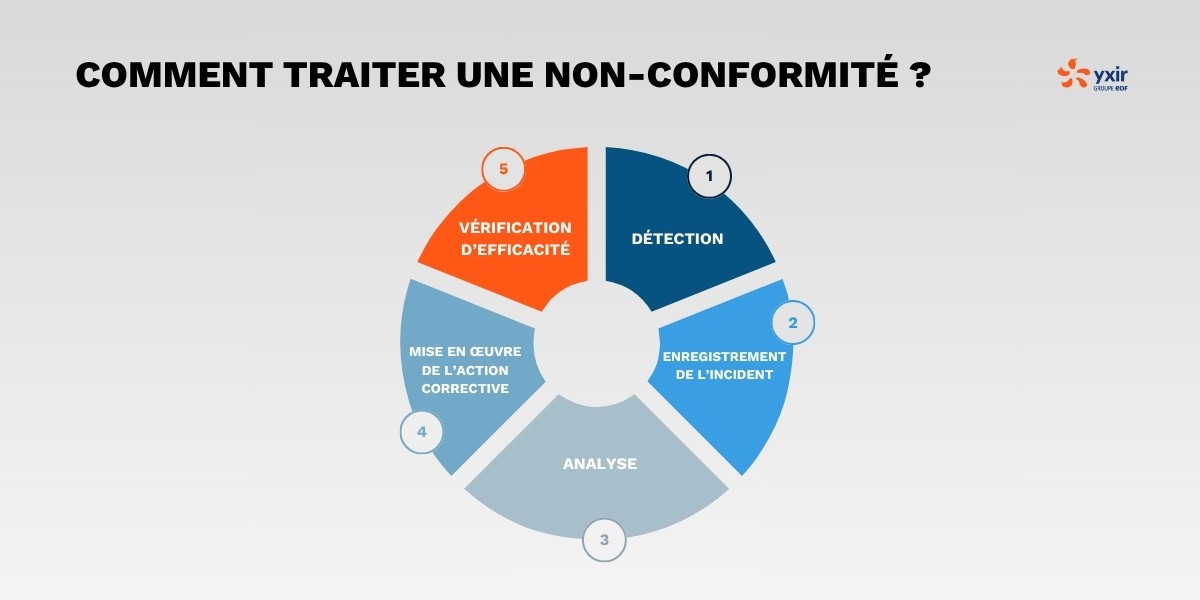
The first is detection.
It can occur in production, during an audit or following a customer alert.
Here, responsiveness is key: the earlier the non-conformance is identified, the more its impact is contained.
Next comes the logging of the incident.
Each non-conformance must be documented in a register or a dedicated form, which includes: the subject concerned, description of the discrepancy, its severity, date, and the person responsible.
This is the basis of effective tracking.
The third step is the analysis.
We seek to understand why the discrepancy occurred, using specific tools - which we will see next.
Finally, we move on to the implementation of corrective action.
This must of course resolve the problem, but also include an effectiveness check: does the correction lead to a sustainable disappearance of the non-conformance?
In an ISO 9001 context, this non-conformance management process is not only recommended but required.
Methods and tools for non-conformance analysis
Analysing a non-conformance requires more than common sense: it requires a rigorous methodology 📐
Among the most powerful tools is the 5 Whys method.
It consists of asking the question "Why?" several times to trace back to the root cause of the problem.
Simple to apply, it is effective, especially in a workshop environment.
Another visual tool is the Ishikawa diagram or fishbone diagram.
It allows for mapping the various potential causes across several axes: method, machine, manpower, milieu (environment), material, measurement.
This is a valuable aid for quality teams in analysis meetings.
But these methods are not enough on their own.
You need to integrate your non-conformance management into a PDCA (Plan-Do-Check-Act) framework.
This means planning actions, implementing them, monitoring results, and then adjusting if necessary.
A structured PDCA approach significantly improves the performance of the quality system.
At Yxir, we have integrated these tools into our SaaS platform so that your teams can easily activate them, analyse faster… and resolve sustainably.
Corrective and Preventive Actions (CAPA)
When a non-conformance is identified, it calls for the implementation of a corrective action.
But to truly secure the quality system, you must go further: prevent the problem from recurring.
That is where CAPAs come in, standing for Corrective And Preventive Actions.
A corrective action aims to eliminate the cause of a detected non-conformance to prevent its recurrence.
It relies on a root cause analysis via the 5 Whys or Ishikawa, as seen previously. It must be adapted, planned, implemented and, above all, verified over time.
Conversely, a preventive action is anticipatory.
It is triggered without a non-conformance necessarily having occurred. It is based on risk analysis or observed trends.
In both cases, a CAPA follows a structured path:
Identification of the need for action
Detailed root cause analysis
Definition of an action plan with owners and deadlines
Monitoring implementation
Short and medium-term effectiveness checks
And of course, documentation in a centralised register to ensure traceability and meet the requirements of quality audits.
We have integrated this CAPA process into our solution at Yxir, with customisable workflows, automatic alerts in case of deviations and time-stamped histories compliant with ISO 9001.
Thanks to digital management of non-conformances and CAPA, you no longer lose information, you focus on the essentials… and you manage corrective plans in a proactive and secure way.
Consequences of a non-conformance
Each untreated non-conformance can unpack consequences far wider than the initial discrepancy.
At the product level, it can lead to the manufacturing of defective parts, customer recalls or widespread dissatisfaction due to a non-conforming item.
From an financial perspective, a non-conformance directly impacts costs: scrap, rework, return transport, administrative overload…
This adds up quickly and weighs heavily on the cost of non-quality 💸
Certain non-conformances can also generate major regulatory risks — particularly in sectors subject to strict standards (aerospace, medical, agrifood…).
A failure can lead to the loss of certification, or even legal or contractual sanctions.
Not forgetting the reputational impact: a poorly served customer, a failed audit, a public quality incident… can seriously damage the credibility of a production site or a brand.
Structured management of non-conformances according to ISO 9001 requirements helps contain these risks.
Better still: it transforms each incident into an opportunity for continuous improvement.
It is with this mindset that Yxir helps industrial companies detect earlier, document more effectively and track the consequences at all levels: product, process, performance, compliance.
To not act on a non-conformance is to accept suffering its impacts over time.
Optimised non-conformance management
The starting objective of effective non-conformance management is to correct errors with rigour.
However, it must also fit into a continuous improvement process, which is at the heart of any high-performing quality system.
This begins with a trend analysis of non-conformances:
which types of discrepancies recur frequently? Which processes are most prone to failure? With the right data feedback, you can target weak points and prioritise improvements.
Internal audits and management reviews also play a key role in this optimisation.
They allow you to challenge the quality strategy, validate the effectiveness of CAPAs and redefine objectives when necessary.
Platforms like Yxir allow you to automate the collection of this data and track the overall performance of non-conformance handling.
Result: fewer oversights, clear indicators and, above all, an ability to demonstrate the rigour implemented… indispensable in an audit or when facing a customer.
This is what regulatory compliance is all about: being able to prove that you control your discrepancies and that the quality system is agile, robust and scalable.
Finally, good non-conformance management strengthens customer satisfaction.
By handling complaints quickly, explaining the causes, and implementing serious corrective actions, you show that your company takes quality seriously.
This is also what makes the difference in a demanding industrial B2B environment.
Digital tools for non-conformance management
Faced with growing compliance requirements, it is becoming essential to rely on high-performance digital tools 🖥️
At the very least, non-conformance management must rely on a standardised non-conformance report, stored in a centralised register.
This document must include: the origin of the discrepancy, its description, root cause analysis, planned actions and their tracking.
But in the era of industry 4.0, this paper or Excel approach quickly shows its limits.
At Yxir, we accelerate non-conformance management with an intuitive, collaborative SaaS platform powered by artificial intelligence.
You benefit from:
easier detection of discrepancies via automated alerts
an intelligent analysis engine to suggest probable root causes
real-time tracking of corrective actions (CAPA Workflows)
and consolidated indicators on visual dashboards
Better still, with an AI agent trained on industrial data, we anticipate probable recurrences by cross-referencing your non-conformance history with field and quality data.
Integrating a solution like Yxir into your quality process means reducing processing times, making analyses more reliable and improving the overall performance of your ISO 9001 system.
Example of application in an industrial context
Concrete case in aerospace: non-conformance detected on a critical component
In an aerospace manufacturing plant, a non-conformance is detected during the final inspection of a batch of machined parts destined for a flight control system.
A dimensional defect of 0.3 mm is identified on the bore of a component, whereas the maximum tolerance permitted is 0.1 mm.
The defect is critical: it involves a safety part. The production of the batch is immediately placed in quarantine.
Step-by-step resolution scenario
Detection and logging: quality control identifies the discrepancy using a coordinate measuring machine. A non-conformance report is opened in the QMS system.
Cause analysis: a multidisciplinary team is mobilised. Using an Ishikawa diagram and the 5 Whys method, the following causes are identified:
The machining tool shows abnormal wear.
The tool inspection procedure was not followed.
The operator was not trained on this specific check.
Corrective action: replacement of the tool, update of the procedure, express training of the operator concerned.
Effectiveness check: the next 5 batches are produced and checked without defects. An internal audit validates the robustness of the action plan.
This situation illustrates how a non-conformance can become a lever for improving the overall process: here, a one-off defect revealed a flaw in tool monitoring, leading to a sustainable improvement.
Common mistakes to avoid and best practices to remember
Common mistake: blaming the operator too quickly.
Here, the defect does not stem from an isolated human error, but from a non-robust monitoring process. The temptation to look for a scapegoat can lead to missing the real causes.
Best practice: leverage available data
Tool maintenance records allowed us to identify that the replacement frequency was no longer being followed. Without this data, the analysis would have been incomplete.
Common mistake: correcting without capitalising.
Too often, the action remains a one-off. In this case, updating the procedure in the quality system and briefing the teams allowed the correction to be anchored in the long term.
Best practice: cross-referencing departments and viewpoints.
It was the exchange between quality, production and maintenance that allowed for an overall view of the problem. Without cross-departmental collaboration, the analysis would have been partial.
At Yxir, this type of scenario can be documented and tracked end-to-end, from detection to the verification of corrective action, by linking evidence (photo, report, sensor) at each stage. All of this, within a single, traceable and collaborative system.

******
Faced with increasing regulatory requirements, pressure from customers and performance imperatives, it is becoming essential to rethink the role of non-conformance in industry.
Too often perceived as a sanction or a simple indicator of failure, non-conformance deserves a completely different interpretation.
Because behind every detected discrepancy, there is an opportunity: to challenge established practices, improve a failing process, or even anticipate other future drifts.
The goal is therefore no longer to aim for "zero non-conformance" at all costs — an illusory target in complex environments — but rather to set up a structured, agile and action-oriented non-conformance management system.
Mastering non-conformance means adopting a living quality approach, connected to the reality on the ground, and dedicated to continuous improvement.
It means equipping ourselves better, onboarding teams, securing audits, reducing the hidden costs of non-quality… and building trust.
Concretely, this means detecting non-conformances as early as possible.
Making their logging reliable.
Systematically going to the end of root cause analysis.
And above all — transforming these analyses into effective, monitored and measurable action plans.
Continue reading
The latest innovations in Industry 4.0