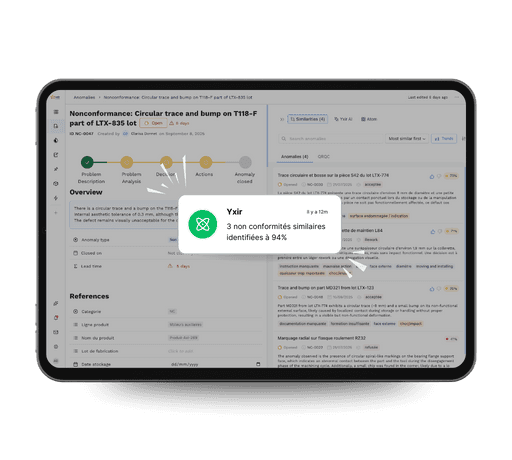
Prevent your suppliers' quality issues from impacting your production
Deviations from your suppliers eventually bring your operations to a standstill. But your supplier quality data is scattered across emails, PDFs and SAP… making it difficult, if not impossible, to drive continuous improvement.
Yxir centralises and cross-references this data to detect early warning signs before a crisis arises and to drive progress across the entire supply chain, collectively.
The solution proposed by Yxir offers a genuine platform that centralises and simplifies our non-conformance management processes.
The AI features on the history allow us to identify issues more quickly, thereby facilitating an immediate resolution without starting from scratch, but by building on work already done or on a knowledge base.
Quality Manager
Safran Landing Systems
Supplier non-quality is endured
Discrepancy, deviations, complaints, audits: each supplier event is treated in isolation, in different tools, by different teams. No one sees the complete chain. Continuous improvement remains an intention, not a supported action plan.
The supplier history exists but is not usable
Recurrences by supplier remain invisible until the crisis
Without structured data, continuous improvement remains theoretical


Yxir for managing supplier quality and the supply chain
Yxir structures your data in order to leverage it with AI.
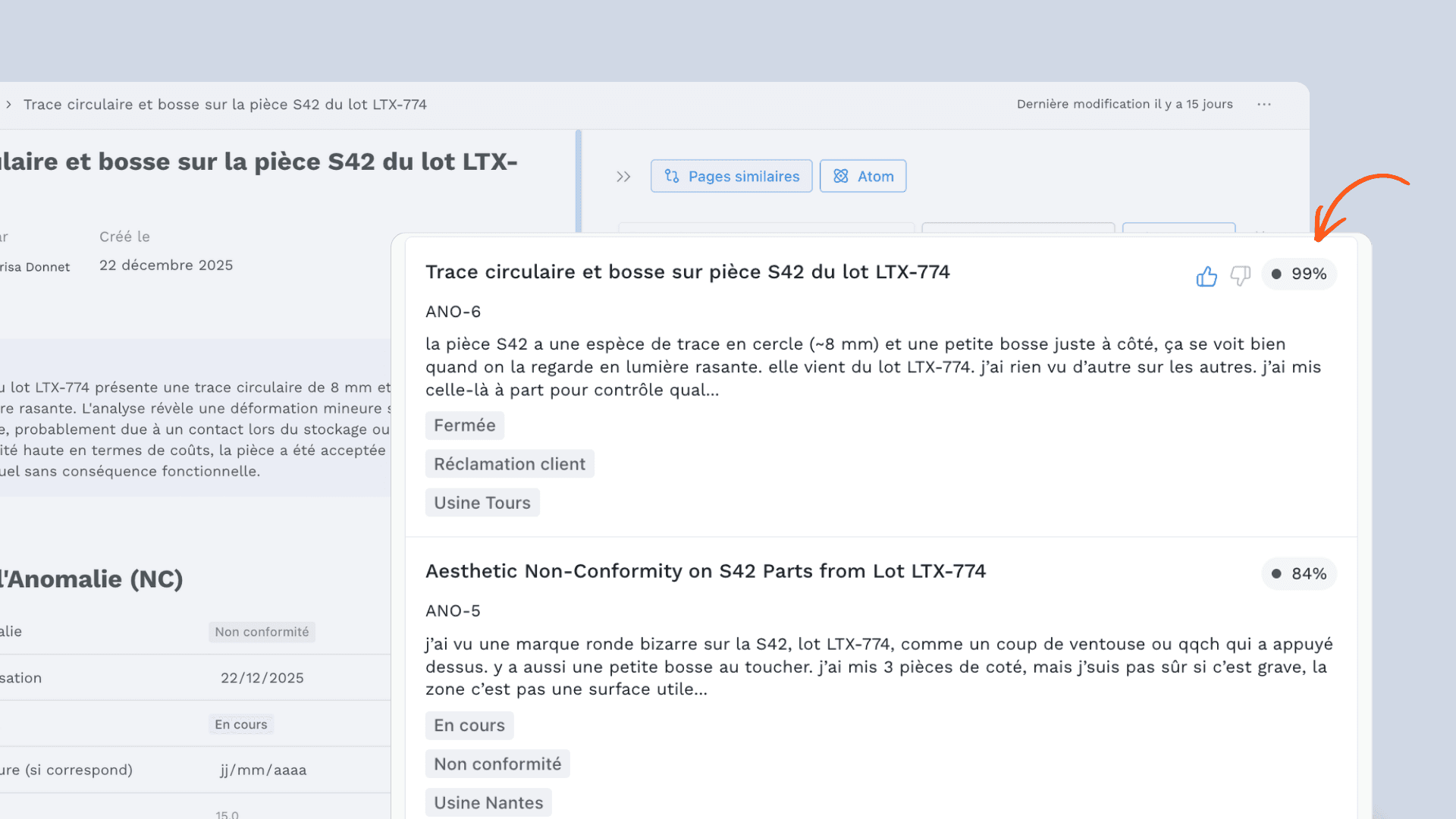
Process supplier requests in just a few minutes
Today, when a supplier submits a deviation or responds to a claim, there is no access to the complete history of this supplier for that part and type of discrepancy.
With Yxir, instantly find all past events related to this supplier and safety reference — to make decisions quickly and consistently, based on what has already been accepted or rejected.
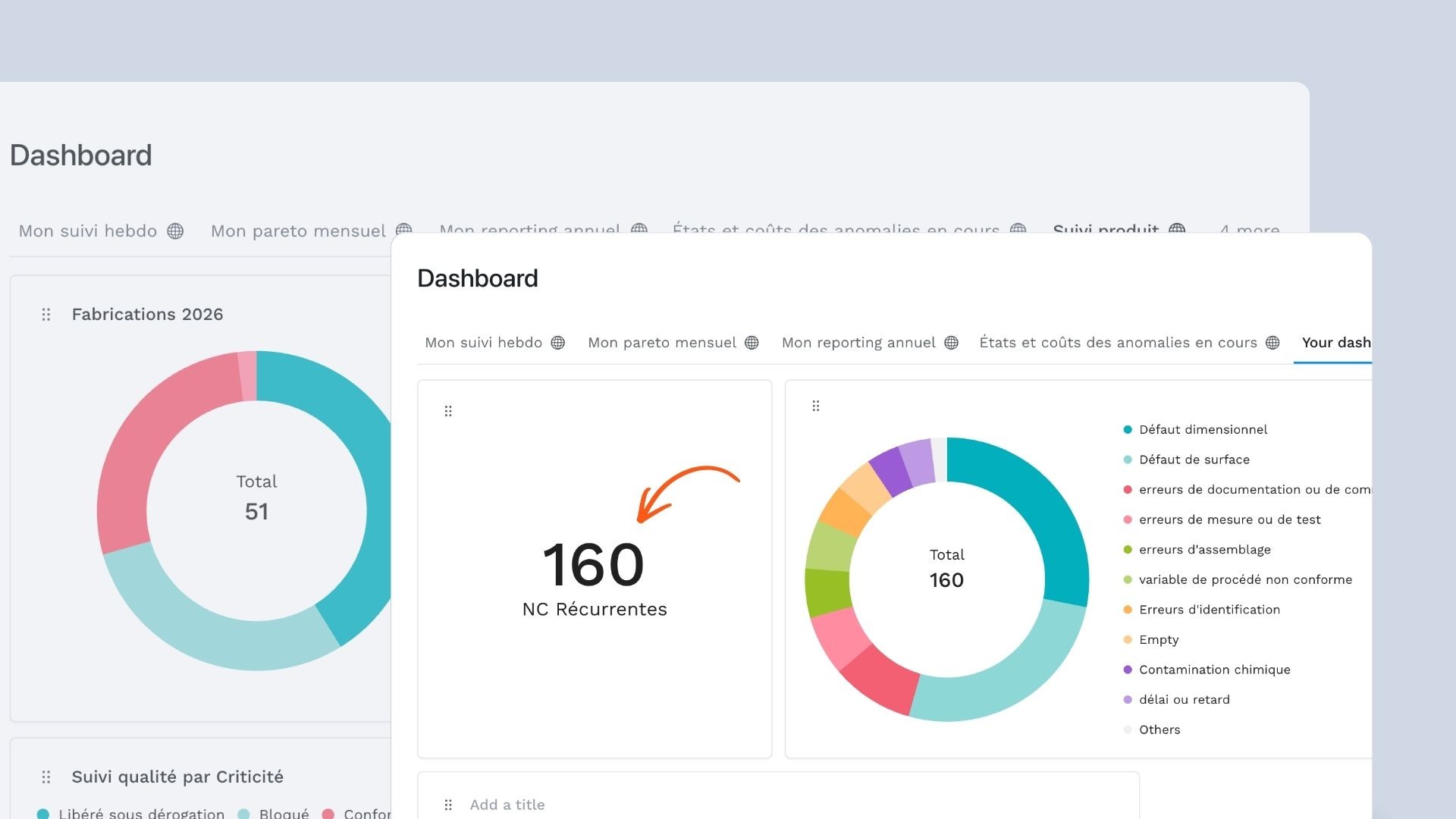
Detect non-conformity signals before they impact your production
Non-conformities, deviations, audits, complaints: because each event is treated in a silo, no one sees a supplier's global pattern, nor the cross-cutting recurrences across multiple suppliers.
With Yxir, you automatically cross-reference all available data across the entire supply chain — to detect structural deviations early, and act before a crisis occurs.
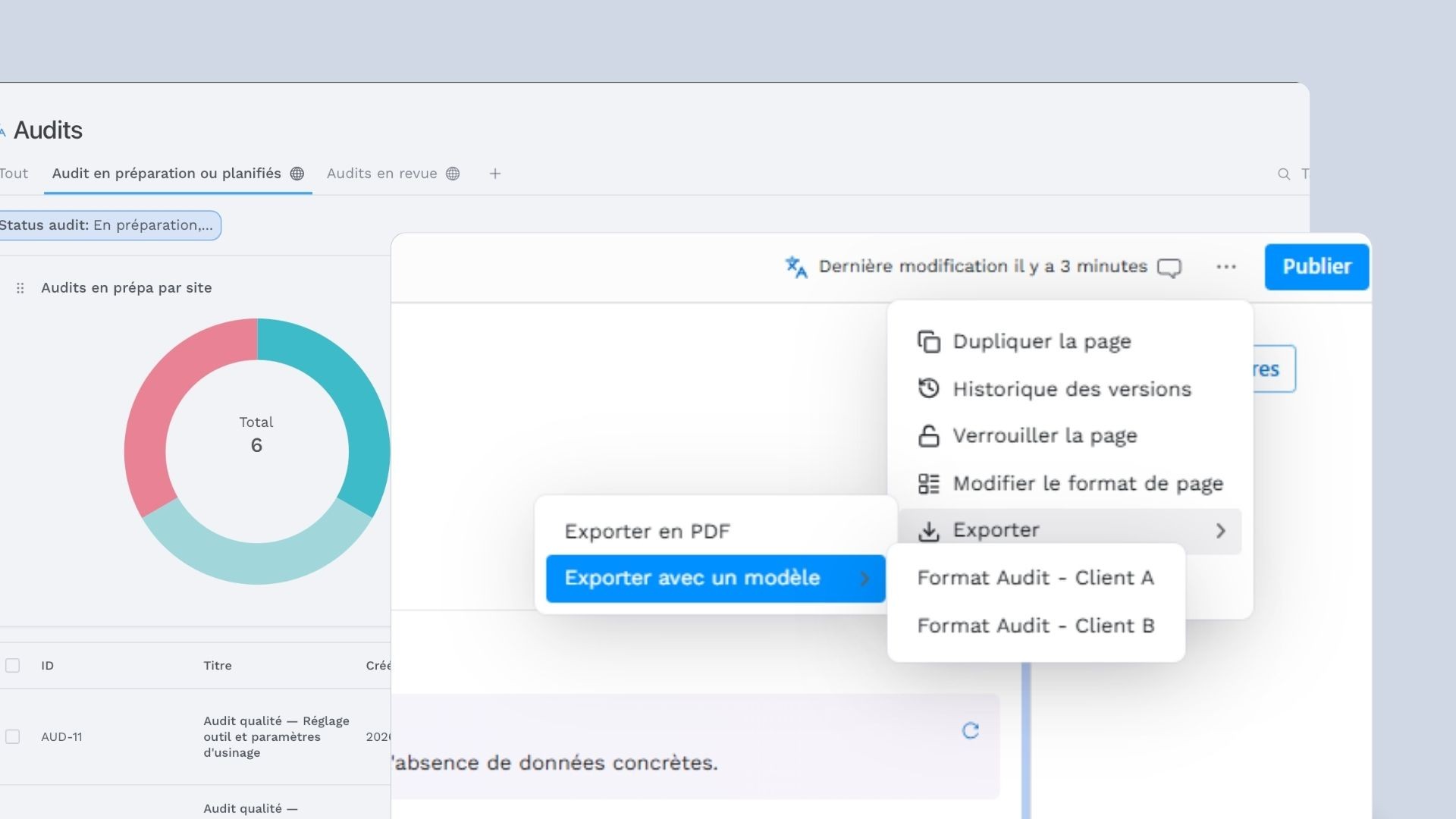
Prepare and conduct supplier audits with the complete history
Before an audit, the team must manually search for past non-conformances, concessions granted, open corrective actions... in different systems. They arrive without a consolidated view of the areas to challenge or the recurrences to confront.
With Yxir, you aggregate the supplier's complete history, and the AI identifies unresolved recurrences and helps you prioritize the areas for improvement to address — for better prepared, more targeted audits, and truly supported improvement plans.
Drive corrective action plans and measure progress
Action plans are tracked in Excel files or emails: it is impossible to know where each action stands in real time, whether deadlines are being met, or if the problem has actually been resolved.
In Yxir, the tracking of corrective actions is structured and automatic (alerts before deadlines, real-time progress, documented closure) so that every complaint or audit leads to a measurable improvement, not a closed file.

It's way more ergonomic to report a new anomaly on Yxir
Previously, from one Bernard Controls site to another, the same problems recurred even though one site had already found the solution, but the others were unaware of it.
User
Ponticelli
Thanks to Yxir, I found a non-conformity that was from 7 years ago.
I would never have been able to identify it on my own. It was extremely helpful!
Quality Manager
Safran Landing Systems
Three ways to use Yxir for supplier quality
Yxir adapts to the maturity of your supplier relationship. You can start alone, internally, and progressively extend to your partners according to your needs.
Mode 1 — Internal use only
Manage supplier quality without involving suppliers in the platform.
Centralise all supplier quality events (NCs, deviations, audits, complaints) in a single actionable space.
Cross-reference and analyse the history of each supplier to prepare audits, investigate requests, and detect deviations.
Manage corrective action plans and measure progress — without changing the supplier's processes.
Internal steering · Immediate start
Mode 2 — Shared access with restricted permissions
When you open Yxir to your suppliers, each only sees their own data.
Each supplier submits their requests (deviations, complaint responses) directly in Yxir, with access only to their own data.
You maintain a cross-functional overview — you can detect patterns common to multiple suppliers and standardise your responses.
Structured, traceable communication, and history automatically capitalised on both sides.
Extended enterprise · Structured collaboration
Mode 3 — Yxir deployed at the strategic supplier
You are supporting the quality skill development of a key supplier.
You push the deployment of Yxir to your supplier.
The supplier uses Yxir to process its internal non-conformities — they capitalise, detect recurrences, and progress on their own data.
The supplier's quality performance improves sustainably — you no longer have to detect defects for them.
Supplier development · Accompanied quality plan
For which teams
SUPPLY CHAIN & PROCUREMENT
You suffer from supplier non-conformities upon receipt — without knowing if they were predictable
Yxir gives you a consolidated view of each supplier's quality performance to help you make decisions on volumes, detect deviations early, and secure your production rates.
SUPPLIER QUALITY ENGINEER (SQE)
You process dozens of requests per month without quick access to each supplier's history
Yxir instantly retrieves previous cases and opinions already issued — allowing you to make quick, consistent decisions without relying on your memory or that of your colleagues.
INDUSTRIAL DIRECTION
The poor quality of your supply chain impacts your production rates — without a dashboard to see where your critical suppliers stand
Yxir offers a cross-functional view of all supplier quality events to drive supply chain performance as an operational indicator.
What this means in practice
Faster and more consistent decisions
A supplier's complete history is accessible in seconds: no more digging through SAP or relying on a colleague's memory to know what has already been accepted or rejected.
End-to-end visibility across the entire supply chain
Recurrences between suppliers are automatically detected: an issue affecting multiple suppliers becomes visible before impacting production, not after.
Better prepared audits, real improvement plans
Each audit is based on the supplier's consolidated history: the areas to be challenged are identified before arriving on site, and action plans are monitored until they are effectively closed.
Continuous improvement that can be measured
Each supplier's progress is visible over time to show where the chain is improving, where it is regressing, and to focus efforts where they have the greatest impact.