What is Lean Management? Principles, tools and application in the digital age

Adopt lean management to boost your performance: discover its principles, tools and benefits to optimise your processes and reduce waste.
Originating from Japan, the lean management working method is an approach heavily inspired by production quality.
Today, it is widely adopted across major industrial groups and continues to inspire the daily rituals of quality teams.
Why is lean management so widely used?
Faced with increasing customer demands, pressure on deadlines and the explosion of data volumes, quality teams need agile and reliable methods.
The challenge, therefore, is to create a performance-oriented organisation, by eliminating waste and making quality processes smoother, faster and more efficient.
Let’s discover together how the principles of lean management apply concretely to quality management.
We identify the true levers of continuous improvement, how to involve your teams and integrate the right indicators.
Why does Lean Management remain essential in 2025?
Industrial companies have never been under so much pressure: increased customer requirements, demands for customisation, sustainability issues, short-term return on investment…
In this context, lean management remains a very widely adopted method in the industry 🏭
Indeed, it is a performance catalyst when intelligently integrated with digital tools and a culture of continuous improvement.
Would you like to reduce your production waste, reinforce quality, while remaining agile in the face of unforeseen events?
Lean management gives you the concrete means to achieve this.
But beware: to be effective today, a lean approach implies a change of mindset, precise process management and an ability to leverage the right technological drivers.
What is lean management? Definition and basic principles
Lean management is a management method born in the Japanese automotive industry, aiming to eliminate waste to create more value with fewer resources 📦
The word "lean" literally means "slim", in the sense of "fat-free": it is about optimising the use of resources, skills and time without compromising quality.
This approach is based on a simple belief: what does not bring value to the customer is waste (called "muda" in Japanese).
Identifying and eliminating this waste improves the performance, quality and responsiveness of the company.
Lean management applies well beyond the production workshop.
Today, we speak of lean in services, innovation, information systems, and even in corporate governance.
But beware: lean is a fundamental approach based on a few essential principles, a strong managerial culture and an ability to adapt to the reality of the field.
Understanding its origins allows us to grasp its power… and the conditions for success.
Origins of the concept: from the Toyota Production System to modern management
Lean management finds its origin in the Toyota Production System (TPS), established after the Second World War in Japan 🇯🇵
Confronted with a shortage of resources, the manufacturer Toyota had to completely rethink its industrial approach in the face of Western mass production models.
Rather than producing in large quantities, Toyota focused on just-in-time production: producing only what the customer requests, when they request it, with flawless quality.
This philosophy gave rise to innovative practices, such as Just-in-Time, quality built into processes or jidoka. Or even the direct involvement of operators.
Subsequently, researchers like James Womack and Daniel Jones codified this approach into what they named lean management: a set of principles applicable to all sectors of activity.
Today, lean is no longer reserved for manufacturing.
It is found in hospitals, banks, administrations, and of course in the cross-functional departments of industrial companies: quality, purchasing, maintenance, R&D…
Adopting a lean approach means being part of a proven tradition while modernising it with current management tools.
Lean manufacturing, lean management and lean in services
A frequent confusion is to believe that lean management is limited to production 🔩
In reality, lean manufacturing is only a subset of lean.
Lean manufacturing refers to the application of lean principles to industrial manufacturing: inventory reduction, flow improvement, elimination of non-value-added tasks.
But the lean philosophy can be applied in all areas.
Lean management focuses on the entire processes of an organisation, including support activities, internal services, engineering, innovation…
As for lean service, it adapts lean concepts to immaterial environments where service delivery involves information processing, such as customer services, IT services or management centres.
In any case, the objective remains constant: maximise value for the customer while minimising internal waste.
It is precisely on this adaptability that the relevance of lean management lies today. At a time when data, responsiveness and customer experience are at the heart of industrial challenges.
The 5 fundamental principles of lean management
What is the principle of lean management? 🙄
To guide a lean approach, James Womack and Daniel Jones defined five founding principles.
They form a structuring framework, applicable to any process, regardless of the sector. By following these steps, you build an agile and customer-oriented system.
First principle: Define value for the customer
It all starts with a simple question: What does the customer actually expect?
Value is not defined by what the company produces, but by what the customer is willing to pay for.
In a lean vision, only an action that transforms a product or service in response to a customer need is a source of value.
This implies redefining priorities, often breaking away from internal habits.
A superfluous report, a redundant control or a meeting with no immediate impact are all activities that unnecessarily consume resources.
So, identifying what actually has value is the first step to eliminating waste.
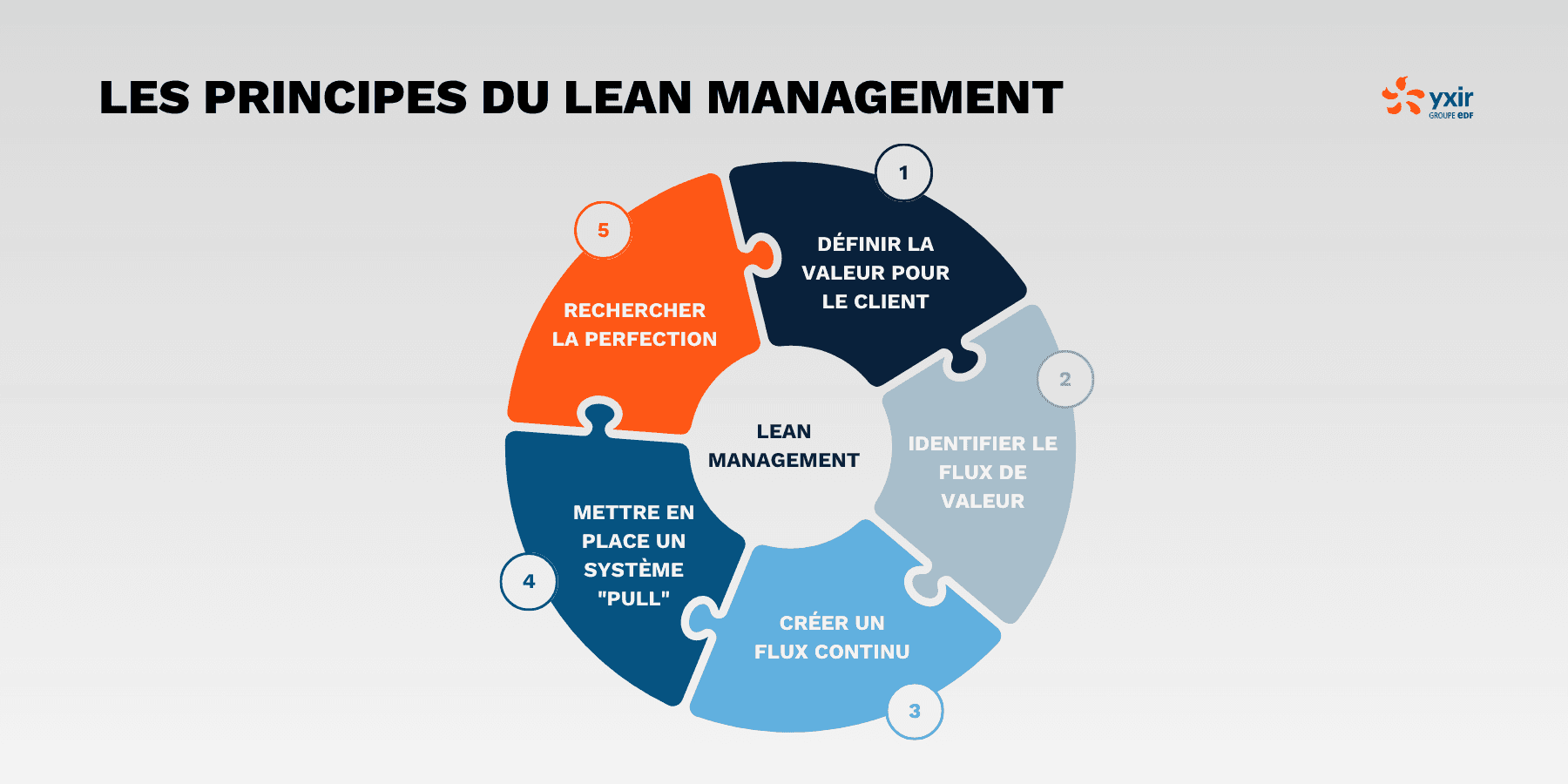
Second principle: Identify the value stream
Once value is defined, we must map out all the steps required to create it. This is what is called the value stream.
With tools like VSM for Value Stream Mapping, we clearly visualise tasks that add value and those that do not.
The objective is twofold: make waste visible and identify areas of instability (bottlenecks, waiting times, defects).
This is a crucial step to transition from siloed operations to a transversally managed vision, focused on fluidity and overall performance.
Third principle: Create continuous flow
A continuous flow aims to eliminate disruptions in the value chain: transfers, waiting times, reworks, storage.
This involves reorganising tasks, standardising processes, adapting workstations, or even restructuring teams.
In an effective lean system, each production or processing step naturally leads to the next, without interruption, without excess inventory, without loss.
The benefits? Fewer delays, fewer errors, more flexibility.
A tight, yet controlled flow allows industrial companies to sustainably improve their competitiveness.
Fourth principle: Establish a pull system ("pull")
Unlike the "push" system, which pushes production based on forecasts, lean favours a pulled flow: nothing is launched without actual demand ☝
This is what is found in Kanban systems for example, where visual signals replace planned production orders.
This mode of operation greatly reduces inventory, avoids overproduction and increases responsiveness to changes in demand.
Above all, it forces continuous operational excellence, because the slightest incident affects every link in the chain.
A well-calibrated pull system allows the company to remain agile, even in an unstable environment.
Fifth principle: Pursue perfection
Last principle, but an essential one: lean management is an endless journey.
Even a process optimised today can be improved tomorrow.
The idea is not to target, but to constantly move closer to absolute perfection through regular small steps.
This path of continuous improvement relies on tools like Kaizen, PDCA or visual management.
But it will only work if teams are engaged, mistakes are viewed as learning opportunities, and leadership leads by example.
It is this collective quest for excellence that sustainably transforms the company.
Through these five principles, lean management establishes a coherent, systemic and customer-oriented framework.
The key tools of lean management
In a lean management approach, it is indeed the tools that allow intentions to be transformed into actions on the ground 🛠️
These methods, widely proven in the industry, allow for precise performance management. Here are the most iconic ones.
5S: organisation and cleanliness of the workstation
The 5S aims to make every workspace cleaner, safer and more efficient. It is a simple method, applicable to any type of environment, industrial or otherwise.
The 5 steps are Sort, Set in order, Shine, Standardise, Sustain. They create an environment conducive to productivity, fostering quality and safety.
It is often the first tool implemented in a lean approach.
Kaizen: continuous improvement
A cultural pillar of lean management, Kaizen is based on the idea that everyone can suggest improvements, no matter how small.
This creates a proactive dynamic and strengthens team engagement in continuous optimisation processes, directly linked to customer satisfaction.
Kanban: real-time flow management
Kanban is a visual management system that facilitates the smooth flow of tasks and products.
With cards, signals or boards, it allows adapting the workload in real time to needs, without overproduction.
A well-dimensioned kanban management improves responsiveness while reducing waste.
Jidoka: automation with built-in quality control
In a lean approach, automation only makes sense if it includes the ability to detect and correct anomalies.
The principle of Jidoka introduces an intelligent self-sufficiency of machines or processes, which automatically stop in the event of a defect.
Result: more reliable production, fewer scraps, and controlled costs of non-quality.
Just-in-Time (JIT): reduction of lead times and inventory
Producing only what is necessary, when it is necessary, and in the right quantity: this is the core of JIT, Just In Time.
This logic reduces dormant stock, accelerates flows, and makes companies more agile in the face of demand variations.
It nevertheless requires strong control over processes and information flows.
SMED: reduction of setup changeover times
The SMED aims to minimise downtime during production changes.
The idea is to switch from one series to another in a matter of minutes, hence the term Single-Minute Exchange of Die.
This supports small runs, customisation and greater industrial flexibility.
Poka-Yoke: error-proofing systems
Poka-Yoke are often simple, yet very powerful devices: they help prevent human errors.
Whether it is a sensor, a physical guide or a restricted entry on a software, everything is designed to make errors impossible at the source.
It is a smart way to secure quality without being coercive.
VSM: value stream mapping
Value Stream Mapping (VSM) is a strategic tool of lean management.
It allows displaying the entire process, spotting bottlenecks, and identifying waste.
By relying on this global vision, teams can prioritise high-value-added actions to optimise production and decision flows.
At Yxir, we directly integrate some of these tools into our platform — notably VSM and Kanban logics — to help our clients manage their continuous improvement using actual data and smart indicators.
Implementing lean management in an industrial company
Deploying a lean approach translates on the ground into a wide-reaching company project, combining best practices, collective commitment and structured management.
Here is how to concretely initiate lean management in an industrial environment.
Steps to initiate a lean approach
It all starts with a diagnostic phase 🔍
We identify current flows, waste, strategic objectives. Then comes the building of the lean roadmap: prioritisation of projects (quality, delivery, cost), choice of tools, team formation.
The first results must be visible quickly. Hence the importance of targeting a high-impact process to begin with.
Conditions for success and adoption levers
The success of a lean transformation often depends on a key factor: the alignment between strategic vision and ground reality.
Active management sponsorship, an already present (or developing) culture of improvement, and regular feedback loops are needed 🌀
The use of real-time management tools, such as automatically updated quality dashboards, allows for measuring progress and staying on track.
Involving teams and managing change
An effective lean is built with the teams, not in their place.
This involves training, empowerment, and establishing continuous improvement rituals: daily meetings, problem solving, visual management.
Lean management changes how problems are viewed: they become opportunities for collective learning.
Examples of application in the automotive, energy and aerospace sectors
🚘 In the automotive industry, the lean approach was used to reduce spare parts inventory while improving the service rate.
🔋 In energy, some companies use VSM to make technical on-site inspections more reliable and avoid unnecessary travel.
✈️ Aerospace applies lean to simplify the complex assembly of structural parts, thanks to visual management and synchronised pull flows.
Whether on mature industrial sites or more agile units, lean management remains an effective method provided its execution is rigorously managed.
Lean management and digital transformation
With digital, lean management enters a new era ⏱️
One where data is available in real time, where machines feedback smart signals and where AI becomes an operational building block of quality management.
Contrary to what one might think, digitalisation and lean do not oppose each other. Quite the contrary ⚡
These are two complementary levers, converging towards the same goal: improving performance without weighing down organisations.
With a platform that enables digitalisation, lean principles take on a whole new dimension.
It is about mapping and analysing flows in real time.
Waste is no longer assumptions, but objectified data. And quality indicators are no longer static: they become smart, evolving, predictive.
This is the full power of an AI-assisted lean approach: the platform does not replace humans, it amplifies them.
It detects anomalies earlier, suggests root causes, automates certain corrective actions… without ever constraining the agility on the ground.
But beware: automating does not mean rigidifying.
In a lean logic, digital must serve the flow, not the other side around. The challenge is to preserve the capacity to adapt, while making processes more reliable at every step.
The concrete benefits of lean management for the company
Lean is not an ideological investment.
Its approach produces measurable results, quickly visible on the ground as well as in indicators 📊
In the first place, it acts on waste – and this word covers much more than a simple excess of raw material.
We are talking here about time lost searching for information, duplicates in quality controls, avoidable customer complaints or dormant stock masking process defects.
With a digitalised Lean approach, there is a net reduction in hidden costs, those not seen on balance sheets but which undermine competitiveness.
Secondly, lean improves the quality of products and services.
By involving teams, detecting errors at the source, structuring action plans, it creates an environment where defects are tracked and corrected before they become critical.
Customer satisfaction is thus reinforced, as is the brand image.
On the schedule side, removing disruptions in flows allows for accelerating production, without cutting corners.
Deliveries are more reliable, schedules more controlled and pressure on teams decreases.
Finally, it is a factor of internal transformation.
Lean gives meaning, visibility and responsibility. It values the expertise of operators, encourages taking initiative and creates a shared performance culture.
A powerful lever of engagement, in a context where industrial attractiveness is also driven by quality of life at work.
Examples and use cases of lean management
Lean is not reserved for Japanese multinationals or car manufacturing plants 🚙
Its principles can be adapted to all sizes of companies, all industrial contexts.
Take the case of an aerospace plant facing high scrap rates on an assembly line.
By mapping the flows, the quality team identifies a manual step subject to variation.
Thanks to the implementation of a simple Poka-Yoke and process standardisation, defects drop in just a few months.
In parallel, a digital Kanban board allows visualising in real time tasks to be processed, with lead times cut in half.
Another example is that of an industrial SME choosing a digital platform like Yxir to structure its lean approach.
The company suffers from a lack of visibility on its non-conformities and action plans.
By deploying a digital quality management platform, it can centralise quality data, make root cause analyses more reliable thanks to integrated AI, and track actions continuously.
In a few weeks, it significantly reduces its rate of recurring deviations, as the tool allows rapid identification of recurrences.
In addition, being well integrated, the tool helps smooth exchanges between production and quality.
Finally, sector benchmarks show that the most advanced companies in lean are often those that have been able to link it to their digital strategy.
In automotive, aerospace, energy or food industry, we observe a clear convergence between operational excellence, digital and lean management, as explained in this article from l'Usine Nouvelle.
Limits and misinterpretations of lean management
In cases where it is poorly applied, lean can become counterproductive 😟
Too often, speed is confused with haste and we can minimise the impact such a project has on teams.
A frequent mistake is to turn lean into a command for raw performance, piling up projects without listening to the shop floor.
In the end, we can end up with exhausted teams, continuous pressure and rushed actions. This is not lean, but a caricature.
Another drift: dogmatic application.
Some think that simply implementing a tool will make the magic happen. Yet, lean is above all a mindset and a culture.
Without questioning habits, without exemplary leadership, tools remain a dead letter.
This is also why good management is essential.
Far from frozen Excel sheets or annual audits, smart management of a lean management strategy relies on up-to-date data, real-time alerts, and contextualised indicators.

*****
Deploying the principles of lean management in an industrial organisation must be a strategic stance.
It is a way of anchoring efficiency, rigour and continuous learning at the heart of operational performance.
Quality standards are evolving rapidly, value chains are internationalising and customer pressure is intensifying.
In this context, the ability to continuously improve, without depending on heavy investments or rigid organisations, becomes a true competitive advantage.
The strength of lean management lies in its universality and its adaptability.
Whether it is a matter of rethinking a production process that is too slow, reducing non-conformities, better exploiting your data or smoothing communication between departments, the principles of lean management offer a coherent reading grid and powerful levers of action.
Finally, the combination of lean approach and digital tools gives a whole new dimension to the method.
A digitalised quality system does not simply replace Excel files or automate repetitive tasks.
Thanks to AI, smart indicators and centralised quality flows, we accelerate anomaly detection, the reporting of weak signals and fact-based decision-making.
We transition from reactive management to proactive steering, by giving teams the concrete means to act.
We reduce non-value-added tasks, make waste visible, facilitate improvement rituals, and connect the field and management around reliable and actionable data.
If you would like to test Yxir, contact us and we will be delighted to discuss your current quality challenges.
Continue reading
The latest innovations in Industry 4.0