What are the best problem-solving methods?

Discover the best problem-solving method to make effective decisions, resolve conflicts and improve your productivity today.
What problem-solving method do you use to tackle your issues?
This question is absolutely crucial for sustainably improving quality within teams.
A repeated non-conformance, a defect that regularly reappears on a production line, a quality indicator that slips without any clear explanation: you know how tempting it is to treat the symptom rather than look for the root cause.
So, how do you step away from firefighting mode and adopt a structured approach that actually reduces the occurrence of problems?
A good problem-solving method must be a structuring process that guides your teams towards a detailed understanding of the problem.
And, above all, towards truly effective corrective actions.
In this article, we analyse how to choose, implement and keep a problem-solving method alive that is tailored to your organisation.
Towards a world with less recurrence, greater peace of mind and real performance gains?
Let's go!
Problem-solving method: why industry must structure its approach
Every day, quality and production teams must react to anomalies, deviations and malfunctions.
But acting in a rush, without a method, often leads to bypassing the analysis, repeating errors and generating new non-conformances.
In a demanding industrial environment, not structuring your problem-solving process comes at a cost: lost time, waste, downtime, customer non-quality and a damaged image.
Yet, with a good problem-solving method, it is entirely possible to transform these critical situations into continuous improvement opportunities.
Nevertheless, a comprehensive approach is required to efficiently structure your resolution processes.
First, it is important to identify the key steps to go from a vague problem to a permanent solution.
Next, you need to mobilise the right quality tools, structure the root cause analysis, implement robust action plans and measure their results.
Finally, it is essential to digitise these processes with innovative solutions to increase efficiency and traceability.
Defining the problem-solving method
A problem-solving method is a structured sequence of steps aimed at identifying a malfunction, finding its root causes and implementing a solution that prevents its reoccurrence.
It relies on proven tools – such as the 5 Whys method, the Ishikawa diagram, or the PDCA cycle – to secure each phase of the process.
In industry, managing non-conformances, controlling deviations and optimising processes require such a rigorous method.
It is an issue inseparable from the quality approach, compliance with ISO 9001 standards, and more broadly, operational performance.
An effective problem-solving method structures thinking, challenges assumptions and aligns decisions across departments.
It fosters collective intelligence, the reporting of facts and the capitalisation of learning.
Without this approach, corrective actions often merely mask symptoms without addressing the underlying issue.
Understanding what a problem-solving method truly is is the starting point for professionalising your practices and laying the foundations of a robust continuous improvement culture.
Why structuring resolution is vital for industry
In an environment where quality and safety requirements are critical, improvising deviation management is a risk that few industries can afford.
The problem-solving method here provides a reliable framework to guide, decide and avoid repeating the same mistakes.
Structuring the resolution helps objectify the analysis: we no longer content ourselves with opinions or intuitions; we rely on measurable facts.
This also saves time: rather than procrastinating, we follow a clear process shared by all.
Industrial companies that have integrated a formal problem-solving method notice concrete benefits: reduction in unplanned downtime, improved resolution rates and better traceability of actions.
It is also a powerful managerial lever.
A rigorous approach lends credibility to quality and production managers in the eyes of auditors, management committees or clients.
In a context of digital transformation, formalising these steps is also a prerequisite for their partial automation through tools.
Identifying and understanding the problem: the first step of a good resolution method
It all starts with a proper definition of the problem.
Without an accurate identification of the malfunction, the entire rest of the problem-solving method loses its effectiveness.
Too often, we rush to the solution without taking the time to observe what is actually happening on the ground.
First, we must collect facts, data and quality indicators.
At this stage, this might involve scrap rate analyses, non-conformance reports, customer complaints, internal audits or Gemba observations.
But this information must be organised.
This is where the 5W2H method proves invaluable.
The method allows us to formulate an objective, comprehensive and shared description of the observed problem, avoiding perception biases.
It is based on the questions: Who? What? Where? When? Why? How? How much?
Let's take an example in the automotive industry: “an electrical component overheats during the final test phase, only on line B, during night shift productions, since the beginning of the month”
This precision is essential for guiding a relevant root cause analysis afterwards.
In a high-performing problem-solving method, this step can even be facilitated by digital quality tracking tools, which log history of anomalies directly in a shared database.
Using the 5W2H method to clearly define your problem is an indispensable reflex to launch a solid, reproducible and collaborative process.
Analysing root causes
The 5 Whys method
A truly effective problem-solving method looks to understand the underlying roots of the malfunction ⁉️
Among the simplest and most powerful tools for this is the 5 Whys method.
This technique consists of systematically asking the question “Why?” for every answer obtained, until the root cause of the problem is reached.
Generally, five iterations are enough to trace back to the real origin of the malfunction.
Let's take a concrete example in industry:
The machine stops mid-production.
Why? — The motor overheated.
Why? — The cooling system was not working.
Why? — The circulation pump was out of service.
Why? — It was not replaced according to the maintenance recommendations.
Why? — The maintenance plan does not cover this equipment.
The value of this resolution tool lies precisely in its ability to reveal organisational or systemic causes, which are often invisible at first glance.
It encourages deep questioning while simplifying the process.
In a structured problem-solving process, this method is often integrated with other analytical tools like Ishikawa (5M) or FMEA.
To find out more, read our article on the 5 Whys
Using the Ishikawa diagram to identify root causes
Complementary to the 5 Whys, the Ishikawa diagram – or fishbone diagram – is an essential tool in any problem-solving method 🐠
Also known as the 5Ms or 6Ms, Ishikawa allows you to visually represent all potential causes of a problem, grouped into broad categories:
Material
Method
Manpower
Machine
Milieu (Environment)
Measurement
By structuring thinking in this way, you avoid limiting yourself to partial hypotheses.
The diagram forces teams to examine the problem from several angles, mobilising facts and field observations.
Let's take a classic use case: recurring welding defects on a production line.
Thanks to the Ishikawa diagram, the team can explore:
1/ the quality of the filler wire - material
2/ the operating procedures - method
3/ welder training - manpower
4/ machine settings
5/ humidity conditions in the workshop
6/ the calibration of testing equipment
This visual and collaborative work encourages the participation of several departments and strengthens collective intelligence.
When well-facilitated - in a Kaizen workshop or during a quality review - this diagram becomes an effective steering tool for your problem resolution.
Generating potential solutions
Structured brainstorming techniques
Once the problem is well-defined and the root causes identified, the next step is to devise solutions.
But beware: this is not about looking for the first idea “that might work” 😏
In a structured problem-solving method, we mobilise a collective idea generation phase, often in the form of a moderated brainstorming session.
Structured brainstorming is based on a few simple but essential principles:
Create a supportive environment to encourage creativity
Get different profiles to participate to enrich perspectives
Separate the moment of idea generation from that of analysis
Among the effective methods, you will find:
6-3-5 brainstorming: 6 people, 3 ideas, 5 minutes
reverse brainstorming: we look for how to worsen the problem, then reverse it
the SCAMPER technique to Substitute, Combine, Adapt, Modify
These approaches help step away from the obvious solutions and build a portfolio of potential responses aligned with the analysed causes.
In industrial environments, where constraints are multiple, this diversity is indispensable.
Filtering and structuring ideas: impact matrix, SWOT analysis
Once the solutions are on the table, it is necessary to structure them to identify those that deserve to be tested.
The problem-solving method does not stop at generating ideas: it also requires a rigorous selection process.
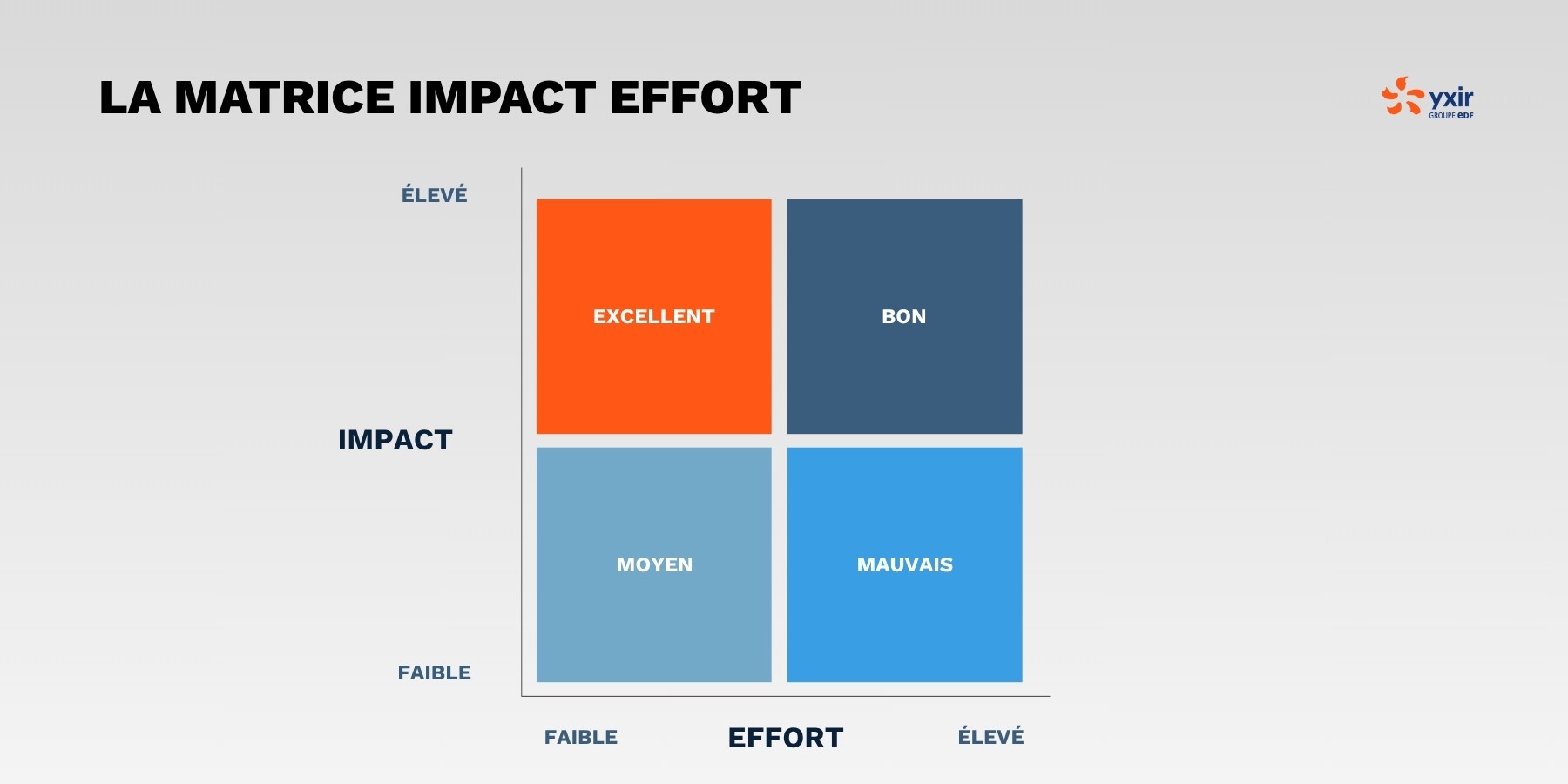
Two tools are widely used for this in industry: the impact matrix and the SWOT analysis.
The effort/impact or feasibility matrix helps prioritising ideas along two axes:
the expected impact on the problem
operational feasibility or required resources
Ideas located in the “high impact / high feasibility” quadrant should be addressed first.
The SWOT analysis, on the other hand, examines the Strengths, Weaknesses, Opportunities and Threats of each solution.
It is particularly useful when working on strategic or regulatory issues.
By structuring these thoughts, you avoid bias - such as choosing an idea because it is supported by an influential manager - and provide an objective framework for decision-making.

This step is often decisive in getting all stakeholders on board with the chosen solution.
Selecting the best solution
Once the potential solution paths have been identified and structured, the challenge now is to choose the most relevant one.
Not necessarily the most obvious. Not necessarily the simplest. But the one that best answers the problem within a realistic operational framework.
Multi-criteria comparison and validation by stakeholders
To avoid a biased or subjective decision, the selection step must rely on a multi-criteria analysis.
Expected impact, technical feasibility, cost, implementation time, compatibility with existing processes, residual risk... all these dimensions must be rigorously evaluated.
A good tool for this: the weighted decision matrix.
Each solution is scored against defined criteria, with weights assigned according to their strategic importance.
This scoring allows one or two “winning” options to emerge that balance performance, feasibility and buy-in.
But the decision is not made alone. To be sustainable, it must be shared.
This is why it is useful to involve stakeholders – production, maintenance, quality, management – in the final validation.
This ensures alignment, reduces resistance to change and maximises the chances of success for the action plan.
Integrating operational and regulatory constraints
In industry, theoretically perfect solutions can prove inapplicable on the floor.
A machine replacement? Impractical without line down time.
A procedure change? Requires regulatory validation or certified training.
The selection of the solution must therefore take into account all operational, human, budgetary and regulatory constraints.
This is also when we evaluate if a small-scale test like a POC or pilot is appropriate to secure large-scale implementation.
By integrating this reality check, you avoid costly failures and lay the groundwork for a controlled rollout in compliance with your sector's requirements.
Deploying the solution and tracking the action plan
Having identified the best solution is not enough: it must still be implemented in a structured manner to guarantee its effectiveness.
This is where an essential continuous improvement method comes in: the PDCA cycle (Plan – Do – Check – Act).
PDCA method for implementation
PDCA is a simple but incredibly powerful framework to steer the rollout of a solution while securing each step.
Plan: define precisely the actions to be carried out, the necessary resources, deadlines and success indicators.
Do: implement the plan in the field, with the teams involved.
Check: measure the initial results, verify that the expected impact is achieved.
Act: adjust, correct, then stabilise the new practices within operational standards.
This cycle allows you to test on a small scale, adjust before generalisation, and embed the solution for the long term. It transforms the action plan into a real continuous improvement driver.
Planning, assigning responsibilities and tracking progress
The success of an action plan also relies on its organisational clarity.
Each action must be scheduled over time, assigned to an owner, and linked to a specific objective.
This avoids classic pitfalls: forgotten tasks, undetected delays or dilution of responsibilities.
In an industrial environment where multiple teams and sites can be involved, having a centralised view of progress is essential.
This is why a digital tool like Yxir greatly facilitates this step:
tasks are assigned with due dates
validations are tracked
tracking indicators are visible in real time
each user knows what they must do, when, and why
Then, the management of the action plan becomes smooth and collaborative, matching the requirements of a high-performing industrial organisation.
Measuring results and adjusting
A problem-solving method does not end with the deployment of the solution.
It is in the post-implementation tracking that you genuinely verify if the problem has been solved – and sustainably.
This is also the step where the approach takes on its full meaning in a logical framework of continuous improvement.
Performance indicators and feedback loop
To measure the effectiveness of a solution, it is vital to rely on key performance indicators (KPIs) defined beforehand:
the recurrence rate of the anomaly
the resolution rate at first treatment
compliance with implementation deadlines
measured gains: reduction in scrap, cycle times, etc.
These data points allow you to objectively validate the impact of the solution and quickly identify if adjustments are needed.
The key here is to set up a structured feedback loop: you don't measure to archive, you measure to learn and progress.
Feedback to foster the continuous improvement approach
Finally, every problem solved is a learning opportunity.
Organising a post-implementation review (PIR) at the end of the process allows you to:
capitalise on what worked
understand the difficulties encountered
strengthen good practices for future initiatives
This moment can take the shape of a quick workshop or a summary sheet.
The objective: turn a one-off action into collective knowledge.
It is this type of approach that progressively instills a culture of rigor, progress and operational resilience within the company.
Presenting the main problem-solving methods
There are several problem-solving approaches, each with its advantages depending on the context, the complexity of the problem and the level of quality maturity of the organisation.
Here is an overview of the methods most commonly used in industry.
8D method: structure and steps
The 8D or Eight Disciplines method is widely used in automotive, aerospace and industries where customer requirements are high.
It is based on a rigorous 8-step approach, often demanded by clients when handling major non-conformances:
D1 – Establish the team
D2 – Describe the problem
D3 – Develop interim containment actions
D4 – Define and verify root causes
D5 – Choose and verify permanent corrective actions
D6 – Implement permanent corrective actions
D7 – Prevent recurrence
D8 – Congratulate the team
The strength of 8D? Its formal structure, its traceability and its ability to quickly mobilise teams on critical problems.
👉 Read also our article: 8D Method: the essential approach to make your industrial quality management reliable
PDCA method: quality cycle
Already mentioned earlier, the PDCA cycle (Plan, Do, Check, Act) is a simple but powerful method to drive an improvement process.
It is particularly suited to repetitive issues, process improvements and quality projects in agile mode.
It is the king of ISO quality methods because it relies on a logic of short loops, promoting experimentation and adjustment.
DMAIC method: Six Sigma approach
Derived from the Six Sigma methodology, DMAIC is more statistical and perfectly suited to complex environments where process variability is a major challenge.
It is structured into 5 phases:
Define: define the problem and objectives
Measure: measure current performance
Analyze: analyse the causes of defects
Improve: identify and test solutions
Control: implement controls to guarantee sustainability
DMAIC is often used in large industrial organisations that have specialised quality teams.
It delivers significant and measurable gains, but requires a certain level of skill and resources.
Kaizen method: daily continuous improvement
Kaizen is based on a simple philosophy: regular improvements involving everyone, at all levels.
It is a lighter, more daily method, but highly powerful in the long run.
It relies on:
field observation (Gemba walk),
the search for small wastes (Muda),
the direct involvement of operators in solving simple problems,
collaborative tools like Kaizen workshops or quality circles.
Kaizen allows you to embed a culture of permanent improvement, without waiting for a major problem to act.
👉 Discover also: Kaizen Method: principles, tools and continuous improvement in the era of AI
Our guidance for choosing the right resolution method
All the methods presented have their merits.
But choosing the right approach depends primarily on your context, your resources, and the type of problem encountered.
Here are a few pointers to help you make the right choices and ensure the effectiveness of your process.
Matching the tool to the complexity of the problem
There is no need to roll out a complete 8D method for a simple, isolated one-off deviation. Conversely, a recurring or high-impact incident deserves in-depth analysis with the right tools.
For a simple and well-defined problem: a 5 Whys analysis or a Kaizen action is often enough.
For a more complex or cross-functional problem: opt for structured approaches like PDCA or FMEA.
For a critical deviation or one with high customer impact: an 8D or DMAIC approach goes to the heart of the matter.
The goal is to adjust the level of effort to the severity and frequency of the problem, so as not to exhaust teams or devalue the methods.
Involving the right stakeholders
A method, no matter how well-thought-out, won’t work without collective buy-in.
It is therefore essential to involve the right players from the start: quality, production, maintenance, methods, or even purchasing or logistics depending on the case.
This collaboration ensures the accuracy of the analysis, the relevance of solutions, and above all, their operational acceptance.
Don't neglect the tracking phase
Many initiatives fail not because they were poorly designed, but because they were not followed up over time.
Without tracking, solutions erode and problems return.
Setting up regular reviews, management indicators and traceability tools is indispensable to anchor actions for the long haul.
It is this discipline of tracking that transforms a good method into a true quality culture.

Adopting a structured problem-solving method is an advantage in industry 👌
It allows you to evolve sustainably in an environment that is increasingly constrained, standardised and competitive.
It is a strategic response to a fundamental need: making your processes reliable, capitalising on field experience and finally freeing up time for improvement. Rather than spending it firefighting 🔥
Too many companies still try to resolve failures with rushed actions, without a rigorous analysis of causes.
They think they are going faster, but the opposite happens 😵💫
Mistakes repeat, hidden costs pile up, and the trust of employees and customers is eroded.
By applying a genuine, structured resolution process, you anchor a new way of thinking about malfunctions.
Every anomaly becomes an opportunity for progress.
Every non-conformance becomes a systemic eye-opener.
Every corrective action becomes a lever for long-term robustness.
And this change of posture creates a virtuous circle: more peace of mind, better anticipation, easier audits, improving customer satisfaction, and more engaged teams – because they see that their reports lead to real improvements.
Contact us to discuss your deviation resolution challenges; we will demonstrate the capabilities of our Yxir platform.
Continue reading
The latest innovations in Industry 4.0