Traceability of non-conformities: Complete guide for QMS, CAPA and ISO 9001 compliance

Improve quality, reduce costs and secure your audits through effective non-conformance traceability. Methods, tools and key indicators.
Challenges of Non-Conformance Traceability
Why is non-conformance traceability crucial for your factory or assembly line?
Without reliable tracking, a non-conformance can spread, affect product safety, and generate costly recalls.
Traceability of non-conformances allows you to identify who detected the NC, where it appeared, and which parts or batches are affected.
This reduces reaction times and limits the impact on production and quality.
The objective is twofold: to reduce operational risks and ensure regulatory compliance.
For quality managers, this means having a structured, accessible, and usable record.
For production managers, it means reduced downtime and better control of flows.
For digital transformation managers, it is an opportunity to automate the capture and processing of NCs.
Do you want to decrease the recurrence of incidents and improve your audits?
Start by defining a clear traceability scope: lines, stations, equipment, and batches.
Next, enforce a standardized recording format for all non-conformances.
In this way, you turn non-conformance traceability into a lever for continuous improvement and a source of trust for your customers and certification bodies.
Regulatory and Normative Requirements for Non-Conformance Traceability
Which standards dictate how you track non-conformances?
ISO 9001 requires tracking of non-conformances and corrective actions.
ISO 13485 and FDA / 21 CFR Part 820 requirements reinforce these obligations in the medical and aerospace sectors.
Non-conformance traceability is often a major audit point during regulatory inspections.
This implies timestamped records, named responsibilities, and proof of verification of CAPA effectiveness.
Compliance best practices also recommend linking each NC to a batch, serial number, or production order.
Furthermore, evidence must be retained for the period required by the standard or sector regulation.
How do you ensure you are ready for an audit?
Automate archiving and make data traceable and searchable.
Standardize mandatory fields in your quality software to avoid missing information.
Finally, prepare summary reports showing the history of NCs, CAPAs, and effectiveness verifications.
This facilitates audits and demonstrates robust governance of non-conformance traceability.

Non-Conformance Management Process
Detection, Recording, and Prioritisation
Where does non-conformance traceability begin?
With detection.
This could be an operator, a quality control inspector, an automated test, or customer feedback.
The important thing is that each report is captured immediately and accurately.
Structured recording: date, location, product code, batch, description, attachments, and operator.
This format guarantees the completeness of the information necessary for analysis.
Prioritisation must follow clear criteria: safety, delivery impact, cost, frequency, and product criticality.
Assign a severity level right at recording to guide immediate actions.
How to prioritise without hesitation?
Define a priority matrix integrated into your workflow, with measurable thresholds.
This speeds up decisions and prevents subjective bias.
To improve non-conformance traceability, also record the immediate actions taken (containment, batch isolation, machine shutdown).
Thus, traceability becomes both an incident log and a roadmap for resolution.
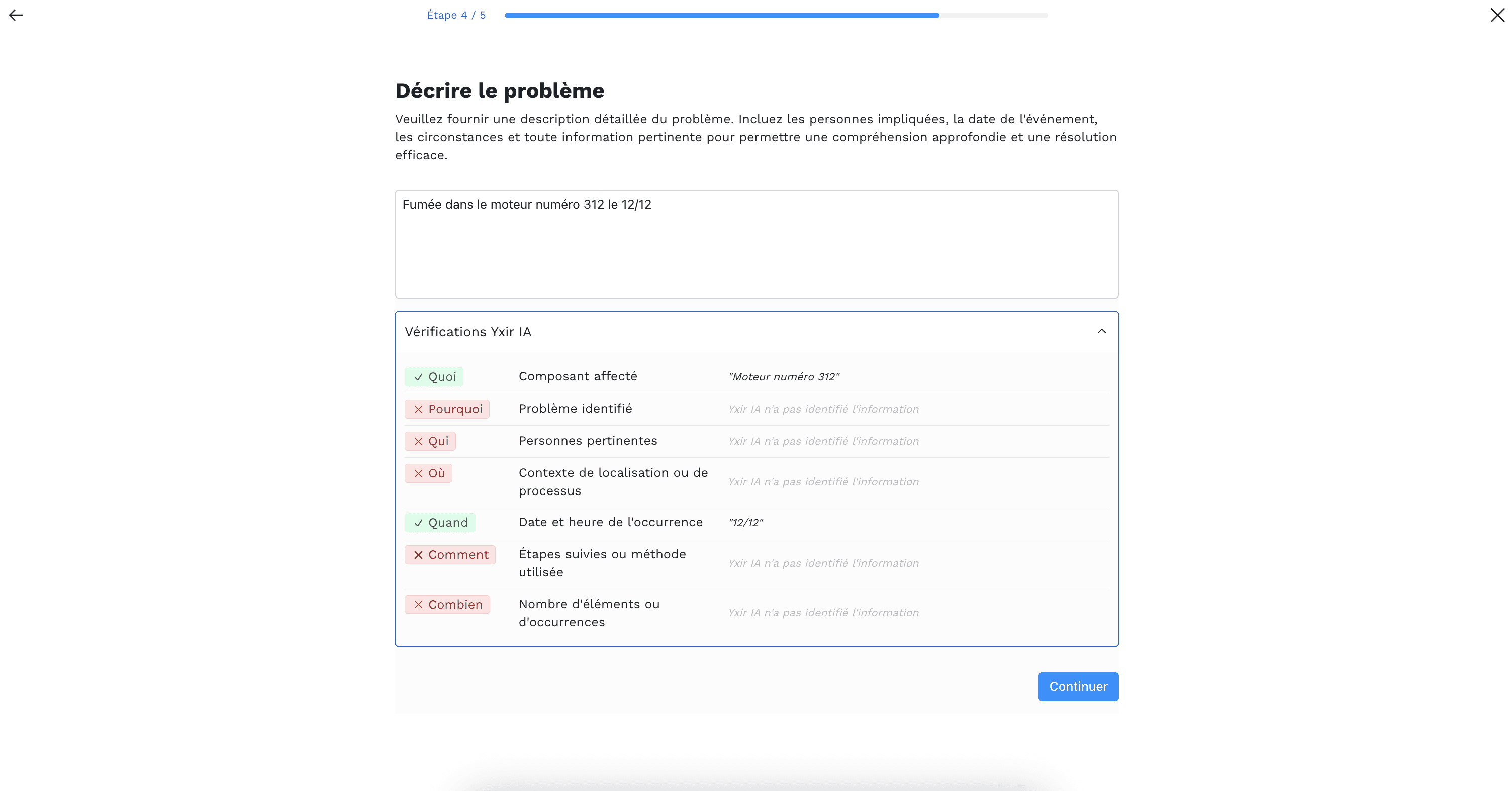
Entering a non-conformance using AI, at Yxir
Root Cause Analysis and CAPA
How to turn non-conformance traceability into sustainable actions?
After detection, perform a root cause analysis (RCA).
Use recognised methods: 5 Whys, Ishikawa, Pareto analysis.
The goal is to link the non-conformance to a systemic cause rather than an isolated incident.
Corrective and Preventive Actions (CAPA): define actions, owners, deadlines, and success indicators.
Record each step in the NC file to ensure legibility and traceability.
Verify CAPA effectiveness through targeted tests or audits.
Document proof of verification for audits.
How to ensure the same NC does not reappear?
Integrate a post-implementation follow-up and measure the recurrence rate.
Capitalise on learnings in an accessible knowledge base.
We recommend automating reminders and linking CAPAs to training and maintenance processes.
In this way, non-conformance traceability becomes a driver of continuous improvement and not just an incident log.
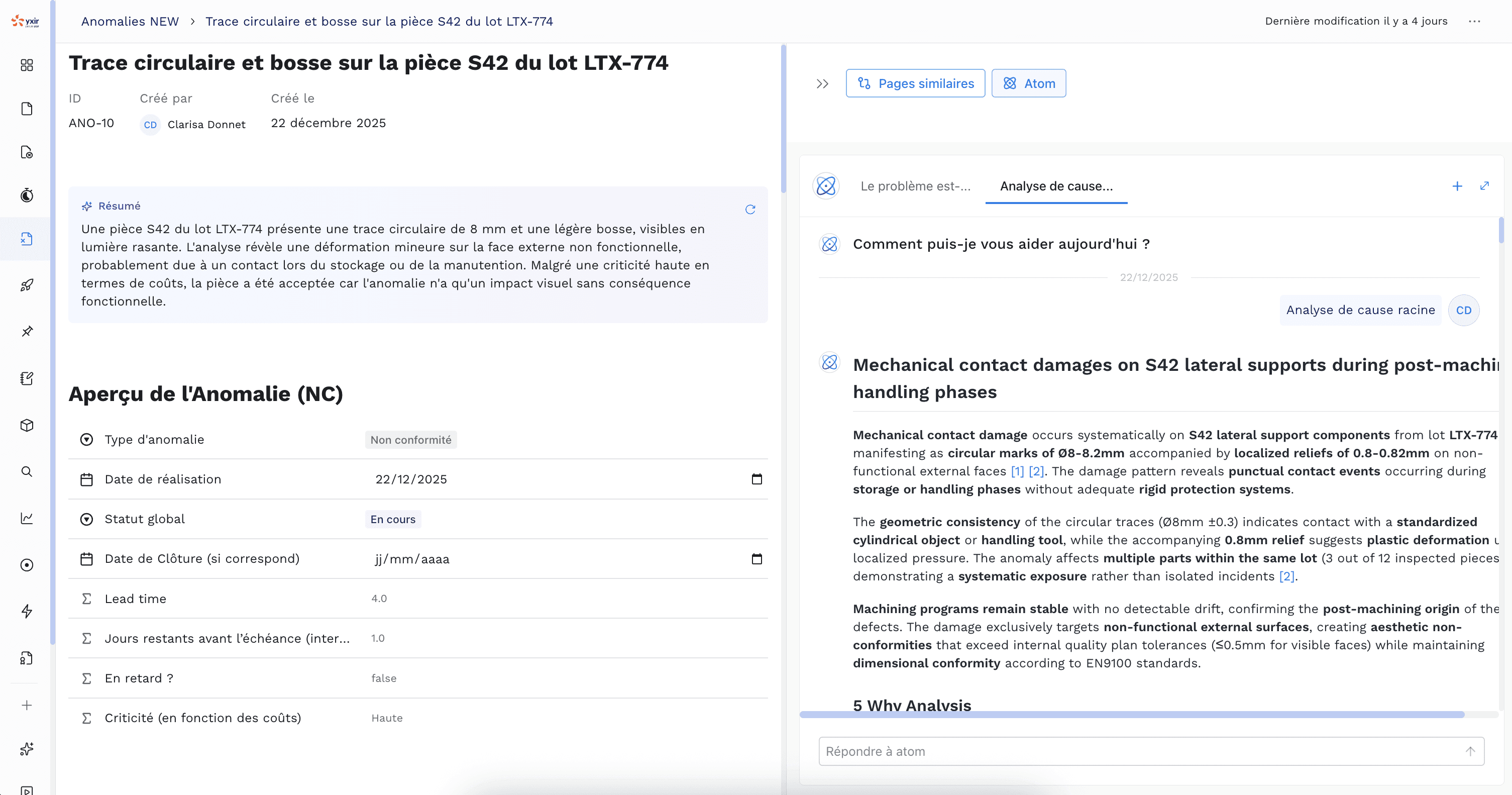
Analysis assistance with AI, at Yxir.
Choosing Digital Tools and Solutions for Non-Conformance Traceability
Selection Criteria and ERP/MES Integration
Do you want to digitalise non-conformance traceability without creating silos?
The choice of quality management software (QMS) is central.
Look for a solution that offers structured recording, configurable workflows, and reporting capabilities.
Key criteria:
• ease of use
• attachment management
• timestamped traceability
• permissions
• native integration with ERP and MES
ERP/MES integration makes it possible to link NCs, production orders, batches, and inventories in real-time.
This reduces entry errors and speeds up containment actions.
Also evaluate API capacity and standard connectors to avoid costly development.
Think about scale: the solution must support your production volume and your regulatory requirements.
How to choose without risk?
Test a POC on a critical scope and measure the impact on processing time, file completeness, and audit capacity.
We recommend involving quality, production, and IT from the evaluation stage to ensure adoption and smooth integration.
Non-conformance traceability depends just as much on the software as on the process and usage habits.
Indicators and Performance Tracking
To steer non-conformance traceability, you need clear and actionable indicators.
Measure the mean time to resolution (MTTR) of an NC, the recurrence rate, the on-time closure rate, and the number of NCs per batch/line.
Also display KPIs related to product quality:
• DPMO
• cost of non-conformances
• impact on delivery times
Build interactive dashboards to track these KPIs in real-time.
Allow drill-down to the batch, machine, and operator level to facilitate analysis.
Integrate views for audits with timestamped export and regulatory filters.
Automate periodic reports for quality management, production, and compliance.
Link your KPIs to SMART goals to turn non-conformance traceability into a lever for continuous improvement.
Finally, set up alerts based on KPI thresholds (e.g. a 20% increase in NCs on a line) to trigger immediate RCAs.
We recommend using visualisation to make trends visible and quickly mobilise teams.
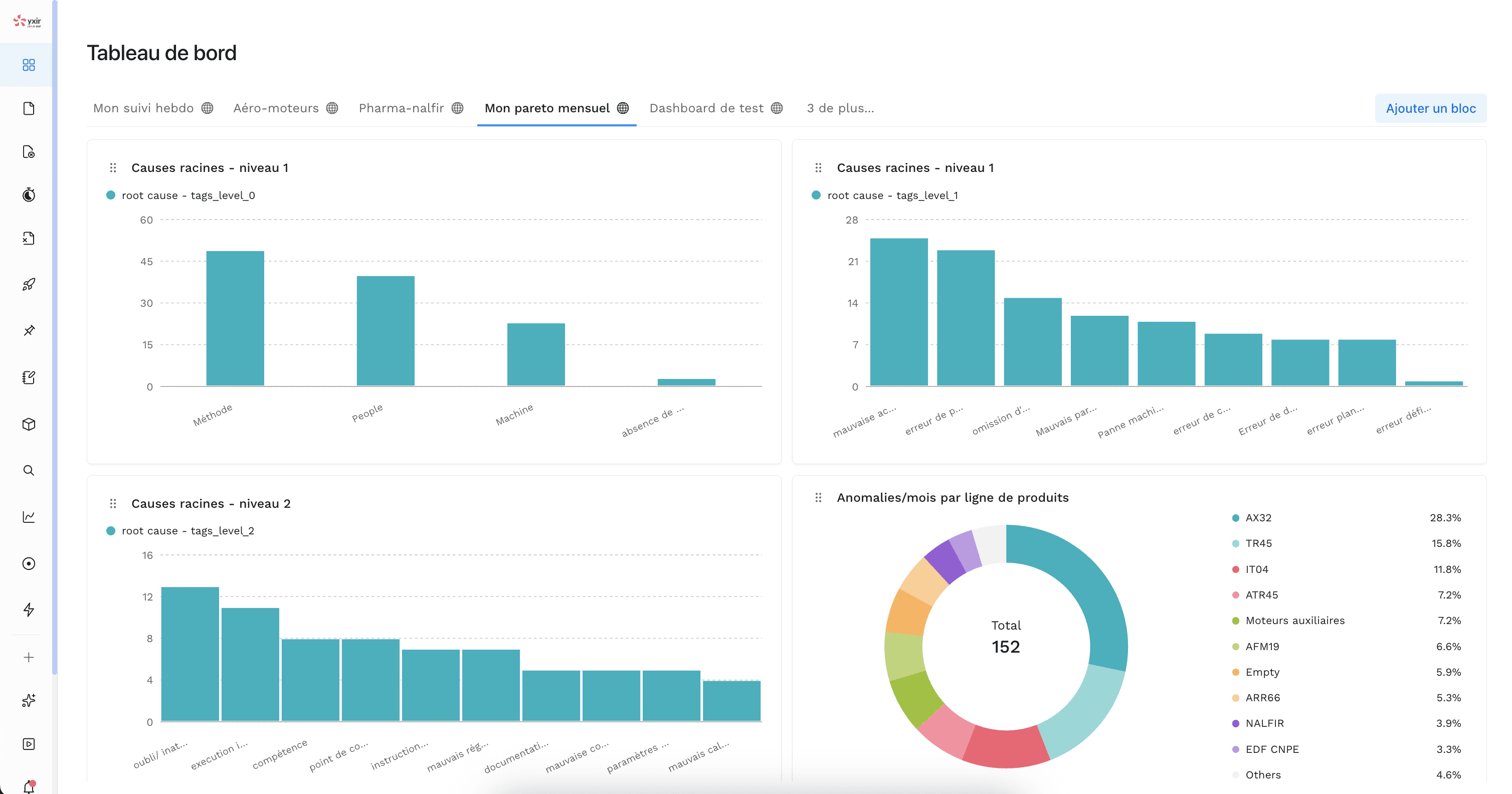
Steering and traceability at Yxir
Methodological Best Practices
To secure non-conformance traceability, standardize your processes and records.
Define a minimum mandatory checklist at declaration:
• date
• location
• product code
• batch
• photos
• operator
• severity
Formalise roles via a clear RACI: who identifies, who analyses, who decides, who verifies CAPA effectiveness.
Document workflows with investigation templates (5 Whys, Ishikawa) to guarantee the quality of RCAs.
Ensure data governance: product classification, batch master data, and user permissions.
Set up regular training and debriefing sessions after incidents.
Maintain an accessible repository of lessons learned, indexed by NC type.
Integrate non-conformance traceability into management reviews and internal audits.
We emphasize the combination of process and tool:
a good software without a clear process creates silos,
and a process without automation remains slow.
Automation of Alerts and Workflows
Automation significantly accelerates non-conformance traceability and reduces human error.
Configure automatic triggers:
• sensor detection
• rejection in quality control
• customer reporting via API
Automatically route NCs according to severity, line, and skills (escalation to quality manager, engineering, production).
Enable multi-channel notifications (email, mobile, MES dashboard) and automatic deadlines with reminders.
Use OCR recognition to extract batch numbers from photos or production slips.
Plan integration with ERP/MES to block affected batches and adjust inventories in real-time.
Experiment with predictive detection via AI to identify patterns before an NC spreads.
Test each workflow via POC and measure the impact on processing time and file completeness.
We recommend implementing high-ROI automations first (escalation, batch blocking, CAPA reminders).
Conclusion:
Non-conformance traceability is not an administrative burden: it is a strategic lever that protects product safety, reduces costs of poor quality, and builds confidence during quality audits.
By combining clear processes, structured NC recording, and an integrated quality software / QMS, you turn non-conformance tracking into a real driver of continuous improvement.
Meeting regulatory requirements (ISO 9001, ISO 13485, FDA / 21 CFR Part 820) becomes much simpler when every NC is timestamped, linked to a batch, and backed by a verified CAPA history.
Measure to steer.
Track clear KPIs — mean time to resolution (MTTR), recurrence rate, closure rate — and link them to SMART goals.
Automate workflows, alerts, and ERP/MES integrations.
Test via POC, measure ROI, and scale up progressively.
Continue reading
The latest innovations in Industry 4.0