PDCA Cycle: the Plan-Do-Check-Act method to boost your continuous improvement

Discover how the PDCA (Plan-Do-Check-Act) cycle optimises your quality processes and improves your performance. Click to master this effective method right now!
The PDCA cycle for Plan-Do-Check-Act is the compass of any solid quality approach.
But between the theory that works well on paper and its practical day-to-day implementation, there is often a gap.
How can you ensure that this cycle is not just an additional process, but a source of continuous improvement within the company?
Many organisations launch improvement actions, but without a rigorous method to structure and sustain their results.
The result: scattered efforts, inconclusive audits. And a quality team that chases discrepancies instead of anticipating them.
If you are looking to embed a sustainable culture of continuous improvement, engage your teams around measurable targets and strengthen the control of your quality system, the PDCA method is made for you.
In this article, we will see how to unleash the full potential of the PDCA cycle, making it seamless through digital tools and artificial intelligence.
With the objective of enabling you to shift from a corrective mindset to a progressive mindset.
Ready to give your quality system a new rhythm?
What is the PDCA cycle? The Plan-Do-Check-Act method explained
Are you looking for a structured, simple and effective way to improve your industrial processes or your quality management system? 🔎
The PDCA cycle, also known as the Deming wheel, is undoubtedly the tool you need.
Used for decades in industry and recommended by ISO standards such as ISO 9001, the PDCA cycle for Plan-Do-Check-Act is a proven methodology for structuring continuous, progressive and measurable improvement.
But how does this cycle actually work? Why is it so widely adopted? And how can you implement it in your activity without spending months on it?
In this article, you will discover in detail the fundamental principles of the PDCA model, its history, its objectives, the four key steps of the cycle, as well as practical advice for its successful implementation within your quality or operational processes.
You will also see how a digital tool and artificial intelligence can multiply the impact of your PDCA approach, by automating controls, centralising data and accelerating decision-making.

Definition of the PDCA cycle
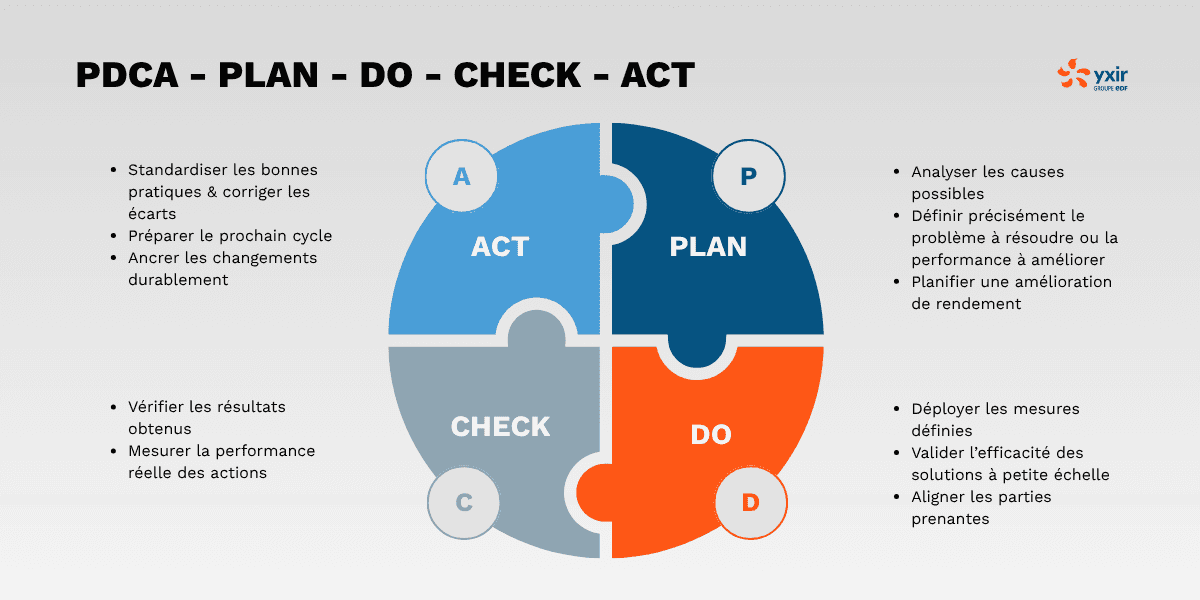
The PDCA cycle is a quality management method structured in four stages:
Plan to plan
Do to do
Check to inspect
Act to adjust
This approach relies on an iterative logic: you plan a targeted improvement, implement the decided actions, measure the results obtained, and then adjust to consolidate or redirect.
It is this cyclical repetition – planning, testing, evaluating, adjusting – that enables continuous improvement at the heart of the requirements of an effective quality management system.
The PDCA cycle is often represented by a wheel or a loop, because it is not a one-off action but a permanent process, suitable for any type of organisation, sector or project scale.
In practice, PDCA is used in industry to manage corrective or preventive actions, improve process reliability, audit production systems or comply with ISO standards.
Origins and founders of the model
The PDCA cycle was popularised by W. Edwards Deming, a major figure in 20th-century quality management.
But the origin of the concept dates back to Walter A. Shewhart, a statistician at Bell Labs, who developed a first cyclical model of management based on observation and adjusted action.
It was in the 1950s that W. Edwards Deming spread the model in Japan, where it became a pillar of the country's industrial revival.
The "Deming wheel" was then adopted by major Japanese companies, particularly in the automotive and electronics industries, which integrated it into their Kaizen approach to continuous improvement.
Since then, the PDCA model has been adopted and structured in numerous quality frameworks, including the ISO 9001 standard, which makes it the operating foundation of quality management systems.
Even today, PDCA remains a central method in the Lean, Six Sigma, QHSE and industrial performance toolkits.
General objectives of PDCA in continuous improvement
PDCA is based above all on one principle: to improve sustainably, whilst minimising risks and maximising learning 🌟
Unlike one-off approaches to problem-solving, it structures each action in a loop format, designed to be sustained over time.
Its main objective is therefore clear: to establish continuous improvement of processes, quality and performance.
This means avoiding drift, anticipating discrepancies, testing actions on a small scale, and then generalising them once validated.
This progressive reasoning allows you to make informed decisions based on measured data, rather than guesswork.
It also encourages team involvement, as each phase is documented, understood and shared.
Another key advantage: PDCA adapts to all levels of maturity of an organisation.
Whether you are undergoing a digital transformation, ISO certification or the industrialisation phase of a new activity, the method adjusts to your constraints.
Finally, by structuring improvement initiatives, the PDCA cycle strengthens the rigour of your quality approaches, while making them more agile and responsive to environmental or regulatory changes.
The 4 stages of the PDCA cycle in detail
Phase 1 – Plan: plan the actions to be carried out
This first step of the PDCA cycle is decisive for what follows 🤗
It determines the success of the entire process.
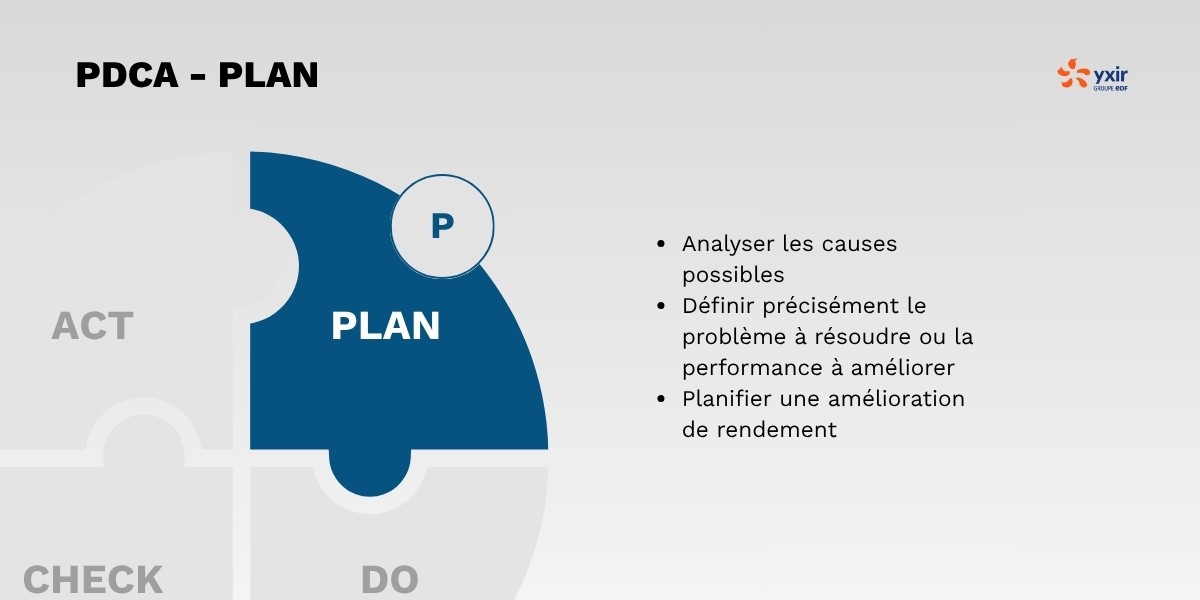
The aim here is to precisely define the problem to be solved or the performance to be improved, based on observable facts, measurable indicators and identified gaps.
Once the diagnosis is established, we analyse the possible causes, study the different options and choose the actions to be tested in a targeted manner.
It is also at this stage that we set the objectives, safety KPIs, the scope and the terms of the action plan 📊
The main benefit of PDCA here is to avoid acting in haste, in favour of a structured approach, based on analysis and short-term projection.
This is what distinguishes the PDCA cycle from a simple list of one-off tasks.
In an industrial environment, this phase allows you, for example, to plan an efficiency improvement on a production line, or to structure a response to a non-conformance detected during a quality audit.
Phase 2 – Do: implement solutions
It is time to take action 👊
In this second step of the PDCA cycle, the measures defined in the previous phase must be deployed.
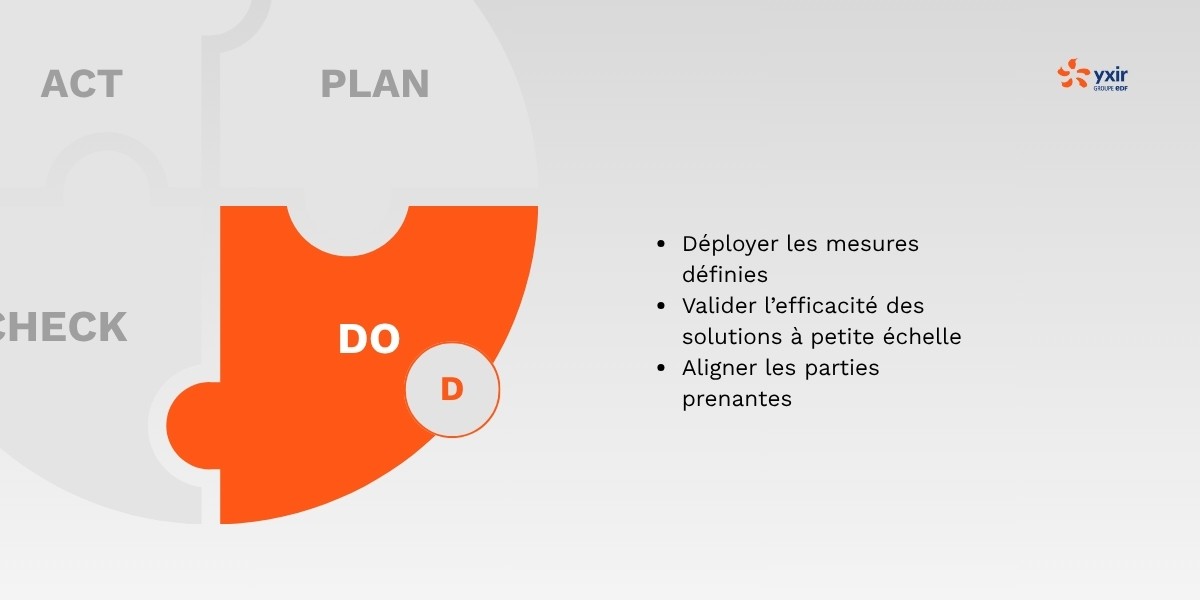
But beware: the key word here is experimentation.
We apply the plan on a restricted scope, with a pilot, controlled and documented deployment.
The idea is not to immediately transform all processes in depth, but to validate the effectiveness of solutions on a small scale.
During this step, data collection is essential: cycle times, defect rates, feedback from operators...
All information will serve to feed into the next phase, dedicated to analysing the results obtained.
Implementing does not just mean executing.
It also involves supervising, raising awareness among teams, planning adapted communication and change management support.
Technical know-how is not enough: stakeholders must also be aligned around a common improvement objective.
It is this pragmatic and framed implementation that then allows for truly constructive feedback during the Check step.
Phase 3 – Check: monitor and measure results
Once the actions are implemented, it is time to move on to analysis 🧐
The "Check" phase of the PDCA cycle consists of rigorously verifying whether the results obtained conform to the objectives set in the "Plan" phase.
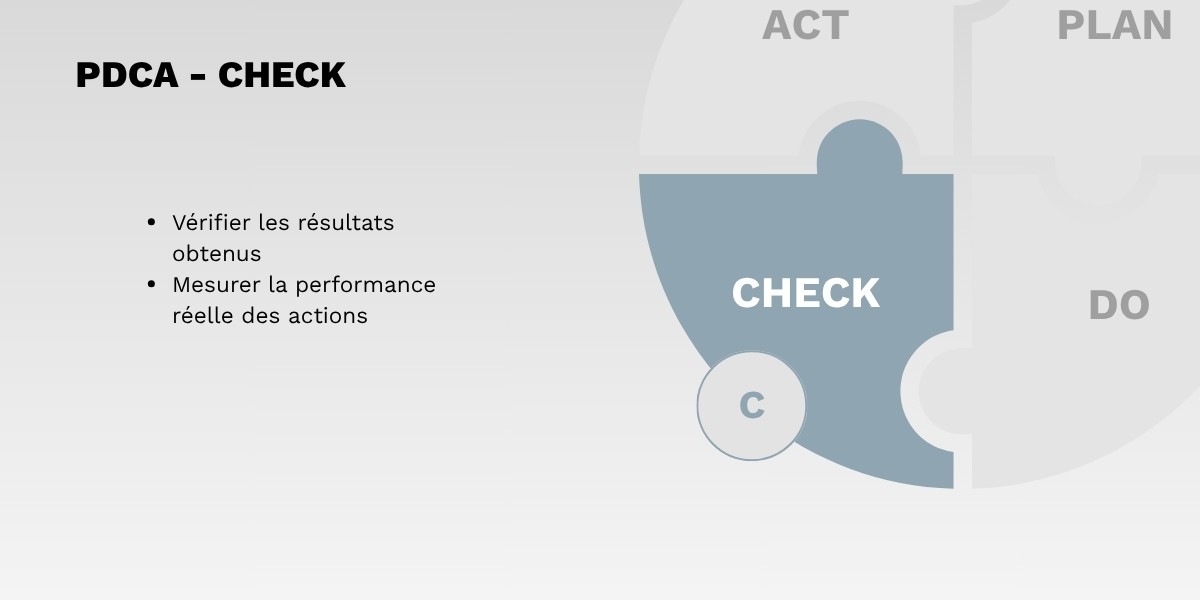
This is where the entire logic of the continuous improvement loop comes in: measuring the actual performance of the actions, comparing it to the key indicators defined upstream of the cycle, identifying any discrepancies and understanding their causes.
We rely on factual data: defect rates, lead times, feedback, costs, stakeholder satisfaction.
This step requires a structured collection of information throughout the test, with particular attention paid to unexpected or short-term effects.
It also makes it possible to determine if the tested solutions have actually improved the process, or if they should instead be corrected or abandoned.
This is a phase that demands rigour and objectivity.
Here again, the use of digital technology can considerably smooth this step of the PDCA cycle.
A SaaS tool like Yxir, for example, automatically centralises quality indicators, facilitates comparisons, alerts on critical deviations and prepares the analysis basis for the next step.
Checking should not be seen as a sanction, but as an opportunity to let the data speak so as to progress calmly, keeping to the course defined initially.
Phase 4 – Act: act and adjust to correct or improve
In this final phase of the PDCA cycle – the loop closes... or restarts!
Once results are verified and discrepancies identified, it is time to make concrete decisions.
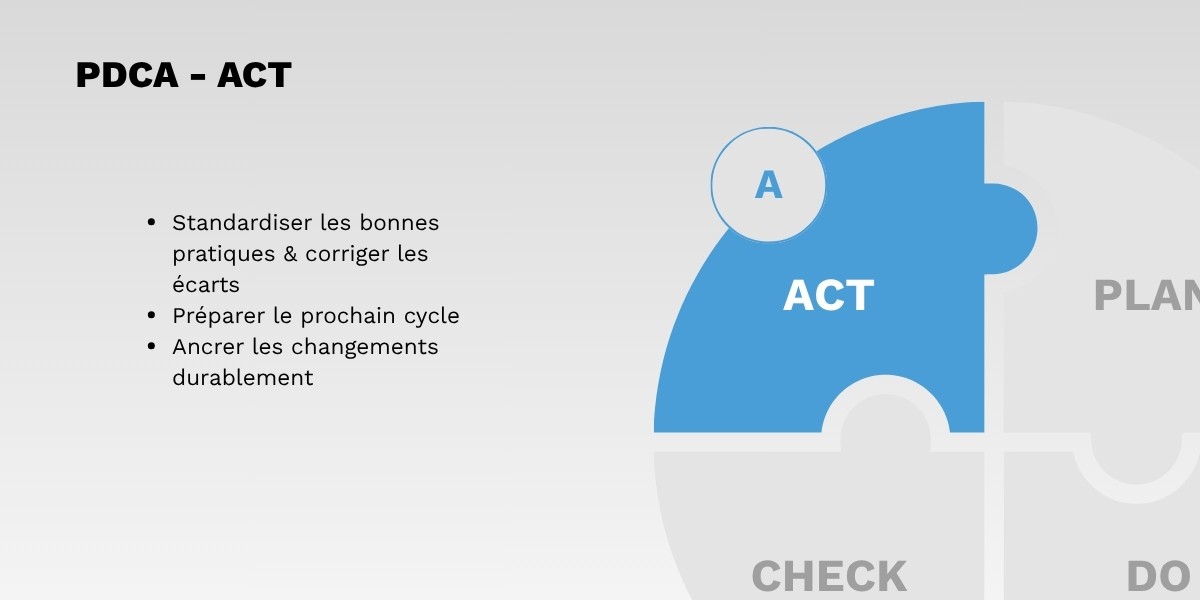
If the objectives are met, we can decide to standardise good practices, deploy validated solutions on a larger scale or integrate them sustainably into processes.
If not, this step allows for correcting deviations, re-evaluating initial assumptions or refining the action plan.
The core of the Plan-Do-Check-Act method lies here: in this logic of continuous improvement, which rejects stagnation and accepts error as a learning lever.
"Act" is never an end in itself: on the contrary, it is the preparation for the next cycle.
In a quality approach, this phase is often formalised by updating documentation, changing procedures or conducting new internal training.
At this stage, involving teams in analysis and formalisation is key to embedding changes sustainably.
At Yxir, we see this phase as a strategic moment: our SaaS platform helps you track the history of the loops, document deliverables, and manage the continuity of improvement in a centralised environment.
Thanks to digitalisation, the "Act" phase becomes faster, more precise and replicable.
This is what allows you to embed a true culture of sustainable performance.
Why use the PDCA cycle?
The PDCA cycle has become a standard because it meets a universal need of organisations: to structure improvement efforts in a simple, measurable and reproducible way.
Used in manufacturing, services, education or even administration, it helps formalise quality approaches and anchor them in concrete operational logic.
First strength of the PDCA cycle: its clarity 🤓
By segmenting any improvement action into successive stages (Plan – Do – Check – Act), it provides a methodological framework that everyone can take ownership of, from the shop floor to management.
Another advantage: its flexibility 💪
The PDCA loop applies just as well to micro-projects (improving a workstation) as to large-scale transformations (redesigning an ISO 9001 certified quality system).
Continuous improvement thus becomes accessible, manageable and sustainable.
Finally, the PDCA cycle is a formidable tool for sharing: it helps involve teams, document progress and structure feedback over time.
This is also why it is at the heart of our approach at Yxir.
Our SaaS solution boosted by artificial intelligence relies fully on the Plan-Do-Check-Act method to automate, track and streamline your entire improvement process, while ensuring full compliance with ISO quality requirements.
Comparison of PDCA with other improvement methods
Differences between PDCA, DMAIC and Kaizen
PDCA, DMAIC and Kaizen share a common goal: continuous improvement. But their approach differs 😊
The PDCA cycle is a generalist loop, applicable to any type of process, which allows for improvement through iteration.
DMAIC, on the other hand, is specific to the Six Sigma method.
It is structured in five phases - Define, Measure, Analyse, Improve, Control - and aims to reduce process variability through a rigorous statistical approach.
More analytical and demanding, it is better suited to complex or heavily performance-oriented projects.
Finally, Kaizen relies on continuous small steps 🐾
It is embedded in the corporate culture: improvement happens daily, at all levels. PDCA is also often used as an operational tool for Kaizen.
Comparison with the FMEA method
The FMEA method (Failure Mode and Effects Analysis) focuses on risk prevention by identifying weak points in a process or product.
Where PDCA structures improvement, FMEA anticipates failures.
These are two complementary approaches: FMEA is used to plan corrective or preventive actions, which can then be integrated into a PDCA cycle to monitor and sustain them.
Complementarity with 5S and Lean tools
PDCA integrates perfectly into Lean approaches and the 5S tools.
5S, for example, helps structure a workstation in an efficient and ergonomic way.
But without PDCA, it is difficult to sustain these actions over time. It is the loop that ensures the improvement remains active, monitored and corrected if necessary.
The PDCA cycle and the ISO 9001 standard
Place of PDCA in the ISO quality management system
The ISO 9001 standard is based on a logic of continuous improvement 🌀
And it is precisely the PDCA cycle that constitutes its backbone.
Each requirement of the framework fits into a phase of the cycle: strategic planning (Plan), process implementation (Do), performance analysis (Check), and improvement actions (Act).
Adopting a PDCA approach therefore allows you to naturally align your practices with the expectations of ISO 9001, while ensuring smooth management of the quality system.
Standard requirements and logic of the PDCA wheel
ISO 9001 does not only ask to correct discrepancies, but to demonstrate a proactive control of quality.
PDCA meets this requirement, by formalising a continuous progression loop.
Certification audits often rely on this logic:
how do you identify your weak points? How do you structure your corrective actions? What are your monitoring indicators?
PDCA provides the framework and the tangible evidence to answer them.
Concrete examples of applying the PDCA cycle
Implementation in an automotive production process
In an automotive plant, PDCA can be used to reduce scrap on an assembly line.
After analysing the causes of non-conformance (Plan), a targeted training action is deployed (Do).
The results are monitored via quality dashboards (Check). If the gap is reduced, the process is standardised (Act). Otherwise, we adjust and restart a cycle.
Use in quality monitoring in aerospace
The aerospace sector imposes rigorous standards 👐
PDCA is used to make critical processes reliable, especially in the quality control of parts.
It allows for structuring performance reviews, adjusting inspection schemes and reacting quickly in the event of a drift.
Application in conducting an internal audit
In ISO approaches, every audit is an opportunity for improvement 👏
PDCA structures the post-audit phase: planning of corrective actions (Plan), implementation (Do), verification of their effectiveness (Check) and formalisation of adjustments (Act).
This is what transforms an audit into a lever for real progress.
Examples in services and digital transformation
PDCA is not limited to industry.
In services, it helps improve customer experience (e.g. reducing response times).
In digital projects, it structures development iterations, the improvement of an internal tool or the adoption of new business software.
Limits of the PDCA cycle and errors to avoid
When PDCA is not suited to a project
PDCA shows its limits on projects with a high level of innovation or a long timeframe.
In this case, iterations are less rapid, experimentation less direct, and other methods like Design Thinking or Agile may be more appropriate.
It is also less relevant if the organisation lacks quality maturity or if data is missing: no reliable analysis = no effective Check.
Frequent traps in executing the cycle
A frequent pitfall: believing you are doing PDCA while skipping steps.
For example, launching actions without a serious diagnosis or closing the cycle without rigorous measurement.
Another trap: failing to involve the shop floor.
A PDCA managed solely by management lacks reality and support.
Success criteria for an effective PDCA approach
A successful PDCA approach relies on the regularity of the loops, cross-functional engagement of teams, reliable data and rigorous documentation.
This rigour – combined with a simple approach – transforms PDCA into an operational excellence tool.
Best practices for setting up a PDCA cycle
Training and engagement of teams
PDCA is not reserved for quality experts.
It becomes a real lever for progress when each team understands its role in the loop.
Training, raising awareness and giving meaning to indicators are essential for getting the group on board.
Integration into a global quality culture
To work, the PDCA cycle must integrate into a shared vision of continuous improvement.
This requires a progress-oriented culture, where error is not sanctioned but analysed, and where every deviation becomes a learning opportunity.
Monitoring and continuous documentation of PDCA loops
The final lever – and by no means the least: digital tracking of cycles.
Too often, PDCA loops follow one after another without leaving a trace. Yet, it is this capitalisation that allows for progress over the long term.
A SaaS tool like Yxir centralises cycles, tracks indicators, alerts on deviations and archives each step.
It structures learning, facilitates audits, and makes progress visible over time.
*****
By truly integrating the PDCA cycle into the core of your ways of working – and not as a documentation compliance trick –, you transform your quality approach.
You shift from a reactive vision to a proactive logic. From a constrained system to a flexible and operational management foundation.
Because basically, the Plan-Do-Check-Act method is a true model of thought and action, which constantly prompts questioning of what can be optimised.
It is also a state of mind.
A rigorous and agile framework, which feeds team autonomy, structures decisions and embeds a sustainable culture of continuous improvement.
And when this cycle is supported by the right tools, its impact is multiplied. The integration of a digital platform is a significant asset.
SaaS solutions, designed specifically for demanding industrial environments, allow you to automate the PDCA loop without compromise.
Planning becomes more visual, collaborative and traceable. Implementation is done with managed logistics, embedded indicators and smoother workflows.
Verifying (Check) relies on real-time data, consolidated automatically, whether in production, inspection or quality audit.
Acting translates into immediate action triggered by alert rules or predictive analyses.
So yes, we can say that the PDCA cycle – when correctly deployed, understood and integrated – becomes a major driver of performance, reliability and strategic alignment.
Continue reading
The latest innovations in Industry 4.0