Objectives of quality criteria: definition, examples and implementation

Discover the best practices for setting, tracking, and effectively achieving team quality criteria objectives.
In a continuous improvement process, setting quality criteria objectives has become an obligatory step.
But let’s be honest: between poorly defined indicators, stagnant audits, and overloaded Excel sheets, quality management can quickly become a headache.
How do you know if your quality objectives are relevant?
In this article, we share the best practices for defining truly effective quality objectives, aligned with your field challenges and business standards.
We also address why some approaches fail, and most importantly, how to avoid them.
Because beyond dashboards, what really matters is to put quality at the service of concrete, visible continuous improvement.
Ready to review your practices and take it to the next level?
What is a quality criterion?
A quality criterion is a measurable or observable parameter used to evaluate the level of quality of a product, service, or process.
In a quality management system (QMS), these criteria serve to judge compliance with established requirements, whether they are normative, regulatory, or customer-specific.
The ISO 9001 standard makes this a foundation of measured and controlled quality within the company.
It is important not to confuse quality criteria, quality requirements, and quality indicators.
The requirement refers to what is expected, requested, or imposed (by a customer, a standard, a specification).
The criterion, for its part, allows this requirement to be interpreted in operational reality.
Finally, the indicator translates this criterion into measurable data (error rate, response time, compliance rate, etc.).
An example: the requirement is "delivery time ≤ 48 hours", the criterion could be logistic responsiveness, and the indicator will be the percentage of on-time deliveries.
Quality criteria are therefore the link between quality strategy and the field.
They guide decisions, structure audits, support customer satisfaction, and facilitate continuous improvement.
This is why key quality approaches such as TQM, Six Sigma, or ISO standards highly structure the management of these criteria.
Why define objectives for your quality criteria?
A criterion alone is not enough.
It is when it is associated with an objective, and therefore with an expected level of performance, that it becomes a management lever.
Defining quality criteria objectives first of all guarantees control over the delivered products and services.
This is crucial in the manufacturing industry, where non-compliance can have economic, technical, or safety consequences.
Next, quality objectives make it possible to align internal processes with customer expectations and regulatory requirements.
For example, in the aerospace industry, setting a maximum tolerance for a dimensional measurement is not an option, but a compliance obligation.
But beyond control, these objectives anchor the company in a logic of continuous improvement and organizational efficiency.
They make it possible to measure variances, detect deviations, and act in a structured way to improve overall quality.
It is also a dialogue tool with teams.
A clear, shared, and measurable objective unites people better than an abstract principle.
To be effective, quality criteria objectives must be broken down by department, operational process, or product, always in connection with the company's overall strategy.
The different types of quality criteria
In an effective quality management system, it is essential to distinguish between several typologies of criteria to manage them correctly.
First, we talk about objective criteria (measurable in a quantitative way) and subjective criteria (relating to perception and feelings).
Scrap rate or average processing time are objective.
The perceived quality of a service or customer satisfaction fall under subjective criteria, often measured via surveys, NPS, or reviews.
Next, some criteria are internal, meaning they are focused on processes managed by the company (cycle times, parts compliance, RFT rate).
Other quality criteria are external, oriented towards the customer experience or partners (complaint rates, response times, clarity of deliverables).
Finally, the nature of the criteria varies greatly depending on the sector.
In the manufacturing industry, we often measure product compliance, process stability, and traceability.
In software, quality criteria include critical error rates, test coverage, or fault tolerance.
In services, these will be response times, user satisfaction, or the smoothness of the customer journey.
Identifying and classifying your quality criteria is essential to setting objectives adapted to each business reality.
Purposes and objectives associated with quality criteria
The objectives of quality criteria are not just milestones to reach but reflect strategic purposes for the company.
First, measuring and comparing performance. A criterion without an objective is a number without meaning.
Setting a compliance objective of 98% gives a clear view of the level of achievement and creates space for analysis.
Secondly, quality criteria help guarantee customer satisfaction.
A service can be technically high-performing but poorly perceived.
Monitoring and objectifying perceived quality is essential to avoid this gap between expected quality and actually delivered quality.
Another possible purpose is to standardize and audit best practices.
Quality objectives facilitate comparisons between sites, teams, or suppliers, and make it possible to identify gaps in order to initiate targeted improvement actions.
It is also a major lever for measured quality vs perceived quality.
ISO 9001 emphasizes the need to demonstrate, with evidence, the quality level achieved.
Through its quality criteria objectives, an organization gives itself the means to prove its performance and turn it into a competitive advantage.
A well-formulated objective becomes an operational compass, a decision-making tool, and a lever for improvement.
Formulating the right objectives is therefore a strategic step.
How to manage and track quality criteria objectives?
Defining quality criteria objectives is a good start. But it is their continuous management that actually improves quality performance.
Everything relies on a structured system of tracking and analysis.
First step: choose suited quality KPIs.
These indicators must be directly linked to the criteria measured, easy to collect, understandable for the teams, and relevant for management.
Examples: non-compliance rate, average response times, NPS, compliance rate with procedures.
Next, it is essential to set up a quality dashboard.
This centralizes key data, allows real-time tracking (or at a defined frequency), and facilitates reporting to both management and operational staff.
This dashboard must be accessible, visual, and quickly actionable, ideally via a digital tool.
The frequency of reviewing a quality objective depends on the context: monthly for sensitive criteria, quarterly for more strategic focus areas.
The important thing is to set a clear rhythm for reviewing objectives, including collaborative analysis sessions and the definition of corrective actions if needed.
Managing quality criteria objectives also means keeping an eye out for deviations.
A gap can be a sign of a deeper issue (procedure, training, workload, organization, etc.).
Best practices for successful implementation in the company
Successfully deploying quality criteria objectives within a company depends on the method, but not only 😊
It is also a question of culture, leadership, and stakeholder involvement.
→ First best practice: involve management and field teams from the very beginning
A quality objective cannot just be decreed from the top down. It must be co-constructed, understood, and accepted.
This creates buy-in, limits resistance to change, and aligns efforts on the ground.
→ Second best practice: avoid common mistakes when defining criteria
For example, choosing too many, vague, or unmeasurable criteria. Or ignoring customer perception in favor of an internal-only perspective.
A poorly defined quality criterion can disrupt instead of improve.
→ Third best practice: integrate quality objectives into existing processes
No need to reinvent everything.
Tools already in place (ERP, CRM, support tools, quality platforms) can be enhanced with the right indicators.
→ Fourth best practice: bring objectives to life in daily routines
Use them during quality committees, present results to teams, display the dashboard, and reward good results: quality then becomes a recognized performance lever in the company.
Digitalizing quality criteria management using artificial intelligence
Quality management is evolving. What used to require Excel files, manual reports, and endless meetings can today be automated, visualized, and managed intelligently.
Artificial intelligence is revolutionizing how companies define, track, and optimize their quality criteria objectives.
Today, it is possible to use a digitalized quality tracking platform, such as a QMS.
For example, our platform is designed to digitalize quality management, leveraging the power of AI.
Three concrete benefits:
Automation of quality indicators collection from different sources: ERP, CRM, support platforms...
Automatic detection of variances and deviations, with suggestions for improvement actions based on real data
Assistance in formulating SMART objectives thanks to the analysis of past performances and sector benchmarks
Our clients can thus create dynamic dashboards, evaluate customer satisfaction in real time, and make informed decisions based on consolidated data.
These platforms guide organizations in their continuous improvement journey, putting qualitative objectives and global quality strategy at the heart of operational management.
Digitalizing quality means gaining responsiveness, consistency, and impact.
Concrete examples of quality criteria objectives by sector
To give meaning to concepts, nothing beats concrete examples.
Here is how quality criteria objectives are expressed according to different business sectors:
In manufacturing ⚙️
Product compliance rate ≥ 98% at the end of the line
Scrap rate ≤ 1.5% over a given period
Average quality control time ≤ 10 minutes per part
These objectives aim to ensure control of the manufacturing process, limit losses, and strive for operational excellence.
In software 🖥️
Monthly service availability rate ≥ 99.9%
Customer satisfaction ≥ 4.5/5 upon exiting technical support
Less than 0.5% of critical anomalies on main features
Here, the challenge is to manage perceived quality and user experience, while ensuring the stability of the digital ecosystem.
In services 🚚
Average response time ≤ 24 business hours
Measured satisfaction rate ≥ 85% via NPS surveys
Complaints rate resolved within 72h ≥ 95%
These quality criteria reflect strong customer expectations regarding responsiveness, human relations, and service reliability.
A good quality management system must adapt its criteria to its environment, while keeping an objective and measurable framework.
How to integrate quality objectives into a continuous improvement process
Defining quality criteria objectives only makes sense if the company is part of a continuous improvement logic.
Every objective achieved, every indicator monitored, must serve to learn, adjust, and therefore progress.
This approach naturally relies on the PDCA cycle, or Plan – Do – Check – Act:
We plan the relevant quality objectives.
We implement them in operations.
We check the results through rigorous and comparable KPIs.
And above all, we implement corrective or preventive actions.
Regular performance analysis leads to the re-evaluation of existing criteria: some become obsolete, others need to be adjusted to keep pace with market or organizational developments.
But beyond methods, the challenge is to nurture a results-oriented quality culture.
Share successes, involve teams in problem-solving, and make quality a reflex rather than an administrative process.
This is how quality objectives stop being numbers in a report and become levers for sustainable performance.
*****
Better defining your quality criteria objectives is a strategic challenge, directly connected to your manufacturing performance, your customer satisfaction, and your capacity to continuously improve your processes.
When each indicator is aligned with a concrete business requirement, and each quality criterion is supported by a clear and achievable objective, your system becomes a full-fledged management tool.
You no longer settle for observing after the fact; you manage in real time.
Operational complexity and regulatory pressure are evolving rapidly in industry, and only robust, measurable, and digitalized quality practices make it possible to reconcile risk control and agility.
And this involves transforming your quality criteria into concrete decision-making tools, usable at all levels of the organization.
This structural work requires a deep understanding of your business challenges, rigorous formalization of key indicators, and an ability to engage all stakeholders in a continuous improvement logic.
With success, you enable better performance management, a reduction in quality gaps, better-controlled compliance, and a smoother customer experience.
At Yxir, we are convinced that a good quality objective is a promise kept on the ground, backed by reliable data, tracked by real-time alerts, and analyzed by a platform that anticipates instead of reacts.
Quality management should no longer be synonymous with bureaucracy or resistance to change.
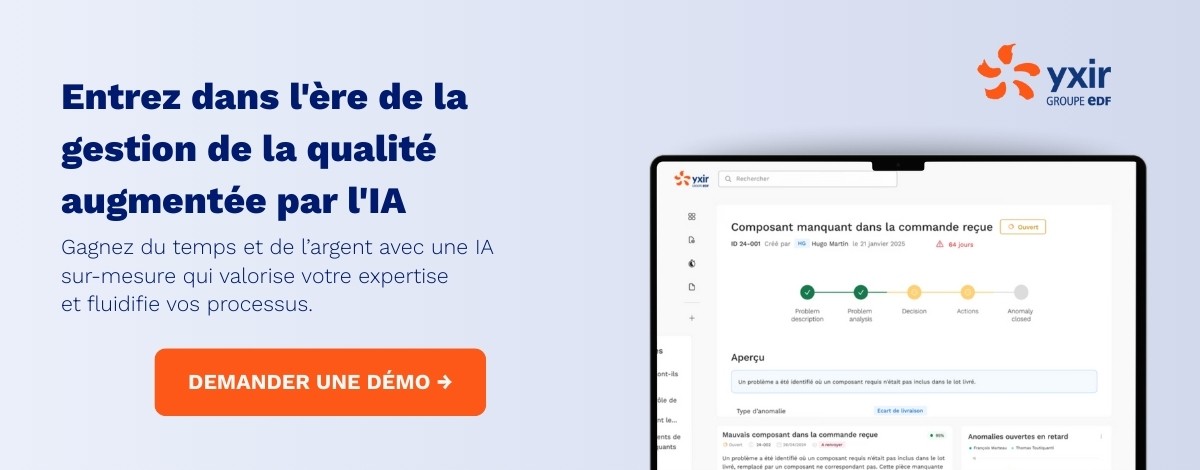
That is why we designed an AI-powered quality management SaaS platform, capable of harmonizing your professional quality criteria, linking them to your normative requirements, and dynamically generating objectives adapted to your operational contexts.
Are you in the process of improving your quality performance? Get in touch with us to learn more.
Continue reading
The latest innovations in Industry 4.0


