SMED: how to gain efficiency by reducing production changeover times

Increase your productivity thanks to the SMED method: discover how to drastically reduce changeover times in production.
When looking to drastically reduce changeover times, we think of the SMED method ud83dude0a
Because this method is a powerful tool to gain efficiency and agility on your production lines.
But beware: applying this method is not just about pasting a few best practices on a schedule.
As you probably know, every minute of downtime is costly. And in a context where your clients demand more responsiveness, it becomes vital to minimise downtime without sacrificing quality.
The SMED method acts on production downtime.
With this article, you will discover how this method, born in the automotive industry, can today transform your organisation, even outside the manufacturing sector.
Concretely, we will show you how to reduce your changeover times, increase your machine availability rate and strengthen the autonomy of your teams
Whilst laying the foundations for a sustainable culture of continuous improvement.
Are you looking for a fast, structured and measurable lever to boost performance?
Let's go.
What is the SMED method?
Significantly reducing changeover times: this is one of the keys to more agile and competitive industrial production.
The SMED (Single-Minute Exchange of Die) method aims to reduce downtime associated with tool or format changes on a production line.
Concretely, its goal is to bring these times down to less than 10 minutes, i.e. to a "single digit".
By mastering SMED, you are able to achieve faster changeovers, thereby increasing your responsiveness to orders, reducing your stocks and better managing demand variability.
With the growing customisation of products and the reduction in delivery times demanded with ever greater flexibility, the SMED method is becoming a powerful methodology.
It is a rigorous methodological approach, based on field observation and operator involvement, which allows for a deep transformation of production practices.

Origin and meaning of the term SMED
What is the origin of the SMED method? ud83dude0f
The term SMED was introduced by Shigeo Shingo, a Japanese engineer working with Toyota in the 1970s.
Faced with the need to quickly adapt production lines to a more diversified demand, he developed a systematic approach to reduce changeover times, a major obstacle to lean production.
SMED stands for "Single-Minute Exchange of Die". This literally translates to changing a die in a single-digit minute (less than ten minutes, in reality).
This concept allowed the Japanese automotive industry to shift from long runs to just-in-time production, by promoting rapid, standardised and time-efficient changeovers.
Since then, the SMED method has spread across all industrial sectors: aerospace, agrifood, pharmaceuticals and energy.
Wherever there are line stoppages caused by tool changes, SMED can make a difference.
Objectives of the SMED method in industry
In today's context of industrial transformation, the SMED method pursues a clear objective: to increase productivity without relying on massive investments ud83cudfd7ufe0f
It achieves this by tackling one of the weak points of industrial performance: unproductive downtime associated with changeovers.
Through a structured process, SMED aims to:
Reduce downtime between two production runs
Minimise the resources required during tool changes
Improve the quality of start-ups after a changeover
With the ultimate goal of: more flexible production, less subject to the constraints of large batches, and therefore more responsive to customer demands
For quality and production departments, implementing SMED also means strengthening work standards, making processes more reliable and reducing the risk of human error during changeovers.
The result: measurable gains in quality, costs and lead times.
Why changeover optimisation is strategic
A poorly managed changeover has a triple impact: production delays, waste of resources, and sometimes even customer dissatisfaction ud83dude31

Optimising these transitions therefore becomes a strong strategic axis.
By reducing changeover times, you decrease downtime, improve equipment efficiency measured by OEE and boost the overall performance of the workshop.
Let's take a concrete example: in the automotive industry, tool change times on presses could exceed two hours in the 1980s.
Thanks to the SMED method, they are today reduced to less than 10 minutes for some manufacturers.
This time saving not only allows for immediate savings, but above all quick adaptation to demand, without overproduction or unnecessary storage.
It is also a lever for financial performance: shorter runs make it possible to reduce stock tied up, better manage flows, and improve profitability per product.
For manufacturers aiming for agility, SMED becomes a necessity.
Impact on production lead times
Reducing production lead times is a commercial imperative in a market where delivery speed often determines the customer's choice ud83dude03
Yet, every minute lost during a changeover delays the availability of the final product by just as much.
This is where the SMED method proves its relevance.
By streamlining operations required for a changeover, it drastically reduces intermediate lead times.
This has an immediate effect on the overall lead time: less downtime means more useful time to produce.
Furthermore: it facilitates make-to-order production, with less stock and better control of pull flows, dear to lean manufacturing.
In energy or aerospace, where customer requirements can change rapidly according to projects, the ability of a production site to respond quickly thanks to SMED becomes a key differentiating factor.
Influence on costs and quality
Optimising changeovers with the SMED method allows you to reduce indirect production costs: unnecessarily mobilised labour, failed restarts, scrap during the first parts, etc. ud83dude0a
Less time wasted also means less energy, less raw material consumption. And therefore, a reduced footprint.
In terms of quality, SMED introduces standardisation. Changeover operations become routine, validated and audited, which reduces the risk of errors.
For example, in pharmaceutical packaging lines, transitioning from one product to another is critical.
Thanks to a well-mastered SMED approach, operators can follow precise, documented procedures with visible control points.
SMED therefore acts as a tool to reconcile economic performance and quality rigour, a balance that all industrial companies in transformation are seeking today.
The core principles of the SMED method
What is the principle of the SMED method? ud83dude44
The SMED method is based on simple but effective principles that allow you to radically transform changeover operations ud83dudc4c
The idea is to move from a long, vague and artisanal process to a fast, standardised and optimised procedure.
And it all starts with the identification of internal and external tasks.
Separation of internal and external operations
This is the first step of the SMED method ud83dudc4d
We start by closely observing the changeover, step by step.
Internal operations are those that can only be performed when the machine is stopped.
For example, dismantling a tool or adjusting a mechanical position.
Conversely, external operations can be carried out while the machine is running: preparing the necessary tools, checking the availability of parts, printing setting documents.
By isolating these two types of tasks, we can prepare as much as possible in advance.
Consequently, the machine is stopped for less time.
And since every minute counts, this simple shifting of activities can save several tens of minutes on a complex format.
This approach is currently used in any industry where changeover times have a strong impact: food production, pharmaceutical filling lines, precision machining or mass assembly.
Conversion of internal operations to external operations
Second fundamental lever of SMED: transform as many internal operations as possible into external operations u270cufe0f
Once the tasks are separated, we analyse how certain internalised interventions can be externalised thanks to modifications in organisation, workstation layout, or even tooling design.
Let's take a concrete example: if adjusting a machine requires a specific alignment, why not use a positioning template to avoid having to perform this operation while stopped?
This optimisation process sometimes includes small investments, but these are largely offset by the time savings achieved.
By making operations smarter, more predictable and better prepared, we streamline the entire process.
In our experience at Yxir, this step is often decisive for dropping below the 10-minute changeover mark, particularly in multi-format production environments.
Standardisation and simplification of tasks
The third pillar of the SMED method is standardisation ud83eudd1f
After sorting and optimising the operations, we must consolidate best practices into robust work standards.
This involves writing detailed operating procedures, training teams, and sometimes redefining roles during the changeover phase.
A well-defined and systemised task is performed faster, with fewer errors and less stress for the operator.
Even better: this allows you to capitalise on improvements and duplicate gains from one workstation to another. And to have a solid base to launch a continuous improvement initiative.
Simplifying movements, using visual checklists or setting up autonomous tools help to make the changeover smoother, faster, and above all, more reliable.
It is this combination of "observation – transformation – standardisation" that gives SMED all its power in a demanding production environment.
Key steps to implement the SMED method
Implementing the SMED method cannot be improvised ud83eudd14
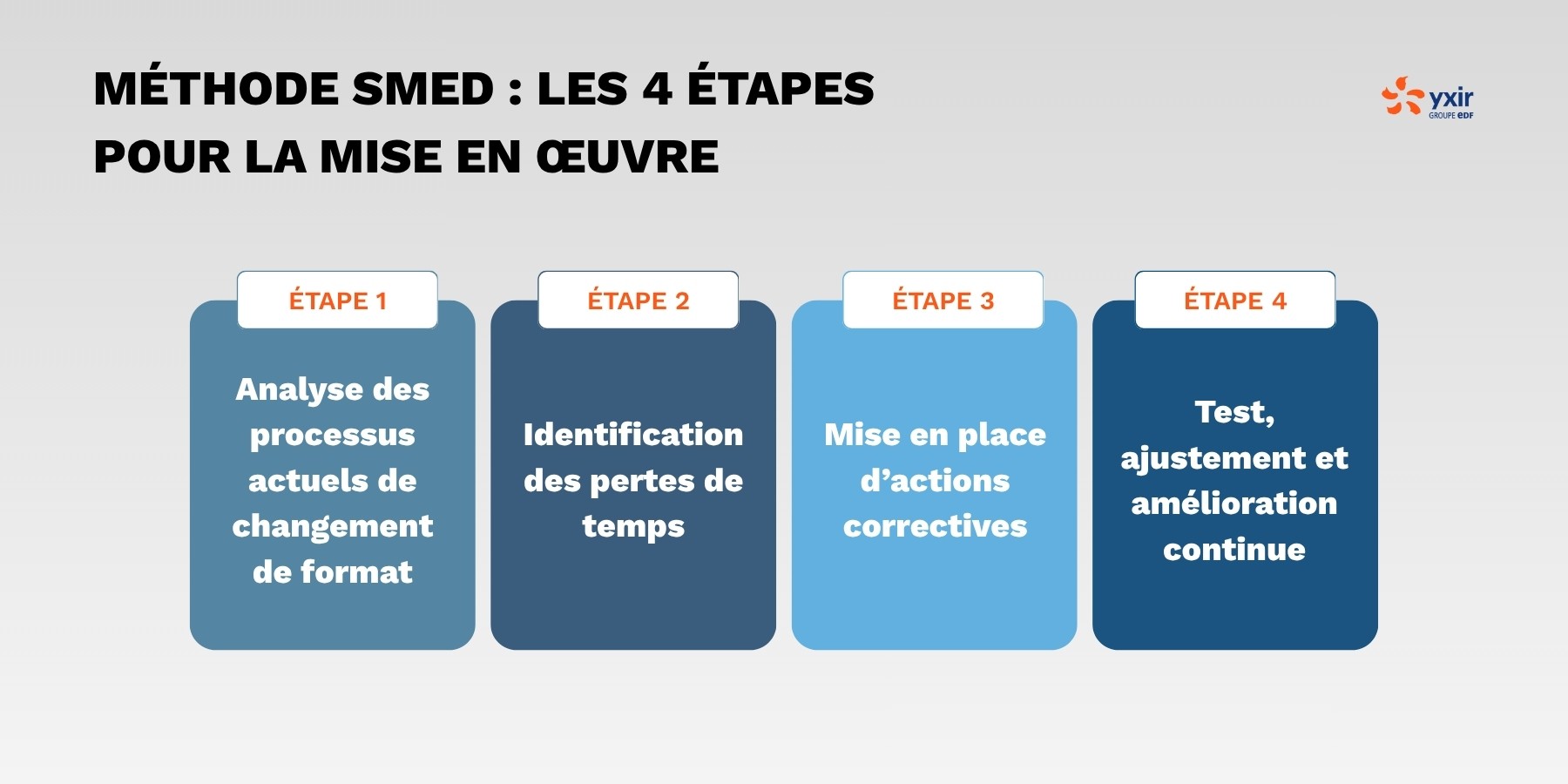
It is a structured, collaborative and iterative approach, which requires observation, measurement and the involvement of field teams.
Here are the major steps to make your SMED project a success and obtain sustainable results.
1. Analysis of current changeover processes
Before acting, you must understand ud83dude0f
The first step consists of observing the current changeover process in detail.
Film, time, write down: every movement counts.
The objective? Identify the exact sequences performed by the operators, the equipment used, movements, waiting times, verifications, and everything that disrupts the smoothness of the changeover.
This analysis must be conducted directly in the field, with the teams, to collect factual data.
It is often during this phase that we discover habits or invisible time losses at first glance: untidy tools, unnecessary verifications, repetitive movements, etc.
At Yxir, we recommend supporting this step with visual tools: process mapping, spaghetti diagram, video analysis.
These aids make the reality of the field tangible and facilitate operator buy-in.
2. Identification of time waste
Once the process is mapped, it is time to analyse where waste is hidden.
The main sources of loss are often linked to:
searching for tools or parts
unprepared manual adjustments
unnecessary movements
or even waiting times related to validations or lack of synchronisation between operators
Every "unproductive" minute must be identified, qualified and quantified.
It is this diagnostic phase that will serve as the basis for all improvement actions.
A good indicator at this stage: the ratio between useful time (value-added) and total changeover time.
The goal of SMED is to maximise the former, while eliminating or converting the latter.
3. Implementation of corrective actions
Once the time losses are identified, it is about rebuilding the changeover process ud83eudd13
This is where SMED takes on its full collaborative dimension.
The best ideas often come from the field: it is the operators who know the subtleties of their workstation.
Corrective actions can involve several levers:
Organisational: define a clear role for each operator, synchronise tasks, plan preparations upstream
Technical: modify a tool, create a template, add a visual aid, improve workstation ergonomics
Procedural: simplify checklists, remove unnecessary validations, clarify the standard sequence
Each improvement must be tested, measured and documented.
This is when teams start to see immediate gains, often 30 to 50% less time from the first iterations.
4. Testing, adjustment and continuous improvement
SMED is not a one-off project: it is a learning process ud83dude09
After the first optimisations, you must test, adjust, stabilise.
Operators must be trained in these new practices and encouraged to provide their feedback.
Every changeover session then becomes an opportunity for improvement.
The use of measured and tracked data in a manufacturing execution system allows you to monitor the evolution of changeover times, identify deviations and consolidate the gains achieved.
This is how the SMED method fits into a logic of continuous improvement, a pillar of lean manufacturing: observe, act, standardise, and repeat.
Measurable benefits of the SMED method in industry
A well-conducted SMED process quickly translates into visible and quantifiable results ud83dudcc8
Beyond simple time savings, this method has a profound impact on the overall industrial performance: productivity, flexibility, quality and team engagement.
Here are the main benefits observed in the field.
1. Reduction of tool changeover times
This is obviously the first success indicator of a SMED project: changeover time drops drastically ud83dude0d
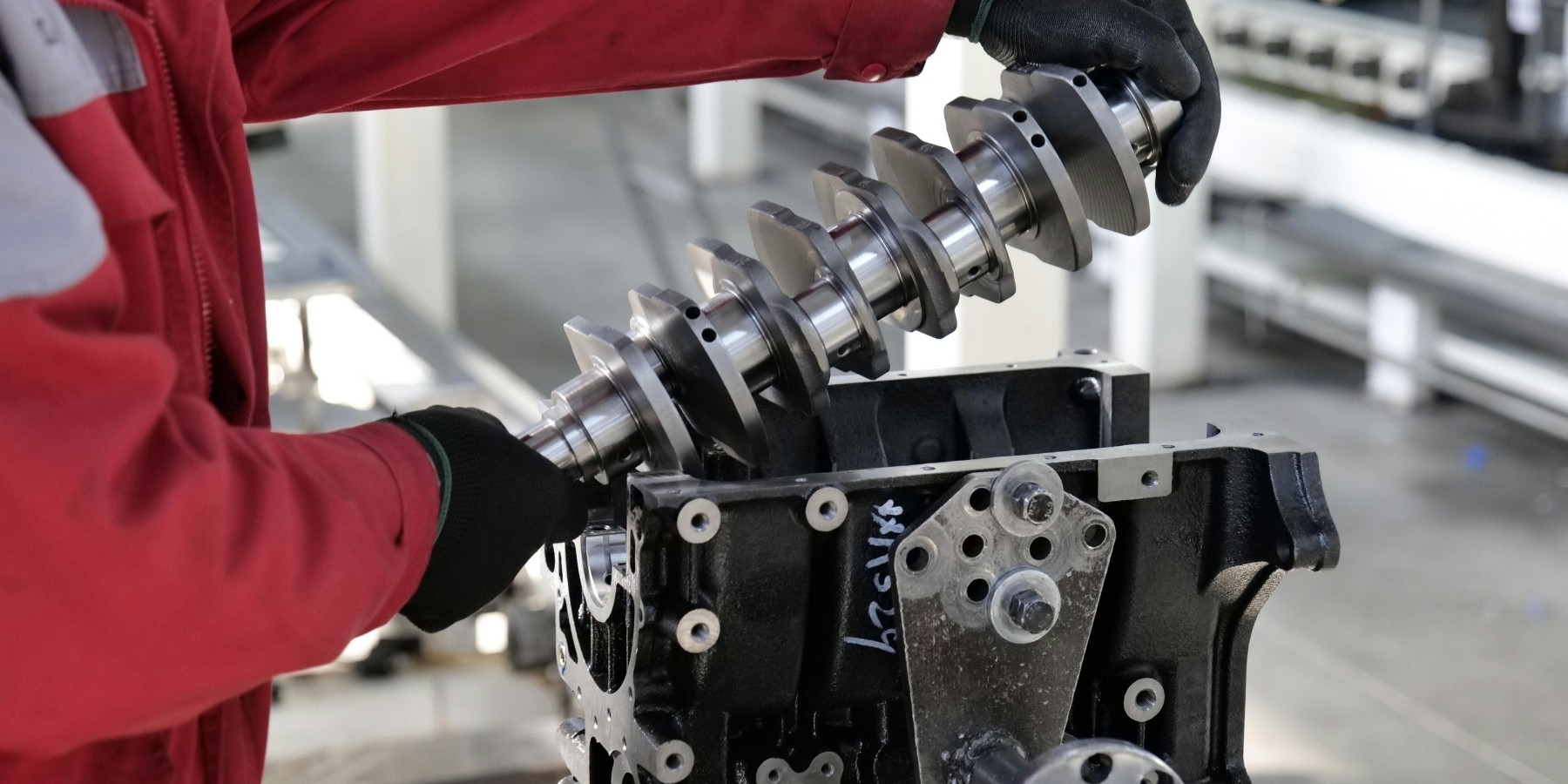
In most cases, companies see a reduction of 30 to 70% in machine downtime from the very first iterations.
Let's take a simple example:
On a food packaging line, the changeover required 45 minutes.
After applying the SMED method (video analysis, standardisation, tool preparation), this same changeover was brought down to 15 minutes.
The result: a 10% increase in production capacity without any major material investment.
These time savings convert immediately into additional availability to produce — and therefore better profitability of the equipment.
2. Increase in production flexibility
SMED allows you to reduce batch sizes without impacting productivity ud83dudcaa
In other words, you can produce more references, more frequently, without loss of efficiency.
This is a key lever to respond to demand variability or the growing customisation of products.
Lines become more agile, capable of switching from one product to another quickly, while maintaining a high level of quality.
This flexibility is currently a strong competitive advantage, especially in highly volatile sectors (automotive, cosmetics, electronics, energy).
3. Strengthening industrial competitiveness
By reducing downtime, SMED improves OEE (Overall Equipment Effectiveness) and allows you to increase production without additional investment.
Every minute gained is directly reinjected into performance.
But beyond the figures, the SMED method also contributes to:
Making processes reliable, by standardisation of movements and reducing human errors
Strengthening the culture of continuous improvement, thanks to the involvement of shop-floor teams
Optimising the use of resources, both human and material
In other words: you produce faster, with the same team, and often with better quality.
It is this combination — productivity + rigour + human engagement — that makes SMED a pillar of modern competitiveness.
4. Financial and environmental gains
Time savings logically translate into financial savings: less energy consumed during shutdowns, less waste at startup, less intermediate stock ud83dudcb8
But there is also a positive environmental impact: every optimised minute of operation means a reduction in energy consumption per unit produced.
SMED therefore fits fully into responsible production and sustainable performance initiatives, in line with energy sobriety objectives and the reduction of industrial waste.
Examples of application in different industrial sectors
The strength of SMED is its versatility ud83dude03
Although originating from the automotive world, the method applies today to all environments where changes of format, tools or references generate time losses.
Here are some concrete examples of application in different sectors.
1. Concrete case in the automotive industry
It is in the automotive industry that the SMED method was born, and where it proved its full strength ud83dude97
At an automotive brand, applying SMED to stamping presses allows reducing tool changes — from several hours to several minutes.
This revolution made just-in-time production possible, the core of the brand's production system.
Even today, many manufacturers and equipment suppliers rely on SMED to:
reduce downtime between two models
improve quality at startup
increase flexibility to respond to the diversity of vehicle versions.
The result: more responsiveness, less stock, and tighter steering of the value chain.
2. Implementation in the aerospace sector
In aerospace, each component requires specific tooling and very high-precision settings u2708ufe0f
Changeovers can therefore become extremely long and costly.
The SMED method allows standardising and securing these complex changeovers, by combining shop-floor observation, advance preparation and visual tools.
Example: on a structural parts machining line, a company was able to reduce its changeover time from 80 to 25 minutes by:
preparing tools in advance
using quick fixture systems
formalising a single operating procedure for all operators.
The result: up to 70% savings in changeover time, better traceability of interventions, and a reduction in post-restart scrap.
In a context as regulated and demanding as aerospace, SMED therefore becomes both a tool of performance and reliability.
3. Gains observed in the energy industry
Players in the energy sector, whether in production, maintenance or transformation, must deal with complex installations, often with a high level of security ud83dudd10
Applying the SMED method to these environments means reducing planned outages during maintenance, calibration or equipment change operations.
Concrete example: on an energy production site, a maintenance intervention requiring a full line outage for several hours was reduced by almost half thanks to a SMED preparation:
tools and parts prepared externally
team synchronisation
detailed planning of critical operations
This type of approach is particularly valuable in sectors requiring high availability (nuclear, thermal production, or renewables), where every minute of downtime costs thousands of pounds.
Tools and techniques associated with the SMED method
For a SMED project to be truly effective, it must rely on concrete tools for analysis, measurement and standardisation ud83euddf1
These tools allow you to objectify observations, mobilise teams and track progress over time.
Here are the most commonly used in changeover optimisation initiatives.
1. Use of video analysis
The use of video is one of the most powerful levers of SMED ud83cudfa5
Nothing beats a video analysis to objectively observe format change operations.
Filming interventions allows to:
visualise unnecessary movements
spot redundant motions
identify waiting times or time spent searching for tools
precisely quantify the actual duration of each task
By confronting operators with these images, we transform the perception of the problem: "feeling" gives way to measured facts.
The discussion becomes constructive, improvement-oriented, and the teams take ownership of the solutions.
2. Spaghetti diagrams and flow mapping
The spaghetti diagram is a simple but formidable visual tool: it tracks all the movements of an operator during a changeover.
The result?
A database-backed, often striking image of the flow complexity and time losses related to back-and-forth travel.
The objective is to reduce unnecessary movements by reorganising the workstation, bringing tools closer, or sequencing interventions better.
Combined with flow mapping (VSM - Value Stream Mapping), this tool allows understanding the interactions between operators, machines and materials.
We can then identify steps with no added value and propose concrete solutions: better ergonomics, synchronisation, upstream preparation
3. 5S and SMED: complementary approaches
5S and SMED form an inseparable duo in any lean initiative.
The 5S method aims to organise, standardise and maintain order at the workstation: sort, set in order, shine, standardise, and sustain.
A well-applied 5S environment is the foundation of an effective SMED:
tools are in their place
preparation areas are defined
documents and checklists are accessible
anomalies are visible immediately
In other words, 5S creates the conditions for a smooth, fast and stress-free changeover.
And conversely, a well-run SMED project reinforces the 5S culture, because it highlights the importance of rigour and preparation
4. Standardisation and visual checklists
To guarantee the repeatability and reliability of changes, standardisation is essential.
Implementing visual checklists, simple instruction sheets and illustrated operating procedures allows:
guiding operators step-by-step
avoiding oversights
limiting reliance on individual experience
A good standard is short, visual, and validated by the shop floor.
It evolves with feedback — a key principle of continuous improvement.
Using digital tools like Yxir, these standards can be integrated directly into quality workflows, linked to the traceability of interventions and enriched with real data from the field.

*****
Implementing a SMED approach is a transformation opportunity for any industrial organisation seeking to gain agility, reliability and competitiveness.
In a context where product life cycles are shortening, where customers expect an almost immediate response, being able to trigger a fast, controlled and repeatable changeover becomes a clear competitive advantage.
Reducing adjustment times and useless phases, securing restarts, involving operators in analysis and continuous improvement: the entire value chain is positively impacted.
We see it in the field: companies that succeed in their digital and operational transformation are those that know how to combine relevant technological solutions with proven methods like SMED.
They integrate this approach into a global logic of lean manufacturing, making their work standards reliable and enhancing the skills of their teams.
SMED is therefore not just a one-off optimisation tool.
It is a pillar for building a resilient industrial culture, capable of responding with responsiveness and constancy to demand variability.
It is also a fantastic level to break down silos, promoting collaboration between production, quality, maintenance and methods.
At Yxir, we are convinced that this method can become a catalyst for your operational excellence ambitions.
By acting directly on daily pain points such as time losses, startup errors or disorganisation during fast changeovers, it brings measurable results in the short term while feeding a sustainable continuous improvement dynamic.
Continue reading
The latest innovations in Industry 4.0