OEE (Overall Equipment Effectiveness) / OPE (Overall Process Effectiveness): Definition, Calculation and Improvement

OEE (Overall Equipment Effectiveness) is the key industrial performance indicator. Discover its definition, calculation formula and how to improve it to optimise your industrial performance.
Accurately measuring your Overall Equipment Effectiveness (OEE) is an essential step when you really want to optimise your industrial performance.
And yet, how many companies today remain completely in the dark regarding this key KPI? 💁
You feel as though your lines are not performing too badly, that production shutdowns are normal, that losses are under control... But without tracking a reliable OEE on a daily basis, you are flying blind.
That is where everything is decided: knowing where, when and why performance drops. Not after the event, but in real time.
Correctly measured, OEE becomes a formidable tool for identifying areas for improvement, reducing waste, and above all, committing your teams to clear and concrete objectives.
In this article, you will discover how to effectively measure your OEE, avoid the most common pitfalls, and turn figures into real capacity for action.
Because quality and performance always begin with proper measurement.
What is OEE (Overall Equipment Effectiveness)?
Why does your production line fail to achieve its objectives, despite high-performance equipment and committed teams? 🙄
Often, the gap between theoretical potential and actual output is poorly understood or poorly measured. This is precisely where overall equipment effectiveness or OEE comes in.
By definition, OEE is a key industrial performance indicator that measures the overall effectiveness of production equipment.
It aggregates three essential dimensions: machine availability, speed performance and the quality of manufactured products.
In other words, it tells you how much useful time was actually turned into producing compliant parts at the expected speed.
Used daily in sectors such as automotive, aerospace or energy, OEE is a standard in lean manufacturing, TPM (Total Productive Maintenance) or Six Sigma approaches.
But you still need to fully understand what it measures, what it does not measure, and how to exploit it effectively.
By reading on, you will know not only how to calculate and analyse OEE, but above all how to make it a concrete lever for improving your industrial performance.

The 3 components of OEE: availability, performance and quality
Overall Equipment Effectiveness (OEE) is the multiplication of three key factors: availability, performance and quality.
These three components show respectively whether your machine is running when it should, at the right speed, and whether it is producing compliant parts.
A drop in any one of these three elements is enough to bring down OEE 📉
The value of analysing the details is therefore to understand where the losses in productivity are located.
Availability: downtime and operational capacity
Availability measures the percentage of time during which a production line is actually running compared to its theoretical planned production time 👩🏭
Unplanned maintenance, breakdowns, excessively long changeovers or staff shortages can heavily impact this component.
For example, if your equipment was scheduled to run for 8 hours but was down for 2 hours, your availability is 75%.
Availability is often the most critical in the short term, because downtime is visible, costly and often preventable through well-organised preventive maintenance.
Performance: actual speed vs theoretical speed
Performance assesses the actual manufacturing speed compared to the machine's design speed.
A machine may be available, but producing too slowly 🐌
Mechanical wear, poor configuration or weak operator control can degrade this metric.
Let's take an example: if a machine is supposed to produce 100 parts per hour but only outputs 80, the performance is 80%.
This component of OEE highlights hidden waste, which is often ignored because it is less visible than a machine shutdown.
Quality: compliant parts out of total production
Quality, the final component of OEE, represents the number of compliant parts produced relative to the total number of parts made 💪
Any scrap, rework or out-of-tolerance parts lowers this rate, even if the machines are running fast and non-stop.
If a line produces 1000 parts in a day, but 50 are considered non-compliant, it means that the quality rate is 95%.
This measurement is essential because it links OEE directly to the end result: the value delivered to the customer.
OEE does not just aim to do more, but to produce better, by reducing defects at source.
How is Overall Equipment Effectiveness (OEE) calculated?
Now that we understand OEE, let's take a closer look at calculating it precisely.
OEE mathematical formula
Overall equipment effectiveness is calculated using the following OEE formula:
OEE = Availability × Performance × Quality
Which means:
OEE (%) = (Actual production time / Theoretical available time) × (Actual speed / Design speed) × (Compliant parts / Produced parts)
Each of these components ranges from 0 to 1 (or 0 to 100%), and the product of the three gives an overall OEE.
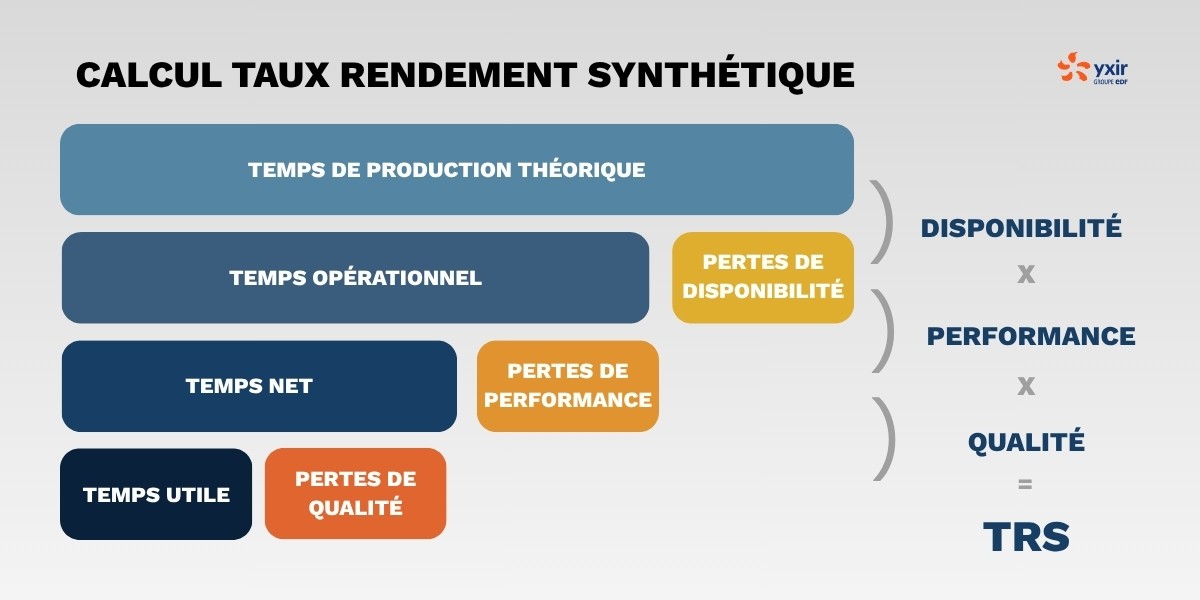
This OEE calculation approach makes the different areas for improvement visible.
An OEE of 60% does not just mean
Continue reading
The latest innovations in Industry 4.0