How to use the Carré d'As method for problem solving?

Discover the Carré d’As method: a powerful methodology to accelerate your problem solving and boost continuous improvement.
The "carré d’as" (four-of-a-kind) method is something you may have heard of without ever really digging into.
Yet, it is a great opportunity to boost the effectiveness of your quality management system 😇
Are you tired of audits that always point out the same non-conformities, of action plans that remain a dead letter?
It is time to move to a more structured quality approach that is more engaging for your teams.
The "carré d’as" method is above all a simple reading grid that helps lay the foundations of a genuine culture of continuous improvement.
It facilitates prioritisation, clarifies responsibilities and offers a concrete action framework to move your quality projects forward more serenely.
In this article, we will show you how this method can transform your quality management and breathe new life into it.
You will discover the four key dimensions to investigate, the 7 steps for its implementation and how to integrate them into your daily operations.
Are you ready to structure your quality actions in a sustainable way?
Then let's dive together into the secrets of the "carré d’as" method.
What is the "carré d’as" method?
It is based on a way of structuring information clearly and quickly.
In concrete terms, it is a table divided into four boxes, each representing an essential facet of the reflection:
mastered ideas, discovered ideas, questions raised and personal remarks
This method was born in the field of education, as a pedagogical tool to help students structure a summary sheet after a reading or a lesson.
Today, it is widely used in various contexts, including in business, particularly during project meetings, audit feedbacks or collaborative workshops.
The "carré d’as" promotes organised reflection, relevant feedback and the co-construction of knowledge.
It is a simple yet powerful analysis tool that transforms passive note-taking into an active and reflective learning process.
Objective: capture and structure the essential while encouraging critical thinking.
Why use the "carré d’as" method?
Are you looking for a quick and structured way to bring out the essential after a meeting, customer feedback or training?
The "carré d’as" method precisely allows you to create a clear and actionable summary from dense content or a collective discussion.
This tool develops the ability to identify what has been understood, what is being discovered, what remains unclear, but also to express a structured opinion.
It is used both to stimulate individual analysis and to enrich group reflection.
In industry, quality managers, project managers or innovation team members can use it to react quickly to a work session or prepare a clear presentation to management.
Its intuitive structure makes the "carré d’as" method particularly suited to contexts requiring rigour and efficiency.
By encouraging everyone to formulate questions and opinions, it also promotes dialogue and creativity.
You save time, clarify knowledge and feed your database of useful feedback for continuous improvement.
The four dimensions of the "carré d’as"
The strength of the "carré d’as" method lies in the complementarity of its four dimensions, designed to organise thought and stimulate critical analysis.
The first box, "Mastered ideas", serves to anchor acquired knowledge. This is where known, confirmed or well-understood concepts are noted.
Useful for stabilising the knowledge base of the team or a participant.
The second, "Discovered ideas", allows you to identify new information, facts or concepts perceived as innovative or unexpected.
This is often where the beginnings of an improvement or transformation emerge.
The third section, "Questions to explore further", carries the ambition to explore.
What raises a question or deserves further clarification?
This dimension feeds professional curiosity and guides the next steps of the project or training.
Finally, "Personal opinions" invites individual expression. Here, a reasoned opinion, a feeling or critical feedback is formulated.
This is the lever that connects rational analysis to subjective engagement and collective dynamics.
These four complementary axes form a simple yet rich grid, which transforms traditional reporting into a tool for living knowledge.
How to apply the "carré d’as" method step by step
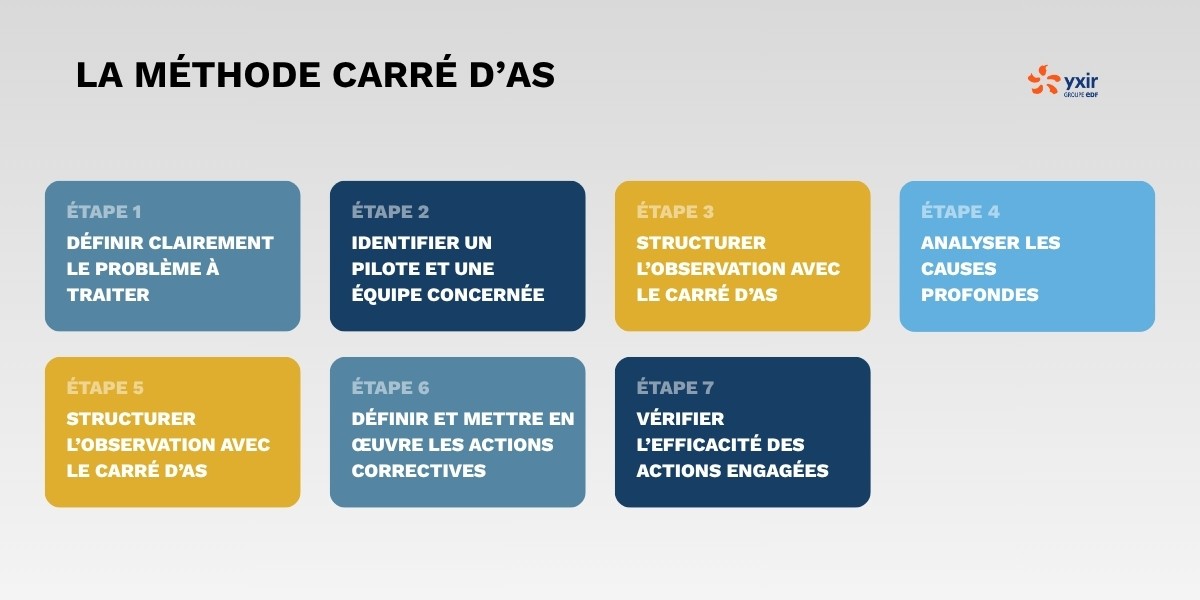
To go further than simply filling in four boxes, some industrial quality teams break down the "carré d’as" method into 7 structured steps.
This enriched version allows for sustainable grounding of reflection and transforms analysis into a concrete action plan, aligned with the requirements of an efficient quality system.
Here is how to apply it effectively 👇
1. Clearly define the problem to be addressed
Before filling anything in, you still need to lay the right foundations.
What is the subject of the work? An identified non-conformity? Critical customer feedback? An audit gap?
It is this scoping step that prevents overly vague or superficial analyses.
2. Identify a lead and an affected team
Every "carré d’as" deserves a leader.
Who collects the information? Who leads the collective discussion?
It is important to bring together the right stakeholders (shop floor, quality, support...) to ensure a complete and representative analysis.
3. Structure the observation with the "carré d’as"
We then enter the heart of the method:
Mastered ideas: what is already known, confirmed facts.
Discovered ideas: what is being learned, what surprises.
Questions: what remains unclear or deserves further clarification.
Personal opinions: what everyone feels or wishes to express.
Each member of the team can fill in their own grid or a common version can be co-constructed.
4. Analyse root causes
Once the initial data is set out, it is time to dig deeper.
Based on the questions and discoveries, tools like the 5 Whys, Ishikawa or root cause analysis are mobilised.
The objective here: do not stop at the symptoms.
5. Define and implement corrective actions
Is immediate action required?
Do we need to modify a process, train a team, review an operating procedure?
The "carré d’as" serves here as a starting point to build a precise action plan, realistic and, above all, traceable.
6. Verify the effectiveness of the taken actions
Once actions are deployed, back to the field: are the effects visible?
Is the problem resolved at the source? This validation step is essential to avoid boomerang effects.
7. Capitalise on and share lessons learned
Finally, the method does not stop at resolving the problem.
We formalise learning: updating standards, internal dissemination, integration into a knowledge base.
It is this final step that transforms a one-off resolution into sustainable progress.
Implementation methods according to contexts
One of the great assets of the "carré d’as" method is its versatility 😊
Whether you are in a classroom, in a team meeting or in an individual reflection session, this analysis tool adapts perfectly.
On one's own, the "carré d’as" method serves as a structuring support to organise ideas after a reading, training or a dense discussion.
You can use it to prepare a clear summary, synthesise your notes or simply reinforce your understanding of a subject.
In a working group, particularly in a project context, the "carré d’as" becomes a lever for co-construction.
Everyone expresses what they retain, discover, question or think – which feeds the discussion and promotes collective intelligence.
At school, teachers and trainers use it as a pedagogical summary sheet. It is also an excellent tool for formative assessment.
Within quality management, the "carré d’as" method makes total sense to analyse customer feedback, capitalise on an audit or structure a brainstorming session.
It allows every employee to formalise their perceptions while ensuring a consistent summary within a team.
The "Carré d’As" method is a collaborative summary tool that provides a simple, quick and relevant method to organise thought, anchor learning and facilitate communication.
Example of the "carré d’as" method applied in business
Let's take a concrete case: a company receives customer feedback following the delivery of a digital solution.
The subsequent steering meeting is busy.
Rather than writing a traditional meeting report, the team uses the "carré d’as" method to structure a feedback summary.
In the "Mastered ideas" box, the team enters: delivery on time, scope compliance, nominal operation of key features.
In "Discovered ideas": unanticipated need regarding user-friendliness, new request for dashboard customisation.
"Questions": why was the end user not integrated earlier? How to handle an update during production?
Finally, in "Personal opinions": feeling that user exchange was sincere, strong area for improvement on project communication.
This example shows how the "carré d’as" method allows to quickly structure a reflective analysis and prepare a clear report for management or the project committee.
Another case: after an internal audit in a quality department, the "carré d’as" is used to summarise findings, bring out points of uncertainty and prioritise action paths.
Tips to optimise the use of the method
To get the most out of the "carré d’as" method, a few best practices can make all the difference.
Always start by scoping the subject of reflection: a vague topic yields scattered results.
Use an appealing visual format: an A4 sheet folded in 4, a whiteboard in a meeting, or a shared digital canvas.
In groups, limit the filling time to 10-15 minutes to encourage spontaneity.
Then value the sharing phase: each participant can explain an element of their grid, this promotes active listening and diversity of perspectives.
On the side of common mistakes, be careful not to fall into pure description.
The "carré d’as" is a summary tool, not an exhaustive note-taking process.
Also, avoid neglecting the "personal opinions" column: this is often where the most valuable insights to move forward are hidden.
Finally, for novices, we advise a first dry run before a real situation.
It is also possible to associate the method with other analysis tools such as constructive feedback (DESC) or concept maps.
With these few tips, the "carré d’as" method becomes a real asset for idea management and structured feedback.
Resources and tools to use the method
To facilitate the adoption of the "carré d’as" method, it is best to offer simple and directly actionable tools.
An Excel, Notion or Google Sheets template can also be cloned for collaborative use.
You can also integrate this matrix into your quality management software - like Yxir.
Some note-taking applications, like Miro or Mural, offer ready-to-use canvases to adapt according to your context.
A tip: add a color code to each box to reinforce the visual dimension and facilitate memorisation.
On the educational resources side, several guides exist to train your teams in using the "carré d’as".
You will find explanatory videos, practical sheets or infographics illustrating the process step by step online.
Finally, for companies, it is entirely possible to integrate this simple tool into a knowledge management process or continuous feedback platform.
The "carré d’as" is not just a note-taking tool, it is an intelligent analysis support that can adapt to any working environment.
Adaptation of the "carré d’as" method for industrial companies
The industrial sector faces challenges in capitalising on knowledge, document rigour and continuous improvement 🌀
The "carré d’as" method fits perfectly into this logic.
In a quality department, for example, it allows to structure the reporting of an audit, formalise gaps and prepare readable action plans.
In production, it can be used as a feedback tool following an incident or a non-conformity.
Operators, technicians and managers complete the "carré d’as" together to identify acquired points, new developments, unclear areas and draw concrete lessons.
On the innovation side, the method becomes a quick summary tool after a creativity or design thinking session.
It allows a shared vision to emerge, while keeping track of individual contributions.
Another advantage: it is compatible with lean approaches like PDCA, Six Sigma methodologies or even 5 Whys or Ishikawa problem-solving sessions.
By integrating this analysis method into adapted digital tools like those offered by Yxir, you facilitate the traceability, dissemination and use of operational knowledge.
Thus, the "carré d’as" method becomes a real performance accelerator to achieve organisational excellence in industry.

*****
Using the "carré d’as" in a quality management approach is a concrete lever to structure reflections that are often scattered 🤨
It also makes complex findings intelligible and gets all teams on board with a truly collaborative continuous improvement process.
Too often, lessons learned remain in the state of reports that are difficult to use.
Feedback collected following a meeting, an audit or a root cause analysis is briefly archived, rarely re-read and even less transformed into structuring actions.
The "carré d’as" method breaks with this logic.
By organising information into four complementary axes — acquired knowledge, new ideas, grey areas and personal perspectives — it creates a snapshot and shared view of the situation.
A snapshot that is immediately actionable because it sheds light on what we already know, what we have just learned, what still needs to be explored and what everyone feels in their practice.
In an industrial context where information flows are dense and responsiveness requirements are very real, this ability to prioritises qualitative data is a strategic challenge.
With the "carré d’as", you gain clarity 🌟
Your employees become players, as each box gives them a voice and a space to express themselves.
You also gain efficiency ✌️
A well-structured summary avoids misunderstandings, duplicates, the traps of the implicit. It becomes the basis of a living, shared action plan understood by all.
And above all, you gain organisational maturity.
By repeating the exercise across projects, audits or strategic committees, you build a real capitalisation of learning, feeding what we at Yxir call organisational intelligence.
It is therefore not just about summarising better, but about learning better together. Transforming a classic pedagogical tool into a modern team performance instrument.
By integrating this structured reflection method into your quality processes, you send a clear signal: that of modernising your management with rigour and meaning.
The "carré d’as", as a simple and collaborative tool, is an excellent entry point to promote reflective analysis, organise ideas, clarify critical questions and bring up the weak signals hidden in feedback.
It promotes a more collective governance, more shared and deeply rooted in the reality of the shop floor.
Want to chat about implementing the "Carré d’As" method? Contact us to discuss it.
Continue reading
The latest innovations in Industry 4.0