DMAIC Method: Complete guide to improving your processes in 5 steps

DMAIC: learn the 5 steps to improve your processes quickly. Definition, use cases and practical examples.
The DMAIC method is a tool used by quality managers to sustainably improve performance, quality and customer satisfaction.
It is a methodical, data-driven and results-oriented approach.
In your daily routine, you may notice recurring non-conformities, loss of efficiency on certain critical processes, or discrepancies between customer needs and the delivered product.
And if you are looking for a structured way to handle your quality pain points, optimise your processes or reduce your non-conformities, this DMAIC method is probably made for you.
Originating from Six Sigma and widely used in industry, the DMAIC method is a structured approach in 5 steps.
It helps to sustainably resolve complex problems, improve the quality of your processes, and anchor a culture of continuous improvement within your teams.
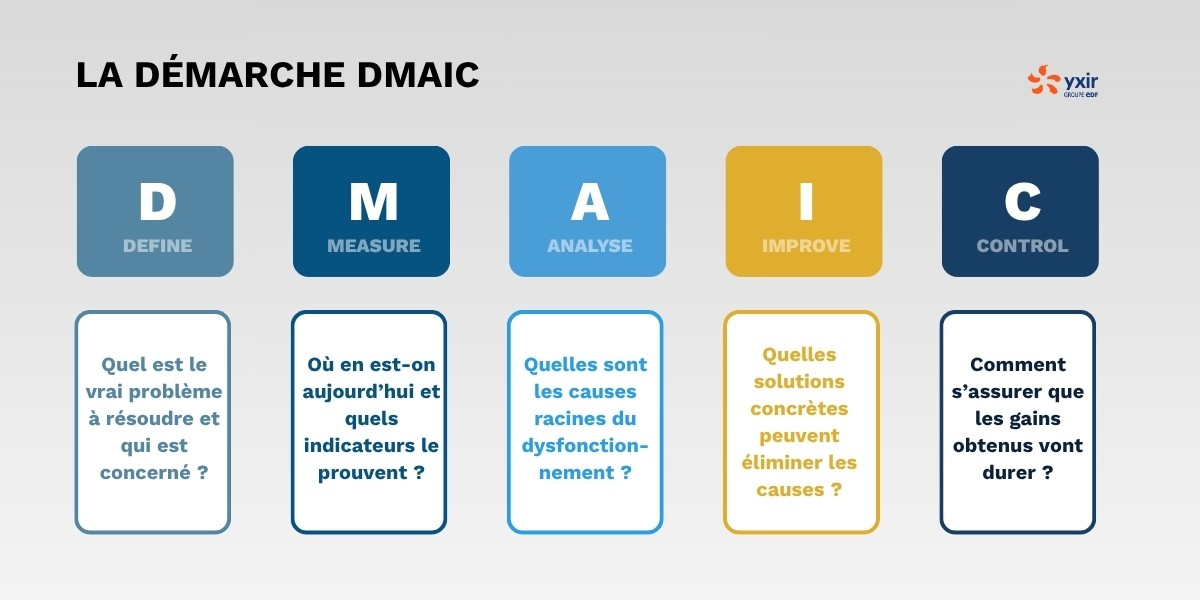
Together, we will break down the 5 key steps of the DMAIC method – Define, Measure, Analyze, Improve, Control.
And above all, we explore how to apply them concretely in your organisation.
Whatever your level of quality maturity, you will leave with an immediately actionable approach to make your improvement projects a success.
You will also discover the tools to use for each step of the method, as well as application examples in industry.
Let’s go!
What is the DMAIC method?
The DMAIC method is a problem-solving tool and continuous improvement approach.
Its name is the acronym for five key steps: Define, Measure, Analyze, Improve, Control.
Each phase follows a rigorous logic, oriented towards operational efficiency and eliminating the root causes of dysfunctions.
Historically, the DMAIC process is a pillar of Six Sigma, a quality management method developed at Motorola in the 1980s, and then deeply integrated into Lean industrial practices.
It relies on two strong principles: relying on data rather than intuition and involving field workers at each stage.
Unlike other more intuitive approaches, the DMAIC method offers a precise and reproducible model of each improvement.
Today, it is one of the international standards in process reliability, particularly in sectors where quality performance is critical: automotive, aerospace, energy, medical devices…

Why use the DMAIC method in industry?
In an industrial environment subject to increasingly demanding quality requirements, the DMAIC method stands out as a driver of sustainable performance. 😃
It makes it possible to rationally identify the real causes of dysfunctions.
It creates the conditions to resolve them without temporary patch-ups.
One of the major contributions of the DMAIC method is its ability to handle complex, multidimensional problems, often at the crossroads of several departments.
For example, excessive variability in the scrap rate is not just a production issue, but also involves quality control, purchasing, and even design.
The DMAIC approach engages the right stakeholders around a shared diagnosis and a measurable action plan.
This avoids ineffective corrective actions or "gadget solutions" that do not last over time.
In addition, the DMAIC method fuels a continuous improvement logic: the cycle doesn't stop once the problem is solved.
The results are monitored, standards are updated, and lessons learned are formalised.
On the scale of a production site or an industrial group, this systematic approach becomes a powerful vector for operational transformation.
The steps of the DMAIC method
Define: scoping the problem and expectations with method
“Define” is the first phase of the DMAIC method. This first step is strategic.
It guides the rest of the project.
It is about clearly formulating the problem to be solved, based on observable facts and real expectations.
The quality of this phase conditions the relevance of future analyses.
To begin, we must identify the needs of internal or external customers through the voice of the customer.
At this stage, ask yourself these questions:
What is expected in terms of quality, lead time, or cost?
What discrepancies are currently being observed?
Next, stakeholders must be identified: who is affected, who is the decision-maker, who holds the field information?
Two structuring tools support this phase.
SIPOC, which stands for Supplier, Input, Process, Output, Customer.
It allows for rapidly mapping a process, while visualising its inputs, outputs and contributors.
In addition, it provides a common and objective vision.
The project charter is the reference document that formalises the goal, success indicators, project team, and key milestones.
It is essential for keeping on track and avoiding scope creep.
A company that skips this "Define" step runs the risk of treating a symptom instead of tackling the real cause.
With the DMAIC method, this initial rigour becomes a guarantee of efficiency for the rest of the improvement project.
Measure: objective quantification of the initial situation
The second step of the DMAIC method aims to answer a simple question: what is the current performance of the process? 📊
Too often, decisions are made based on subjective perceptions.
The “Measure” phase puts data back at the heart of the diagnosis.
It begins with the rigorous selection of relevant performance indicators (or KPIs).
We can measure a non-conformity rate, a cycle time, a material loss… depending on the problem.
This data must be reliable and collected in a structured way.
It is often necessary at this stage to set up a precise measurement plan, with definition of metrics, data collection tools, frequency, and responsibilities.
To visualise the entire process from end to end, a tool like VSM (Value Stream Mapping) is very useful.
It helps pinpoint bottlenecks, waste, or sources of variability.
Finally, verifying the process capability – that is, its ability to meet customer specifications – often constitutes a critical step at this stage.
With this numbers-based approach, the DMAIC method moves away from the subjective, establishes an objective reference point, and paves the way for a rigorous causal analysis.
Too many companies jump straight to actions without having clarified the measurement of the problem: this is taking the risk of solving the wrong problem.
Do you want to drive real gains? Start by measuring what matters.
Analyse: identifying root causes and understanding performance gaps
The third step of the DMAIC method — the "Analyze" phase — marks an essential turning point in any continuous improvement approach 🙌
It aims to identify the root causes of dysfunctions by relying on reliable data collected during the previous phase.
Too often, problem-solving projects stop at superficial hypotheses.
DMAIC Six Sigma offers a contrasting and rigorous approach.
Initially, it is about formalising the observed discrepancies between current performance and expected specifications.
At this stage, several quality analysis tools can be mobilised.
The Ishikawa diagram (or fishbone diagram) helps structure potential causes around traditional categories: Method, Environment, Manpower, Machine, Material, and Measurement (the 6Ms).
The 5 Whys approach then makes it possible to drill down to the source of a problem, avoiding stopping at the first symptom observed.
Pareto's law (80/20) helps isolate the few major factors that account for the majority of the discrepancies – a powerful lever for prioritising your actions.
For industrial organisations, this phase is also an opportunity to use more advanced statistical tools: correlation analysis, variance studies, hypothesis testing…
These methods reinforce the robustness of the diagnosis.
At Yxir, we firmly believe that quality management through data analysis is a strategic pillar.
It is by understanding precisely the causes of a problem that we can build effective and lasting solutions.
Improve: Designing, testing and deploying sustainable solutions
Once the problem is well defined, measured and analysed, the time comes to take action.
The fourth step of the DMAIC method, named "Improve", aims to implement targeted, tested and validated solutions to improve a quality process.
This is a phase where creativity and rigour must walk hand in hand.
The objective is clear: eliminate the identified root causes, reduce variability and make performance reliable.
To achieve this, the facilitated brainstorming workshop is often used.
It allows potential solutions to emerge, mobilising collective intelligence.
Then, the impact matrix (effort / benefit) guides the sorting of ideas: which ones are both impactful and realistic to implement?
Once the solutions are chosen, a crucial testing phase follows.
Simulations, prototypes or pilots are set up to validate effectiveness in a real-world environment.
Only after field validation is the solution generalised.
In a Lean context, the DMAIC method recommends proceeding through quick iterations.
At Yxir, we strongly encourage this experimental approach, as it helps reduce risks and adjust solutions to the realities of the field without disrupting production.
Our platform also facilitates test tracking, documentation and traceability at every step.
This is how improvement becomes controlled and, above all, measurable.
Control: Anchoring the results over time
The final phase of the DMAIC method, "Control", is indispensable to guarantee the sustainability of the implemented improvements 🌟
Too many continuous improvement projects fail due to a lack of follow-up post-deployment.
DMAIC Six Sigma integrates this notion of sustainability and quality control right from the start.
It is not enough to temporarily improve a quality process.
We must ensure that the results hold over time, that performance remains stable, and that deviations are detected in time.
To do this, we set up monitoring indicators. Often the same as those used in the "Measure" phase.
These KPIs are now regularly monitored, with alert thresholds and performance review routines.
The second pillar of this "Control" phase is the creation or updating of standards.
This means formalising best practices, including changes in operating procedures, training field teams, and even periodically auditing the application of the new processes.
With this logic, the control plan becomes a living tool, evolving alongside process maturity.
At Yxir, our AI platform facilitates this critical phase.
It allows for centralising quality data, automatically detecting discrepancies and alerting managers when an indicator deviates.
Monitoring becomes seamless, responsive and data-driven.
Advantages of the DMAIC method for an industrial organisation
Process and cost control
One of the most tangible benefits of the DMAIC method is enhanced process control.
Each implemented improvement is based on an accurate diagnosis, reliable indicators, and a tested action plan.
Result: performance gaps are narrowed, delays drop, and scrap rates decrease.
This methodological rigour also translates into better cost control, particularly those costs associated with non-quality (reworks, scrap, after-sales service, customer dissatisfaction).
By identifying waste and addressing root causes, the DMAIC method directly contributes to the company's financial performance.
Data-driven and results-oriented approach
One of the great advantages of the DMAIC method is its ability to make data talk, and to ground decisions in facts 💪
No more intuitive actions or "spur-of-the-moment" projects that struggle to deliver concrete results.
With DMAIC, each step relies on numbers, objective measurements, and analysis tools.
This is what allows for objectifying progress, demonstrating the gains achieved, and convincing internal or external stakeholders (management, clients, certification bodies…).
This results-oriented approach is also an excellent lever for strategic alignment, connecting shop-floor initiatives to overall performance and customer satisfaction goals.
Collaborative involvement of teams
Finally, the DMAIC method creates a collective dynamic 💫
Unlike top-down approaches, it involves operational teams, support functions, and sometimes even suppliers or customers right from the beginning.
Each phase of the project mobilises different skills: field expertise, data analysis, project facilitation, customer feedback…
This crossing of perspectives allows for a detailed understanding of problems, better acceptance of solutions, and above all, a stronger commitment to their implementation.
Concrete examples of applying the DMAIC method in industry
Case in automotive: reducing scrap on an assembly line
In an automotive component manufacturing plant, an abnormally high scrap rate was observed at the end of the line on a strategic product.
The DMAIC method made it possible to clearly define the problem (“Define”), measure the defect occurrence across stations and shifts (“Measure”), and then identify a misalignment on an automated tightening tool (“Analyze”).
An improvement plan was deployed with adjustments to machine parameters, targeted training, and systematic checks (“Improve”).
The “Control” phase integrated daily defect tracking and a new quality control standard.
Result: -45% scrap in 6 weeks, and improved process stability.
Case in aerospace: failure cause analysis on critical parts
In an aerospace maintenance workshop, recurring non-conformities were reported on critical parts after inspection.
The DMAIC approach made it possible to trace back to the root causes: a cleaning procedure that was partially understood and applied differently by different shifts.
Thanks to cross-analysis of gaps, process mapping, and field observation, the procedure was clarified, standardised, and formalised.
The gains were immediate: reduction in supplier return rates, homogenisation of practices, and time savings in final inspection.
Case in energy: maintenance process optimisation
A company in the energy sector faced excessive delays in preventive maintenance interventions on certain critical facilities ⚡️
By applying the DMAIC method, the teams first measured the gaps between the planned schedule and actual interventions, highlighting bottlenecks in planning and request processing.
A new prioritisation tool was implemented, accompanied by an operational dashboard.
The average intervention time was reduced by 30%, resulting in better equipment availability and a decrease in emergency costs.

*****
DMAIC is a comprehensive method for improving the quality process.
It is a real common thread for making your processes reliable, making your data speak, and putting the shop floor back at the heart of problem-solving. And also, anchoring best practices in the long term.
And it is exactly this methodological rigour that makes it a reliable tool in an industrial environment where uncertainty and pressure on costs and lead times are the norm.
Adopting a DMAIC approach means choosing a fact-based approach, informed decisions, structured data-driven management, and also a collective dynamic.
Because nothing works sustainably if teams are not on board, if stakeholders do not share a clear diagnosis, or if findings remain at the symptom level.
The DMAIC method helps you frame quality issues with rigour, dissected root causes with clarity, experiment with improvement ideas methodically, and consolidate progress achieved over time.
This five-step approach quickly becomes a shared reference, a common reading grid for different departments, and a vector for alignment and inter-departmental collaboration.
On the ground, the benefits are tangible: reduction in non-conformities, better control of the costs of non-quality, more robust processes, and enhanced customer satisfaction.
And beyond operational results, it is also a lever for upskilling teams, an excellent school for critical analysis, project management and continuous improvement.
We see this every day at Yxir: industrial companies that structure their quality management with the DMAIC method have a real advantage in driving the transition towards a more resilient, agile, and customer-oriented organisation.
Especially when they rely on smart digital tools to make data reliable, quicken analysis loops, or automate the tracking of action plans.
Our customers use our platform to gain visibility over quality data, prioritise improvement projects based on potential gains, standardise DMAIC practices across their teams, and inject artificial intelligence where it can make a difference: weak signal detection, cause cross-analysis, guided recommendations.
The DMAIC method is evolving with its time and, thanks to data and digital technology, is becoming an accessible tool for any industrial organisation that wants to progress fast, well, and sustainably.
What matters now is not just knowing the five phases of the DMAIC method. It is living them on the ground, embedding them in your practices, and equipping them intelligently.
Wondering where to start?
Discover how Yxir, our AI platform dedicated to industrial quality, can help you make your DMAIC projects reliable, managed, and accelerated.
Continue reading
The latest innovations in Industry 4.0