RCA (Root Cause Analysis): Complete Guide 2025 — methods, steps, tools and practical examples (5 Whys, Ishikawa, FTA)
RCA root cause analysis: free guide to identifying and eliminating the root causes of incidents. Concrete methods & tools to prevent breakdowns.
Are you facing recurring breakdowns, costly non-conformances, or declining customer satisfaction?
This guide shows you how to turn these incidents into sustainable improvement opportunities thanks to RCA root cause analysis.
Root Cause Analysis (RCA) aims to identify the root cause or causes of an incident to prevent its recurrence.
It is a strategic skill for quality managers, production directors, and digital transformation managers in the manufacturing industry.
By reading this article, you will learn concretely how to scope an RCA, collect operational evidence, use proven methods like the 5 Whys and the Ishikawa diagram, and transform the results into effective CAPA.
You will also discover how to choose a software tool to track workflows and measure the impact of corrective actions.
Why invest in RCA?
Because a robust analysis reduces incidents, controls non-quality costs, and fuels a continuous improvement process (Lean, Six Sigma, DMAIC).
Ready to reconcile operational performance with quality requirements?
Read on to get a step-by-step methodology and concrete case studies applicable to energy, aeronautics, and automotive.
Understanding RCA root cause analysis
What is RCA root cause analysis?
RCA root cause analysis is a structured method to identify the root cause or causes of an incident, breakdown, or non-conformance.
It aims to go beyond the symptoms to find the root origin of the problem.
The objective is to address the cause rather than repeat superficial corrective actions.
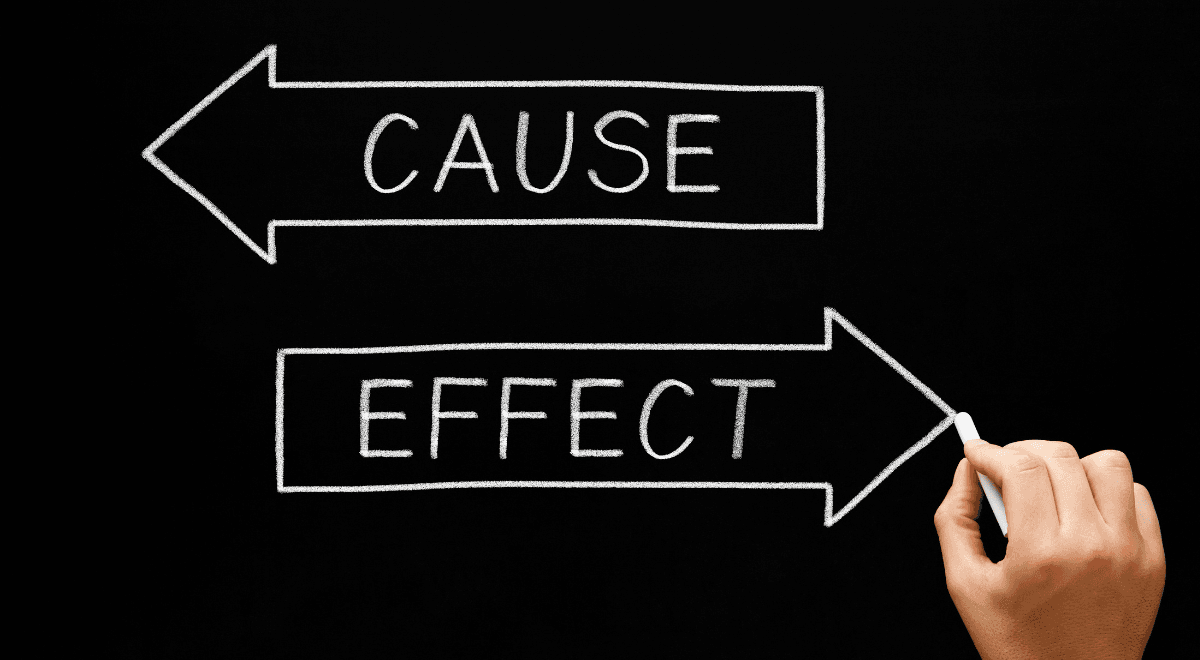
Why is RCA root cause analysis essential?
In industry, every unresolved incident costs in productivity, quality, and reputation.
RCA root cause analysis reduces the recurrence of breakdowns, improves quality control, and fuels continuous improvement.
Addressing the root cause allows you to turn feedback into a lever for efficiency.
Definition of root cause analysis (RCA root cause analysis)
Defining the scope of the analysis precisely is the first step of a successful RCA root cause analysis.
Root cause analysis combines qualitative and quantitative methods to establish a causal link between the observed event and its origins.
It includes:
the collection of evidence (logs, procedures, records),
the multi-disciplinary workshop to challenge hypotheses.
A good definition avoids bias and directs CAPA actions towards sustainable solutions.
Quality and operational challenges of RCA root cause analysis
RCA root cause analysis directly impacts industrial performance.
In quality:
it reduces non-conformances,
it increases customer satisfaction.
In operations:
it decreases production interruptions,
it optimises maintenance.
Challenges include reducing recurring costs, improving safety, and compliance with standards (ISO 9001, best practices).
Adopting RCA means transforming incidents into continuous improvement opportunities.

When and why to use RCA root cause analysis
Contexts of use for RCA root cause analysis
In what contexts should you launch an RCA root cause analysis?
Use RCA root cause analysis as soon as a:
recurring incident,
critical breakdown,
or a major non-conformance occurs.
It is relevant in:
production,
maintenance,
R&D,
supply chain,
industrial IT.
For one-off incidents without heavy operational consequences, a light investigation may suffice.
Choosing the right context guarantees a proportionate effort and a tangible ROI.
Why prioritise RCA root cause analysis?
The reason is simple: addressing the root cause prevents the recurrence of incidents.
RCA root cause analysis allows you to:
direct CAPAs towards preventive rather than corrective actions,
foster team accountability,
improve decision traceability.
Expected result: reduction in downtimes, improvement in OEE, and strengthening of the quality culture.

Key methods of analysis for the root cause (RCA root cause analysis)
A quick overview of the methods used in RCA root cause analysis.
Classic approaches combine:
simple tools (5 Whys),
formal tools (FTA).
The choice depends on the complexity of the failure and the available data.
Knowing several methods allows you to adapt the analysis to the industrial context.
5 Whys method for RCA root cause analysis
The 5 Whys method is an iterative technique to trace back from the effect to the cause.
It consists of asking the question "Why?" successively until reaching the root cause.
In practice, the exercise is conducted in a workshop with:
operational actors,
quality managers.
Advantage: simplicity and speed. Limitation: risk of partial answers without evidence.
Use the 5 Whys method as a starting point, then complement it with other tools if necessary.

Ishikawa Diagram (Fishbone) and RCA root cause analysis
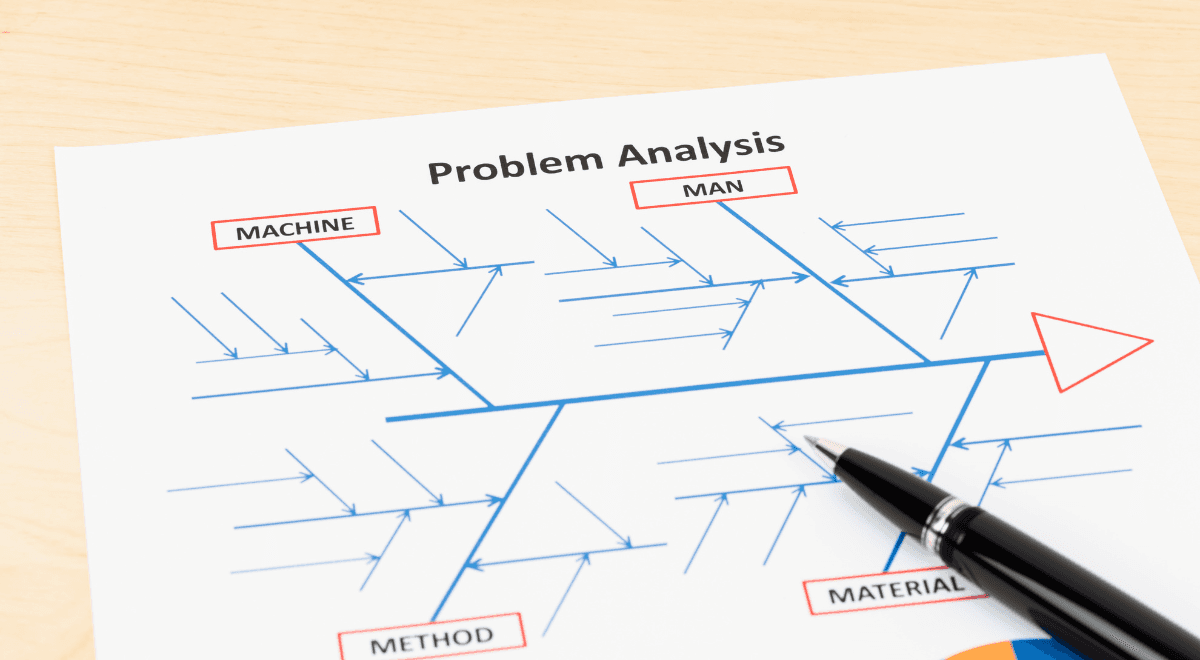
The Ishikawa diagram visually structures the possible causes around an effect.
It segments the factors (machines, methods, materials, environment, manpower, measurements) to facilitate brainstorming.
In RCA root cause analysis, Ishikawa is used to:
capture all hypotheses,
prioritise lines of investigation.
It promotes cross-functionality and prevents the isolation of knowledge.
Associate Ishikawa with data validation to consolidate hypotheses.
Fault Tree Analysis (FTA) in RCA root cause analysis
Fault Tree Analysis (FTA) models the combinations of events leading to a systemic failure.
It is a logical and hierarchical approach suitable for complex systems (aerospace, energy).
In RCA root cause analysis, FTA allows you to:
quantify failure paths,
identify critical points.
It requires reliability skills and an event database to be effective.
Pareto, 8D, and DMAIC applied to RCA root cause analysis
Complementary methods strengthen the robustness of an RCA root cause analysis.
The Pareto chart prioritises incidents according to their impact.
The 8D method structures team resolution with validation of corrective actions.
DMAIC (Six Sigma) brings statistical rigour to process-related causes.
Combining Pareto, 8D, and DMAIC provides both operational pragmatism and analytical rigour.

Detailed stages of the RCA root cause analysis process
The success of an RCA root cause analysis relies on a clear sequence of stages.
Each stage reduces uncertainty and guides corrective actions towards the root cause.
Below, we detail the typical process applicable in manufacturing, IT, or healthcare.
Use this roadmap to structure your workshops and your CAPAs.
Scope and identify the problem — RCA root cause analysis
Start by defining the scope of the analysis precisely.
Formulate the observed effect in measurable terms:
what,
when,
where,
who,
what impact.
Determine the time limits and the systems involved.
Clear scoping avoids scope creep and guides data collection.
RCA root cause analysis starts here: without a well-defined problem, the analysis loses its effectiveness.
Collect data and evidence — RCA root cause analysis
Gather all available evidence:
logs,
records,
procedures,
quality reports,
machine records.
Interview operators and stakeholders through structured interviews.
Archive evidence in a traceable manner so you can go back if needed.
Quantitative data + qualitative testimonies = solid foundation for RCA root cause analysis.
Avoid unverified assumptions and prioritise facts.
Analyse and validate causes — RCA root cause analysis
Organise a multi-disciplinary workshop to challenge hypotheses.
Use complementary tools:
Ishikawa,
5 Whys,
FTA,
statistical analyses if necessary.
Validate each hypothesis with evidence or reproducible tests.
Classify causes into:
immediate,
contributing,
root.
Validation is critical: RCA root cause analysis without proof often leads to ineffective actions.

Plan corrective and preventive actions (CAPA) — RCA root cause analysis
Draft a clear CAPA plan with:
responsibilities,
deadlines,
success indicators.
Differentiate between:
corrective actions (fix now),
preventive actions (prevent recurrence).
Prioritise by impact, cost, and effort, using a Pareto chart if helpful.
Integrate the traceability of decisions for audits and feedback.
A good CAPA turns RCA root cause analysis into sustainable gains.
Implementation and efficacy tracking — RCA root cause analysis
Deploy actions with rigorous tracking:
milestones,
KPIs,
periodic review.
Measure the impact on:
incident frequency,
OEE,
cost of non-quality.
Plan a post-implementation validation to confirm the elimination of the root cause.
Document learnings to enrich the knowledge base.
Tracking and proof of efficacy close the loop of the RCA root cause analysis cycle.
Concrete examples and case studies — RCA root cause analysis
Aerospace case: critical vibration was causing line stoppages.
The RCA root cause analysis revealed a battery-sensor combination and an unsuitable maintenance procedure.
Actions:
sensor change,
update of operating procedures,
training.
Result: 90% reduction in incidents within 6 months.
Automotive case: repeated dimensional dispersion on a part.
The RCA identified a machine setting and a raw material out of spec.
Actions:
process adjustment,
material receiving inspection.
Result: non-conformances divided by 4 and savings on scrap.
RCA root cause analysis enables quick and measurable gains when properly conducted.
Document before/after to quantify ROI and convince decision-makers.
Best practices and pitfalls to avoid — RCA root cause analysis
Involve operational teams from the start to obtain realistic data.
Ensure rigorous and traceable documentation for each stage of the RCA root cause analysis.
Do not confuse symptom and cause: target the root, not the plaster.
Avoid "blame" workshops; promote a culture of continuous improvement.
Iterate: if the action does not have the expected effect, relaunch the analysis with new data.
Transparency, evidence, and accountability are the keys to an effective RCA.
Tools and software for RCA root cause analysis
Choose a SaaS platform that offers:
data integration,
real-time collaboration,
automated reporting.
Key criteria:
traceability of actions,
CAPA workflow,
ERP/PLM integration,
export for audit.
At Yxir we offer a solution designed for RCA root cause analysis:
centralisation of evidence, Ishikawa/5 Whys/FTA templates, and tracking of KPIs.
Yxir advantage: quick configuration, mobile access, and dashboards to drive your CAPAs.
Choose according to maturity, budget, and desired integration.
FAQ — RCA root cause analysis
How long does an RCA root cause analysis take?
Depends on complexity: from a few hours for a simple incident (5 Whys) to several weeks for a complete FTA.
Plan resources and milestones accordingly.
What roles should be involved in an RCA root cause analysis?
Operators, maintenance, quality, process engineering, management, and often a facilitator.
Cross-functionality guarantees a complete vision.
What is the difference between RCA, CAPA, and PDCA?
RCA root cause analysis identifies the root cause.
The CAPA plans and executes corrective and preventive actions resulting from the RCA.
The PDCA is a broader continuous improvement cycle that can integrate RCA and CAPA.
These approaches are complementary, not competing.
Final conclusion: moving from incidents to measurable gains
RCA root cause analysis transforms recurring incidents into measurable levers for improvement.
By applying a structured approach, you no longer patch symptoms but eliminate the root cause, which permanently reduces breakdowns, non-conformances, and associated costs.
Scoping the study correctly, collecting reliable evidence, analysing with suitable methods (5 Whys, Ishikawa diagram, FTA), and translating the results into operational CAPA are the essential steps.
Each of these phases must be documented and validated by evidence to guarantee the effectiveness of the actions and avoid steps backward.
The benefits are concrete and measurable:
lower incidents, improvement in OEE, reduction in the cost of non-quality, and better customer satisfaction.
Quantifying before/after and tracking clear KPIs allows you to demonstrate the ROI of RCAs and prioritise investments (Lean, Six Sigma, DMAIC) according to the real impact.
Success also depends on organisation and culture.
Involving operational teams from the start, promoting a cross-functional approach, and avoiding blame workshops are essential to obtain realistic data and sustainable actions.
Iterating when necessary and capitalising on learnings enrich the knowledge base and reinforce the reliability of future analyses.
Choosing the right tool accelerates the industrialisation of the method.
Choose a SaaS platform offering traceability of evidence, CAPA workflows, ERP/PLM integration, and automated reporting.
We offer a solution designed to centralise evidence, facilitate your workshops (Ishikawa/5 Whys/FTA templates), and drive your KPIs via dashboards accessible on mobile.
Take action pragmatically: start with a pilot on a critical scope, measure the impact, and then extend the approach.
Try Yxir for free to centralise your analyses, track your actions, and quickly demonstrate the value of RCA root cause analysis.
Contact our team for a demo tailored to your industry and bespoke support to transform your incidents into sustainable gains.
Continue reading
The latest innovations in Industry 4.0