ORP Method: complete step-by-step guide with examples and KPIs
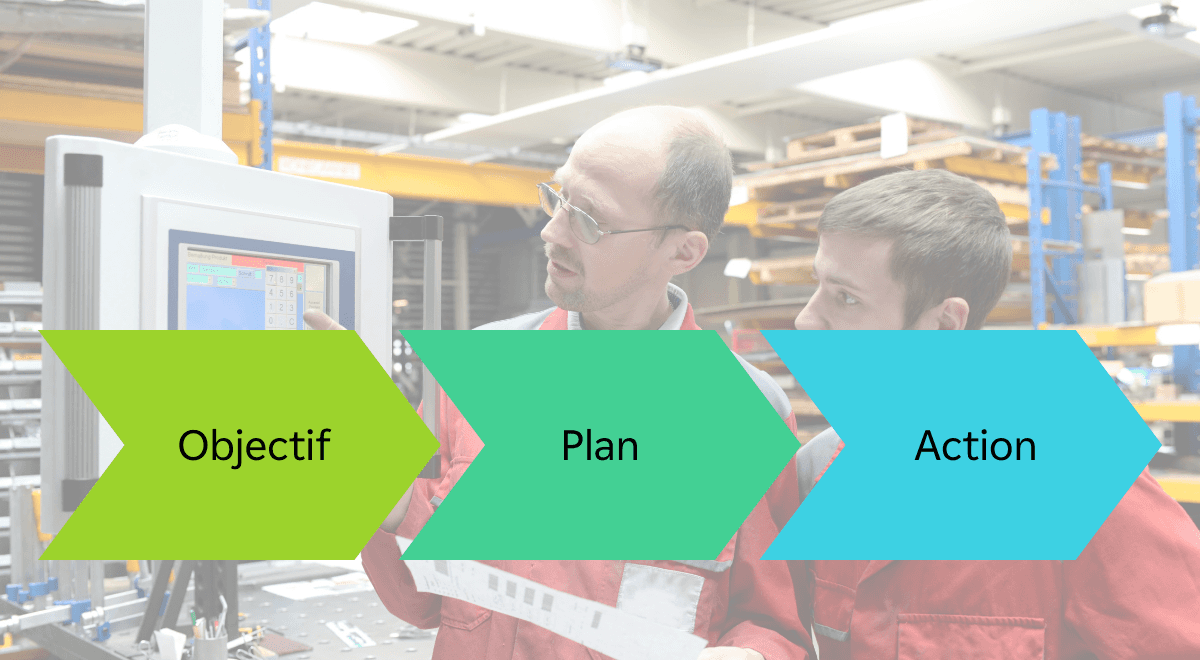
The ORP method meets this need precisely by structuring management around Objective - Result - Action plan.
Are you struggling to align your strategic objectives with measurable operational actions in your factory or engineering office?
The ORP method responds precisely to this need by structuring steering around Objective - Result - Plan of Action.
In this article, you will discover how to formulate clear objectives, define relevant KPIs, and build executable action plans in industrial contexts (energy, aeronautics, automotive).
Why read further?
Because you will learn practical steps to deploy the ORP methodology, concrete examples, and pitfalls to avoid during the first cycles.
We will explain how to organise an effective scoping workshop, which qualitative and quantitative indicators to select, and how to integrate the ORP method into your existing steering committees.
This article is aimed at quality managers, production directors, innovation managers, and digital transformation directors looking to accelerate continuous improvement without making processes more complex.
By the end, you will have an operational framework to launch a first ORP cycle, track progress, and iterate quickly.
Ready to make your actions measurable and your results visible?
Definition and origin of the ORP method
What is the ORP method and where does it come from?
The ORP method is a simple and structured approach to steering initiatives: Objective, Result, Plan of action.
It is inspired by quality management and project steering practices common in industry.
Its effectiveness lies in the simultaneous clarification of what is aimed for, how success will be measured, and who does what.
This approach is particularly suitable for complex industrial environments such as energy, aeronautics, or automotive.
The simplicity of the ORP method facilitates alignment between management, production, and quality.
It has its roots in proven methods (PDCA, SMART, OKR) but stands out through its operational pragmatism.
Key takeaway: the ORP method quickly structures an improvement process without bureaucratic heaviness.

Challenges and benefits of the ORP method
Why adopt the ORP method now?
Because most projects fail due to a lack of clarity on the status of the objective or relevant indicators.
The ORP method brings clarity, measurability, and traceability.
It allows for the prioritisation of actions and the transparent allocation of resources.
In production, this reduces non-conformities and downtime.
In innovation or R&D, it accelerates reproducible experimentation.
For quality teams, the ORP method facilitates reporting to the COMEX and the steering committee.
The benefit is twofold: improvement of operational performance and better communication of documentation.
Expected result: reduced list of wasted time, decisions based on KPIs, accountability of stakeholders.
Key steps of the ORP method
The ORP method is based on three clear steps.
These steps are sequential but iterative.
They require you to:
formulate a precise objective,
define measurable results,
build an achievable plan of action.
This structure reduces ambiguity at project start.
It also facilitates the setup of an ORP dashboard adaptable to the industrial context.
Below, each letter will be detailed so you can apply it immediately to a quality or production topic.
O for Objective — formulate and prioritise
How to define a relevant Objective with the ORP method?
Start by stating it in a clear and engaging sentence, focused on the impact on the customer or the process.
Specify the scope: equipment, line, site, or product scope.
Prioritise according to criticality: safety, regulatory compliance, cost of non-quality.
Make sure the objective is achievable and accepted by stakeholders.
The ORP method recommends adding a deadline and a main owner.
If you are a quality manager, ask yourself: will this objective reduce a measurable risk?
Tip: a well-calibrated objective avoids ineffective action plans.

R for Result — associated indicators and KPIs
What should you measure to know if the objective has been achieved?
The ORP method requires Results expressed through clear and relevant KPIs.
Choose a mix of KPIs:
quantitative (defect rate, cycle times, cost of non-quality),
qualitative (customer satisfaction, document compliance).
For each KPI, define:
the data source,
the collection frequency,
the success threshold.
In industry, favour measurements already integrated into production systems or MES to make data more reliable.
Important: a poorly defined KPI distorts the steering process.
Document the KPI formula so that it is reproducible during ORP reviews.

P for Plan of Action — implementation terms
How to transform objectives and KPIs into concrete actions?
The Plan of Action of the ORP method describes:
tasks,
owners,
deliverables,
deadlines.
Each action must have an identified owner and a review date.
Favour short, verifiable actions to obtain quick wins and strengthen momentum.
Include risk mitigation actions and quality control points.
For industrial projects, link the action plan to the Gantt chart or the shutdown schedule to avoid resource conflicts.
Reminder: without an accurate action plan, the objective remains just an intention.
ORP performance indicators and steering
Steering is based on the Objective – Result – Plan of Action loop.
The ORP method is designed to feed short, factual monitoring meetings.
An ORP dashboard summarises:
the progress of KPIs,
the status of actions.
It must make deviations visible and suggest corrective measures.
For quality management, the readability of the dashboard is crucial for arbitrating priorities.
We recommend automating KPI collection where possible.
Goal: quick decisions, clear accountability, continuous improvement built into the steering.
Definition of qualitative and quantitative KPIs
Which KPIs to choose for ORP steering?
Quantitative KPIs measure objective performance:
scrap rate,
OEE,
mean time to repair.
Qualitative KPIs evaluate perception and compliance:
customer feedback,
document compliance,
internal audits.
Associate with each KPI:
a verification method,
an owner.
The ORP method prioritises coherence between the objective and the chosen KPIs.
Avoid convenience KPIs that do not reflect the actual impact on the process.
Advice: limit the number of KPIs to the essentials to keep the ORP dashboard readable.
Frequency and monitoring terms
How often should you track your ORP?
The frequency depends on:
the cycle of the process,
the criticality of the objective.
For production actions, weekly or daily monitoring may be necessary.
For R&D or digital transformation projects, a monthly pace may suffice.
Organise regular reviews with a short format:
KPI status,
completed actions,
blockages,
decisions.
Document decisions in the ORP register to ensure traceability.
Good practice: synchronise ORP reviews with existing steering committees to avoid extra meetings.

Step-by-step deployment
Ready to deploy the ORP method in your factory or quality department?
The deployment follows three phases: preparation, execution, and adjustment.
Before launching, host a scoping workshop to align stakeholders and validate the boundaries.
Enforce a short pilot phase to test the methodology and adjust the dashboard format.
We detail below how to structure each of these steps to guarantee adoption.
Project preparation and scoping
How to prepare an effective ORP launch?
Invite key stakeholders: production, quality, maintenance, supply chain.
Define the scope, the value hypothesis, and available resources.
Develop the ORP charter which formalises the objective, KPIs, and success criteria.
Schedule a kickoff workshop to align expectations and responsibilities.
Tip: start with a limited scope (one line or one process) to demonstrate value quickly.
Execution and indicator monitoring
During execution:
collect KPIs according to the defined frequency,
hold short, structured reviews to arbitrate and clear blockages,
update the ORP dashboard and communicate progress to teams.
Ensure data quality to avoid making decisions based on incorrect information.
Reminder: rigour in tracking transforms actions into measurable results.

Adjustments and iterations
The ORP method is iterative by nature.
After each cycle:
analyse KPI deviations,
update the objective or action plan if necessary,
optimise successful actions and standardise new reflexes.
If a KPI is not relevant, replace it rather than keeping it out of inertia.
Goal: continually improve the process while keeping a sustainable decision-making pace.
Tools and templates for the ORP method
The ORP method gains efficiency with simple and standardised tools.
We recommend starting with an Excel or Google Sheets ORP template to structure:
the Objective,
the Results (KPIs),
the Plan of action.
This file must contain these fields:
scope, owner, KPI, formula, collection frequency, action status.
To industrialise steering, specialised SaaS solutions bring:
automated collection,
historisation,
shared ORP dashboards.
Prefer a tool that integrates with the MES or ERP to make data reliable.
On the visual side, diagrams such as Gantt, swimlanes, or kanban facilitate tracking the action plan.
For workshops, provide printable ORP sheets: one page per project for steering committees.
Tip: start with a minimal template (max 3 KPIs) then industrialise to SaaS if volume warrants it.
At Yxir, we help choose the right Excel/SaaS mix according to your data maturity and operational constraints.
Best practices and pitfalls to avoid
The success of the ORP method depends as much on the format as the behaviour of the teams.
Avoid the classic pitfall: poorly calibrated or too many objectives that dilute attention.
Do not multiply KPIs; favour 2–4 relevant indicators per objective.
Do not entrust data updates to a single person without a validation process.
Enforce short, regular reviews and document decisions in the ORP register.
To involve teams:
associate them during the scoping workshop,
deliver quick wins with short actions.
Encourage transparency: shared ORP dashboard and alerts on deviations.
Beware of convenience KPIs that do not measure actual impact.
Reminder: the ORP method is pragmatic — seek simplicity and reproducibility.
We recommend short training sessions for pilots and an executive sponsor to clear blockages.
Comparison with other steering methods
The ORP method sits at the intersection of operational steering and continuous improvement.
Compared to PDCA, ORP is more direct: PDCA structures the improvement cycle, while ORP formalises the Objective, Result, and Plan of Action for immediate steering.
Against SMART, ORP recovers the notion of a measurable objective but adds the systematic link to KPIs and the plan.
Compared to OKRs, ORP is more operational and less ambition-oriented: OKRs push the stretch goal and strategic alignment, while ORP prioritises execution and traceability.
The 5W2H remains a good complement to detail the actions of the ORP Plan of Action.
In summary, the ORP methodology excels at rapid steering and field accountability.
Use PDCA or OKR in parallel when you need wider improvement cycles or ambitious strategic objectives.
Use cases and feedback
The ORP method is adapted to many sectors, with simple adjustments depending on the context.
In energy, ORP allows you to reduce unplanned shutdowns by targeting availability and MTTR KPIs.
In aeronautics, it helps steer supplier non-conformities with trackable KPIs and short action plans.
In manufacturing, ORP limits the cost of non-quality by prioritising critical lines.
Quality managers report a gain in clarity:
fewer long meetings, quicker decisions, visible KPI improvements.
For R&D or SaaS teams, ORP structures experiments with measurable results and release plans.
Takeaway: the ORP method is pragmatic and adaptable — its impact depends on the rigour of its implementation.
Taking action with the ORP method
What you should remember to take action with the ORP method:
the ORP method gives you a simple framework to transform ambitions into measurable results.
It clearly links:
Objective,
Result (KPIs),
Plan of Action,
and facilitates operational steering in industrial environments.
Start with a limited scope to demonstrate value quickly.
Launch a scoping workshop with production, quality, maintenance, and supply chain to align the objective, KPIs, and responsibilities.
Choose 2 to 4 relevant KPIs per objective, document their formula and collection frequency, and connect them to your data sources (MES, ERP, or field entries).
Industrialise following with a simple ORP template before considering a SaaS solution.
A structured Excel or Google Sheets file is enough for a pilot and allows you to iterate on the ORP dashboard format.
Automate indicator collection where possible to make reporting reliable and accelerate decisions.
Adopt short cycles and structured reviews.
Short and regular monitoring meetings make deviations visible and allow for fast corrective actions.
Document decisions in the ORP register to ensure traceability and continuity between steering committees.
Do not lose sight of culture and accountability.
An executive sponsor and trained pilots facilitate adoption and block removal.
Favour checkable actions and quick wins to engage teams in a virtuous circle of continuous improvement.
Be prepared to compare and complement the ORP method with other approaches depending on your needs.
Use PDCA to structure wider improvement loops, OKR for strategic ambitions, and 5W2H to detail action plans.
ORP remains the right compromise when the goal is to speed up execution and improve operational tracking.
To turn this framework into concrete results, follow these first steps:
launch a scoping workshop, define a priority objective, formalise 2–4 KPIs, build an action plan with owners and deadlines, and hold short reviews.
If a KPI does not reflect the expected impact, replace it and standardise what works.
Rigour in steering and the simplicity of the setup are the keys to success.
Together with you, we can build ORP templates, scoping workshops, and support to accelerate deployment across your sites.
Move from theory to execution: make your objectives visible, your KPIs reliable, and your action plans truly effective.
Continue reading
The latest innovations in Industry 4.0