5 Whys method: speed up problem solving

Discover the "5 Whys" method to effectively solve problems at their root. A simple, powerful technique approved by management experts. Click to apply it right now!
The "5 Whys" method is one of the most powerful tools for identifying the real cause of a quality problem.
How many times do teams spend time correcting errors... only for them to reappear a few months later?
Asking "Why?" five times allows you to go beyond the symptoms to address the true source of the failure.
But beware: when used well, this method can transform your continuous improvement process.
Conversely, if poorly applied, it remains on the surface and builds shaky solutions.
So, how can you practically exploit it within your quality procedures? What pitfalls should you avoid, and above all, how do you integrate it into your tools, your audits, your non-conformity analyses?
In this article, you will discover how the "5 Whys" method must be established at the heart of field teams to become incredibly effective in its results.
Ready to stop chasing errors and start building sustainable quality? Let's go.
What is the 5 Whys method?
Faced with a non-conformity, a malfunction or a failure, understanding the origin is often a greater challenge than repairing the consequences 👨🔧
The 5 Whys method (or 5W in English) is a causal analysis technique designed to identify the root cause of a problem by asking a series of simple but powerful questions: "Why?".
The principle is to trace back the chain of causes by questioning each answer given five times – or more if necessary.
The objective is to move from visible symptoms to the real origin of the problem.
This method was developed by Taiichi Ohno at Toyota in the 1950s, as part of the Lean production system.
Today, it is fully integrated into continuous improvement approaches such as Kaizen or quality audits.
Simple on paper, the 5 Whys method requires rigour in its practical application.
It distinguishes itself from other cause analysis tools like the Ishikawa diagram or Six Sigma's DMAIC by its simplicity and its ability to quickly involve field teams.
Are you looking to make your processes more reliable, limit recurring errors or understand the origin of a quality discrepancy?
The 5 Whys method can revolutionise the effectiveness of your teams.

Why use the 5 Whys method in industry?
In an industrial environment subject to quality, performance and safety requirements, managing problems is a strategic challenge 🤗
The 5 Whys method is an accessible tool, directly usable in workshops as well as during quality reviews.
It allows for a quick response to non-conformity while building a sustainable solution.
Unlike other more complex approaches, this method requires neither software nor heavy training.
It promotes stepping back, critical thinking and collaborative work.
Faced with the same incident, we often observe that actions taken without a deep causal analysis resolve nothing in the long term.
By systematically asking the question "Why?", this approach avoids superficial solutions.
It makes it possible to understand the sequences of causes and get back to the initial problem.
Compared to a fishbone diagram, which maps out multiple possible causes, the 5 Whys method traces a logical path to a focused avenue.
However, it can be combined with other tools such as PDCA or A3 audits to work at different levels of granularity.
What makes it strong is its ability to engage operators, technicians, and engineers in a structured reflection, without complicating the discussions.
It creates a culture of analysis and prevention, rather than sanction and reaction.
How does the 5 Whys method work?
The core of the 5 Whys method relies on a very simple sequence: for each answer provided, you immediately ask a new "Why?" question ☝️
This process is repeated until reaching the root cause, that is to say, the fundamental element that triggered the problem.
Let's take an example: a machine has stopped.
Why? Because a fuse blew.
Why? Because a bearing overheated.
Why? Because it lacked lubricant.
Why? Because the circuit was clogged.
Why? Because the maintenance plan had not scheduled this cleaning.
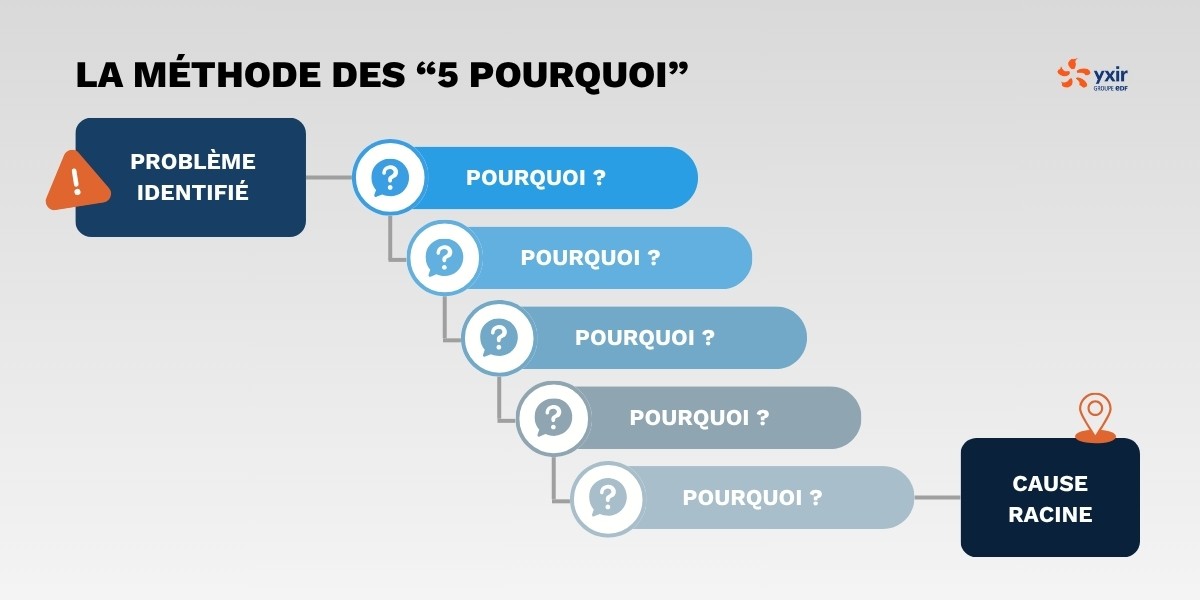
In five questions, we transition from a production stoppage to a flaw in a maintenance process.
The approach is fluid, but demands clarity in the answers and absolute neutrality: it is never active about looking for someone to blame, but rather seeking an explanation.
It should be noted that the number "5" is not a fixed rule 😏
Sometimes three are enough, sometimes seven are necessary. The key is to see the reasoning through to the end.
The 5 Whys method is not a series of questions asked off-the-cuff. It is a logical thinking tool anchored in concrete facts, and a powerful lever to make an industrial process sustainably reliable.
Steps to apply the 5 Whys effectively
The 5 Whys method becomes truly powerful when applied with method and rigour 💪
It all starts with a clear and factual definition of the initial problem. This is not about perceptions or assumptions, but a concrete, measurable, and observable fact.
Next, effectiveness largely depends on the formation of a multidisciplinary team.
This work is not done alone: involving operators, quality managers and technicians allows for a comprehensive and shared vision.
The "Why?" questioning process must then be carried out rigorously 😇
Each answer must be validated by facts or data. Subjective assumptions must be discarded.
Throughout the analysis, it is essential to document discussions, hypotheses, answers and validations.
A simple 5 Whys table can suffice: the initial problem at the top, consecutive columns with the "Whys" asked and their answers.
Once the root cause is identified, all that remains is to define the corrective actions to be implemented to prevent the problem from reoccurring.
These must be concrete, achievable, and tracked over time.
By following these steps in a structured manner, the 5 Whys method becomes second nature among teams for your quality management and continuous improvement system.
Concrete examples of use in industry
The 5 Whys method makes perfect sense when applied to concrete situations 🧑🏭
It allows problem-solving to be approached from a factual angle, with a simple logic to share and follow within a team.
Here are three frequent cases where the 5 Whys method proves particularly effective.
Practical case study in industrial production
A production line stopped abruptly after an emergency stop triggered 🚨
→ Why?
Because a main conveyor jammed.
→ Why did it jam?
Because a motion sensor stopped responding.
→ Why did the sensor stop working?
It was damaged by an accumulation of dust.
→ Why wasn't the dust cleaned?
Because the preventive maintenance schedule did not include this cleaning at this frequency.
→ Why?
Because the clogging thresholds had not been correctly assessed.
Result: only adjusting the maintenance plan is needed to eliminate the problem at its root.
Case study in the Health, Safety and Environment (HSE) sector
An HSE alert is triggered following a chemical spill.
The analysis via the 5 Whys method reveals that the origin traces back to a handling error, due to incomplete labelling, itself resulting from an oversight when integrating a new supplier.
By identifying this root cause, the company was able to set up a specific audit procedure at reception, preventing similar errors.
Visual case study with table or dialogue
To maximise the impact, we advise using a simplified 5 Whys table, listing the initial problem, the consecutive questions and the identified root cause.
In the workshop, this accessible approach is particularly effective for engaging teams in a continuous improvement process based on the 5 Whys method.
5 Whys: best practices for successful application
The effectiveness of the 5 Whys method relies heavily on the rigour of its implementation. Here are some best practices to keep in mind to deploy this analytical tool with impact.
Avoid blaming individuals
The success of the method lies in one golden rule: do not look for a human to blame.
We look for a cause, not a culprit 🔪
An accusatory approach blocks discussions and hinders continuous improvement.
Conversely, a factual and descriptive approach nurtures a quality culture.
Rely on factual data
Each answer to a "Why?" must be backed up by an identified fact: measurement, field observation, document review 📉
Hypotheses or subjective judgments damage the soundness of the analysis.
Keeping track of validations also helps make decisions objective.
Involve the relevant stakeholders
An essential point of the 5 Whys method is the mobilisation of the right people 👷🏻♀️
Operators, technicians or support functions directly affected by the problem must participate in the cause search.
By inviting field experience, you avoid the blind spots of overly theoretical reasoning, while generating better buy-in for corrective actions.
Document discussions
Finally, record the entire reflection in a written document or a visual medium such as a table or A3 sheet.
This is a powerful lever for team sharing, quality audits or performance reviews.
By applying these best practices, the 5 Whys method becomes the best way to improve your problem-solving processes.
Frequent errors to avoid with the 5 Whys method
Even though it seems simple, the 5 Whys method can lose its effectiveness if poorly applied.
Here are the most common pitfalls to avoid to unlock the full potential of this approach to problem-solving.
Lack of rigour in formulating questions
The "Why?" question must always be precise, centered on an objective fact ✅
If it is vague or biased, it can lead to skewed answers.
In the heat of the moment, we tend to go too fast or skip logical steps. It is crucial not to rush through the steps and to validate each intermediate cause.
Skipping steps or hasty conclusions
Stopping the analysis too early is the most classic mistake ❌
Some root causes only reveal themselves at the fifth, or even the sixth level of questioning.
Settling for the first obvious cause risks leading to a very superficial action... which resolves nothing in the long term.
Absence of follow-up on corrective actions
The 5 Whys method does not stop at identifying the root cause 🌱
It also implies implementing an adjusted, measurable corrective action tracked over time.
Without a clear resolution action plan, the whole exercise remains purely theoretical.
Good post-analysis follow-up is therefore vital.
Not involving the right people
Conducting the analysis alone or only among managers risks missing key information.
It is often the operators or technicians who possess the field knowledge necessary for a good understanding of the causes.
Limiting this method to a restricted circle reduces its collective scope and effectiveness.
Integrating the 5 Whys method into your digital tools
Today, industrial performance also relies on the digitisation of quality processes.
Integrating the 5 Whys method into a digital environment allows for its maximum scope and reusability.
Using templates and shared tables
Rather than starting from scratch for each incident, it is possible to create standardised template frameworks for the 5 Whys shared among teams 💬
This ensures approach consistency while simplifying the analysis.
A simple table with "Question", "Answer" and "Validation" columns can be enough, especially if it is collaborative.
Automating analysis via digital solutions
Certain quality management platforms already integrate causal analysis modules, with guided assistance to run through the 5 Whys method.
This is a major time saver for documenting, tracking corrective actions and securing their follow-up in an audit or improvement plan.

*****
Adopting the 5 Whys method means deciding to no longer settle for patching up leaks, but rather understanding why they appear.
It means giving teams the tools to treat problems in depth, without falling into blame-seeking or sterile analysis.
It is also about creating the conditions for a culture focused on the root cause, where quality becomes a shared responsibility, anchored in reality.
Today, in demanding industrial environments — whether it's automotive production, aeronautical equipment or energy projects — error margins are tiny.
Thus, the fast and sustainable treatment of quality discrepancies allows for rapid productivity gains.
The most agile companies know this: it is the speed of analysis and absolute correctness of the diagnosis that make the difference, not the correction speed.
The 5 Whys method aligns fully with this logic.
It allows you to structure the analysis of your non-conformities, whether detected during an audit, following a production incident, or resulting from customer feedback.
It helps you rationalise discussions, fact-check hypotheses, and build a logical argument that engages both operators and quality managers.
Above all, it's a method that adapts to the realities on the ground. No need for heavy investments, endless training or complex software.
It is a robust, effective, and quick tool to deploy... provided you are rigorous.
In fact, at Yxir, we are convinced that the power of the 5 Whys method can be further boosted when combined with suitable digital tools.
A shared analysis table, a centralised database of identified root causes, fluid workflows between functions: all are levers to secure the method over time and capitalise on collective intelligence.
With the right digital tools, you reduce bias, improve traceability of the decisions made, and facilitate the arrival of truly relevant corrective actions.
Continue reading
The latest innovations in Industry 4.0