Operational excellence: 10 tips to transform your industrial operations

Discover how to deploy operational excellence to reduce costs, improve quality, boost productivity and drive your industrial KPIs.
You are facing non-quality costs that are eating into your margins.
You need to reduce production lead times while guaranteeing compliance.
You want to transform your workshops with digitalisation without losing touch with the shop floor.
By aiming for operational excellence, you seek to make your operations more reliable, speedier and more competitive.
We offer practical advice to start or accelerate your process.
Each tip is immediately applicable and designed for demanding sectors such as aerospace, automotive or energy.
Tip 1: define operational excellence in your context
Before any method, you must define what operational excellence means for your business.
Organise a strategic workshop with production, quality, maintenance and innovation.
Map out the challenges: costs, quality, lead time, safety.
Define SMART objectives aligned with the industrial strategy.
Associate relevant KPIs (OEE, scrap rate, lead time) and a time target.
Formalise an initial scope (line, factory, product family) for a pilot.
Measure the current state with process mapping and Gemba Walks.
Prioritise projects according to potential impact and feasibility.
A clear and measurable objective avoids scattering actions without real effect.

Tip 2: involve top management and convey a culture of excellence
Top management commitment is non-negotiable for operational excellence.
The leader must drive the vision and dedicate visible resources.
Create a steering committee with monthly indicators and regular reviews.
Deploy simple communication: objectives, early wins, feedback from the field.
Invest in training managers and operators on Lean and Six Sigma principles.
Value field initiatives through rituals (daily reviews, visible dashboards).
Support change with coaching rather than just theoretical sessions.
Culture is built by example: if management participates in Gemba Walks, the teams follow.

Tip 3: map and standardise key processes
Mapping is the foundation of any operational excellence process.
Start by performing a Value Stream Mapping (VSM) to identify flows, waste and bottlenecks.
Quantify lead time, cycle time and stock between stations to prioritise.
Document critical processes in the form of standard work and operating procedures.
Run standard robustness tests in the field to adjust for micro-variations.
Integrate quality controls and verification points into the documentation.
Organise regular audits to maintain the standard and detect deviations.
Standardising means making improvement reproducible and freeing up time to innovate.

Tip 4: adopt lean management and kaizen
Lean and Kaizen are at the heart of sustainable operational excellence.
Launch pilot Kaizen projects on processes with high improvement potential.
Set up multidisciplinary teams with operators, maintenance and quality.
Define measurable objectives before the project and compare afterwards.
Favour short-term actions that generate value to create momentum.
Document gains and methods to capitalise and disseminate.
Use simple tools:
5S for order
Kanban for flows
SMED to reduce changeover times
Kaizen creates a habit of continuous improvement, not a one-off event.

Tip 5: control variability with Six Sigma
To reduce defects and variability, integrate Six Sigma into your operational excellence approach.
Start by prioritising critical issues for customer quality.
Apply the DMAIC approach on a pilot: define, measure, analyse, improve, control.
Train at least a few employees in statistical tools and analysis methods (capability, correlations).
Use internal case studies to demonstrate the impact before deploying on a large scale.
Link Six Sigma to Kaizen projects to combine quick gains with robust solutions.
Reducing variability means stabilising your performance and securing your customer commitments.
Tip 6: structure the workshop with the 5S method
Maintain and audit standards
The 5S method is one of the fastest levers to materialise an operational excellence approach.
Sort, set in order, shine, standardise and sustain: each S plays a practical role in reducing waste and securing quality.
Start with a 5S project on a pilot zone with high flow.
Enforce simple visual rules (markings, shadow boards, labelling).
Train operators in self-checking and autonomous maintenance.
Schedule weekly 5S audits with a checklist and scoring.
Link these audits to KPIs (OEE, scrap rate, lead time).
A clean and tidy workshop improves safety, reduces wasted time and prepares for digitalisation.
Integrate 5S results into daily rituals (huddle, board).
Evaluate the ROI of 5S actions.

Tip 7: optimise maintenance with TPM
Measure OEE and reduce breakdowns
TPM (Total Productive Maintenance) is central to sustainable operational excellence.
Aim to reduce breakdowns, increase availability and improve quality.
Launch TPM with autonomous maintenance.
Deploy a preventive and condition-based maintenance plan based on MTTR/MTBF.
Measure OEE per equipment and track the main causes of loss.
Integrate a CMMS or IoT sensors to move towards predictive maintenance.
Combine TPM with SMED and Poka-Yoke.
Reducing unplanned downtime increases useful capacity and secures your customer commitments.
Tip 8: steer performance via adapted KPIs
Track scrap rate and lead time
Effective steering relies on clear KPIs aligned with your operational excellence strategy.
Choose actionable indicators:
OEE
scrap rate
lead time
breakdown rate
Takt time
Define SMART targets and a review frequency.
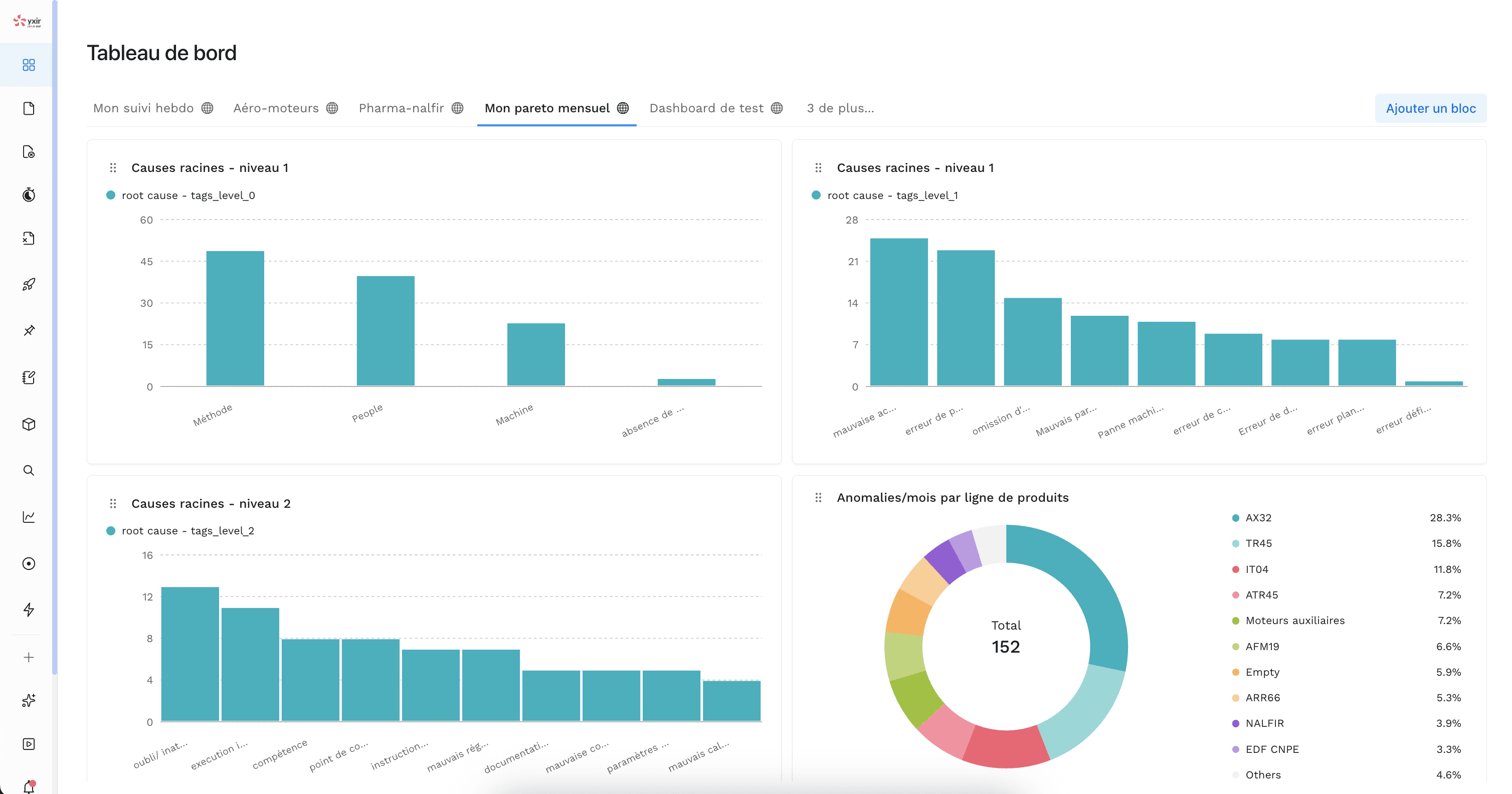
Build visual dashboards for the shop floor + management.
Associate each KPI with an owner.
A good KPI must be understandable, measurable and correlated to customer value.
Tip 9: harness digitalisation and Industry 4.0
Integrate IoT technologies and analytics
Digitalisation is a major accelerator when aligned with concrete needs.
Prioritise:
real-time performance monitoring
predictive maintenance
job order management via MES
Deploy IoT + analytics.
Start with pilots and industrialise.
Ensure data quality and cybersecurity.
Technology must serve the processes, not the other way around.
Tip 10: establish long-term continuous improvement
Capitalise on feedback
Operational excellence is not a project, it is a trajectory.
Institutionalise PDCA/DMAIC.
Capitalise on feedback.
Scale successes.
Implement clear governance.
Strengthen internal culture and skills.
Continuous improvement secures your results over the long term.
Conclusion
Finally, remember one essential thing: aiming for operational excellence is not a luxury, it is a strategic necessity to remain competitive.
Start with a rigorous diagnosis (VSM, Gemba Walk).
Launch a pilot.
Ensure top management commitment.
Steer with OEE, scrap, lead time.
Combine:
Lean / Kaizen
Six Sigma
TPM & 5S
Digitalisation
Standardise.
Institutionalise PDCA.
Measure ROI.
Anticipate the pitfalls:
dispersion
lack of governance
digitalisation without processes
If you are looking to transform these principles into concrete results, we support you to build your roadmap, steer and industrialise the gains.
Continue reading
The latest innovations in Industry 4.0