Kanban method: the complete guide to optimising your industrial flows
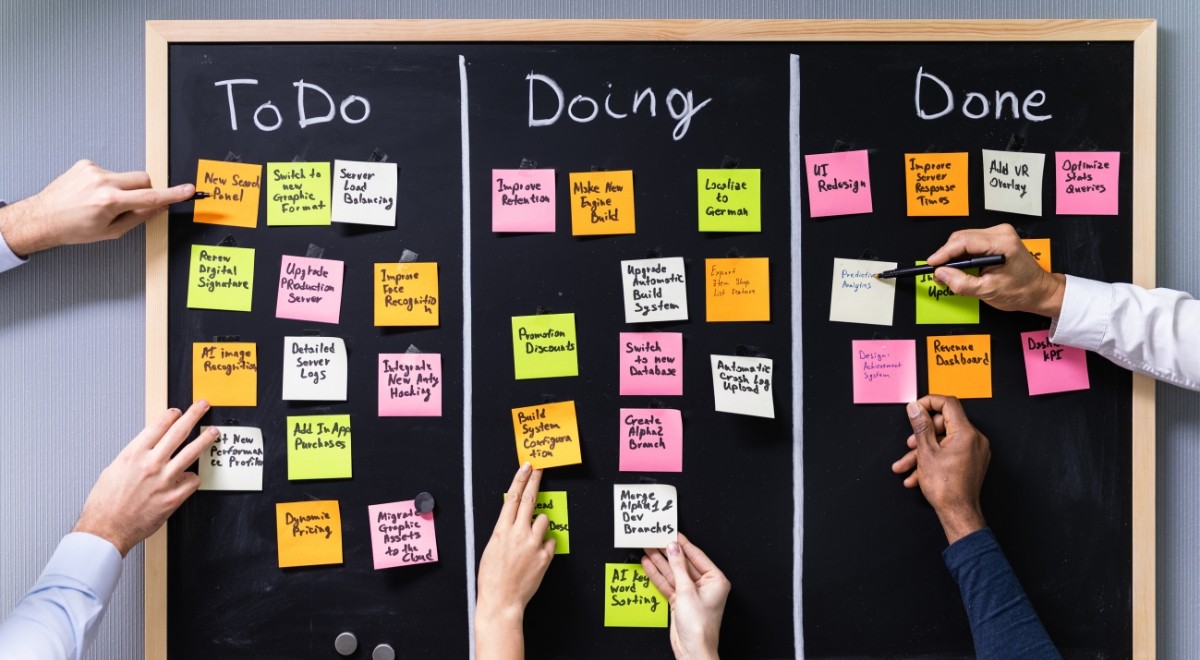
Adopt the Kanban method to boost your productivity! Discover how this visual approach is revolutionising project management.
The kanban method has become a must-have for streamlining production processes and improving task management in real time.
But here is the catch: between theoretical ideals and concrete implementation, there is often a gap 😬
You may have already embarked on a kanban approach, without getting the expected results.
Lack of clarity, overloaded teams, deadlines that are still too long... Does this sound familiar?
If kanban seems promising to you, but you cannot seem to fully master it, then this article is for you.
We are going to deconstruct the fundamentals of this method, while revealing concrete levers to make it a real asset in your quality system.
The objective?
To understand how the kanban method can be effectively integrated into your processes, without making your daily life more complex.
And above all, you will leave with immediate avenues for optimising your flows, gaining visibility and strengthening collaboration among your teams.
Your quality approach can be more agile, do you want to know how?
We will explain everything.
What is the Kanban method? Understanding the system that optimises your industrial flows
Are you looking for an effective way to streamline your processes, make work visible and quickly identify blockages in your production line? 🤓
The Kanban method can help you.
Adopted by demanding sectors like automotive or aerospace, Kanban is a powerful visual management tool for steering production, reducing lead times and improving quality.
In this article, you will discover how the Kanban method works, what principles it is based on and how to concretely implement it in your business.
You will leave with a clear understanding of its benefits, concrete industrial use cases and best practices for implementation.

Definition and origins of Kanban
The word "Kanban" comes from Japanese and literally means "signboard" or "visual signal".
This concept was formalised in Toyota factories in the 1950s to manage pull flows in production, limiting excess and resynchronising teams around a visual process.
The Kanban method is therefore based on a system of cards, boards and columns, which indicate the progress status of a work item.
Each Kanban card represents a task or a product to be processed, moving visually through the flow according to its status.
The objective is simple: to foster better coordination and rapid decision-making, thanks to a shared view of the activity.
Today, this method is applied far beyond the automotive industry, in all sectors where process rationalisation and workflow optimisation constitute a performance lever.
History and link with Lean and the Toyota Production System
The Kanban method has its roots in the Toyota Production System (TPS), a model of industrial excellence that has become the global reference in Lean management 😎
In the post-war years, Japanese industry sought to do better with less: less waste, less stock, but more responsiveness.
The TPS therefore formalised practices like "just-in-time", kaizen (continuous improvement) and the Kanban system, to limit overproduction and adapt the pace to the rate of actual demand.
Kanban is both an operational tool and a philosophy.
It reveals bottlenecks, stimulates collaboration between teams and helps bring about concrete improvements in existing processes.
The link with Lean is fundamental: both share the ambition of maximising the value created for the customer by reducing waste.
In your workshops or design offices, this vision finds a direct echo: you want to align flows, avoid stockouts, make your deliveries reliable.
Kanban is a lever for this alignment.
The fundamental principles of the kanban method
Visualising the workflow: the basis of visual management
The first pillar of the Kanban method is the visualisation of the workflow 🤓
Without visibility, steering is impossible.

This is why setting up a Kanban board is essential.
This board represents the path that a work item follows, from its creation to its delivery.
The standard columns are often: "To Do", "In Progress", "Done".
But in an industrial environment, this flow can include more targeted steps like "Supply", "Quality Control", "Assembly", "Shipping".
Each Kanban card moves through this system, making the progress status of tasks visible.
At a glance, you detect accumulations, blockages, risk areas.
This is visual management applied to the entire value chain.
In aerospace as in energy, this visualisation reduces misunderstandings, aligns teams and supports responsiveness.
By digitalising this board with tools like Jira or BusinessMap (formerly Kanbanize), you gain in traceability, historicisation and agility in multi-site or multi-project steering.
Limitation of work in progress: reducing clutter to accelerate flow
One of the fundamental principles of the Kanban method is the limitation of work in progress, also called WIP limit (Work In Progress limit).
Why? 🤨
Because a saturated system naturally slows down.
The more tasks you have started in parallel, the less capable you are of finishing them on time.
Limiting the WIP means choosing to prioritise fluidity rather than maximum resource utilisation.
In practice, you define a maximum number of cards allowed simultaneously on each column of the Kanban board.
This forces teams to finish what has been started before committing to new work.
This constraint, far from being a constraint, becomes a powerful lever for improvement: blockages are visible earlier, trade-offs are facilitated, and operational discipline improves.
In a manufacturing workshop, for example, this can translate into a limitation on the number of batches waiting between two machines, to limit delays and wasted time.
It is also an excellent tool for empowering teams, by giving them control over their actual workload.
Workflow management and optimisation: aiming for continuous performance
Steering with the Kanban method is not just about visualising: it is about acting on the flow proactively.
Flow management consists of monitoring the speed at which tasks cross the different stages of the Kanban board, to minimise cycle times and reduce the total time between request and delivery (lead time).
By observing transit times, temporary stock spikes, and bottlenecks, you detect where your chain slows down.
This continuous diagnosis allows for concrete adjustments: load balancing, changing roles, or reorganising the bottleneck station.
In industry, where every hour counts, these gains are strategic.
For example, on an automotive assembly line, tracking flow with a digital Kanban board allowed one of our clients to reduce their processing cycle by 18% in six months, by detecting a recurring over-allocation in quality control.
The core of Kanban is therefore this fine and adaptive steering, which relies on field data, shared and updated in real time.
This is where visual management becomes a collective performance lever.
Setting up explicit policies
For the Kanban method to deliver on all its promises, it is essential to establish explicit policies ☝️
These common rules guide the movement of Kanban cards from one column to another.

They define the entry and exit criteria for each step of the workflow.
In other words, they help each team member to know exactly when a task can be considered "ready" or "completed", and under what conditions.
This reduces ambiguity, strengthens transparency and standardises processes.
Implementing explicit policies also means laying the foundations for a culture of continuous improvement.
We identify more clearly what blocks or slows down a flow, which allows rules to evolve based on field adjustments.
On a Kanban board, these policies can be visible directly to reinforce the role of visual management: for example, in the form of inserts, legends or shared documents.
At Yxir, we encourage our clients to start simple, and then enrich these policies as their Lean maturity grows.
Integrating this logic improves pull-flow steering and also fosters operational engagement.
It is these explicit rules that transform a simple Kanban board into a real agile management system.
Integration of feedback loops
In the Kanban method, feedback loops are the driver of continuous improvement.
They allow for regular moments of alignment, where the team analyses the workflow, its blockages, and discusses concrete adjustments.
These feedback loops take several forms.
The most famous is the daily meeting or daily Kanban, where we gather in front of the Kanban board to do a quick status check, detect drifts and adjust priorities.
Other feedback loops can be weekly (flow review), monthly (retrospective) or triggered when a threshold is met (e.g. accumulation of cards in a column).
The objective? To make the flow adaptable, sensitive to weak field signals, while maintaining a collective dynamic.
In an industrial environment, these feedback loops are particularly structuring.
They bring production, quality, supply or maintenance together around the same Kanban board.
This promotes cross-functional coordination and shared real-time analysis.
We have observed among our clients that these loops reinforce responsiveness, reduce decision cycles and consolidate the Lean culture at all levels of the organisation.
Integrating feedback into your Kanban method means opening the way to a more agile, more human, and more resilient steering.
Continuous improvement approach (Kaizen, PDCA)
The Kanban method is based on an essential foundation of Lean: continuous improvement 💪
This principle, known as Kaizen or according to the PDCA cycle for Plan-Do-Check-Act, aims to perfect processes step by step, by involving teams and relying on field data.
Kanban is not a frozen system.

It is an evolving environment that adapts to your constraints, your products and your Lean maturity.
Each adjustment, each iteration on the Kanban board, on explicit policies or WIP limits, must aim for one goal: to reduce waste, eliminate downtime and make quality reliable.
The Kaizen approach applied to the Kanban board can therefore involve small-scale tests (modified production cycle, new task distribution), root cause analyses when a blockage occurs or experiments driven by your cycle time and lead time metrics.
At Yxir, we advise formalising an improvement ritual every 15 or 30 days, with the team concerned.
By integrating Kaizen logic into your Kanban system, you start a cumulative dynamic, where each improvement reinforces the previous one.
And you transform your Kanban board into a real catalyst for sustainable performance.
Why adopt the Kanban method?
The main benefits for the industry
Adopting the Kanban method means choosing a smoother, clearer and more responsive work organisation.
In industry, where production flows involve multiple players, machines and validations, this approach allows teams to be synchronised around a common vision.
Kanban offers a double benefit: it structures without rigidifying.
Where a frozen process can hinder agility, Kanban establishes a visual discipline that helps manage priorities better while allowing room for permanent adjustment.
Each card becomes a clear signal: a need to be addressed, a blockage to be cleared, a flow to be accelerated.
By making work visible, you reduce grey areas and coordination losses between departments.
It is a tool that promotes transparency, collaboration and accountability, three pillars of modern industrial performance.
Impacts on productivity, quality and lead times
The effects of Kanban are measurable.
In many industrial enterprises, its deployment is accompanied by a significant reduction in cycle times, better control of priorities and a drop in non-conformities related to coordination errors.
By limiting work in progress, teams focus on finalisation rather than piling up tasks. Result: fewer interruptions, fewer bottlenecks, and a more regular flow.
This fluidity has a direct effect on delivery times and customer satisfaction.
On the quality side, the visibility offered by Kanban allows anomalies to be detected earlier in the process.
Root causes are identified more quickly, and corrective actions can be implemented without delay.
It is also a strong lever for advancing the culture of continuous improvement, by giving teams the means to steer their daily performance.
In an environment where every minute counts, Kanban becomes a real-time indicator of your production health, a shared dashboard that aligns the field and management on the same priorities.
Typical use cases in industry
Kanban adapts to a wide variety of industrial environments, from the assembly station to equipment maintenance.
In aerospace, it is often used to track the progress of manufacturing orders or the preparation of parts batches, guaranteeing the availability of critical components at the right time.
In automotive, it structures internal logistics: each Kanban card becomes a replenishment signal, reducing stocks while avoiding line outages.
In the energy sector, Kanban is applied to the planning of maintenance interventions and the tracking of quality deviations. It allows operations to be prioritised according to their impact on safety, compliance or plant performance.
These examples have one thing in common: Kanban acts as a visual nervous system, capable of linking all functions involved in the same flow.
It is a universal language, understood as much by operators as by quality, logistics or production managers.
Adopting Kanban is therefore not just about deploying a tool, but establishing a culture of flow, continuous progress and shared performance.
How to deploy the Kanban method in your organisation
Map existing processes
Before setting up a Kanban board, you must first understand your actual workflows.

This mapping step consists of observing how tasks circulate today, where they stall, and which departments intervene at each stage.
It is often at this stage that we discover bottlenecks — those choke points that slow down production — or areas where priorities lack clarity.
A precise diagnosis is essential so that your Kanban method reflects field reality and does not become a mere decorative board.
This preparatory work fits into Lean management logic: identify waste, eliminate flow disruptions and maximise added value at each stage.
Create a Kanban board adapted to your flow
Once processes are identified, you can build your Kanban board.
Each column represents a progress status of the pull flow: from receipt of the request to delivery or final validation.
In an industrial workshop, we can, for example, structure columns around stages such as "Preparation", "Manufacturing", "Quality Control", "Packaging", "Shipping".
Each Kanban card symbolises a task, a batch or a part, and its movement from one column to another materialises the progress of the work.
The objective is to visualise the workflow in real time, at a simple glance.
This is the very principle of visual management: make visible what was not, to steer collective performance more effectively.
Define columns, WIP limits and statuses
The core of the Kanban method lies in the limitation of work in progress (WIP limits).
Each column of the Kanban board must have a maximum threshold of active cards.
This constraint is crucial: it prevents overload, improves team focus and accelerates cycle time.
Defining clear statuses ("To Do", "In Progress", "In Validation", "Done") also helps standardise task progression.
This prevents grey areas where everyone interprets what a "completed" task is differently.
In practice, it is better to start with a simple flow, then refine column granularity as Kanban maturity sets in.
Choose between a physical board or a digital tool
The choice between a physical board and a digital Kanban depends on your organisation's context.
A wall board remains very effective in workshops or design offices where teams work in the same location.
Kanban cards circulate manually there, reinforcing the collaborative dimension and immediate visualisation.
But for multi-site organisations, or those seeking to cross-reference data, indicators and performance tracking, digital tools like Trello, Jira or Kanbanize are more suitable.
These platforms allow for digitalised visual management, connected to your business systems, with automated tracking of lead times and flows.
Whatever the format, the essential thing is to foster clarity, responsiveness and collective responsibility.
Measure performance: cycle time, lead time, throughput
Implementing a Kanban board only makes sense if we measure flow performance.
The key indicators are cycle time (time to complete a task), lead time (total time between request and delivery) and throughput (volume of tasks completed over a given period).
These metrics offer a precise reading of your teams' actual capacity and flow stability.
An increase in cycle time often signals a bottleneck or load imbalance.
Conversely, a regular throughput testifies to a controlled flow.
The Kanban method relies on this data to guide decisions.
They form the basis of PDCA (Plan-Do-Check-Act) and Kaizen, the two pillars of continuous improvement.
Adjust and improve in an iterative logic
Kanban is never frozen.
It is a living system that evolves with needs, teams and production constraints.
After a few weeks of use, it is essential to analyse trends, listen to operator feedback and adjust the rules of the game: WIP limits, status definitions, meeting frequency, flow structure... everything can be refined.
This iterative approach is an integral part of Lean management: test, measure, correct.
This is how Kanban becomes a tool for continuous improvement, and not just a frozen framework.
Organisations that succeed in their Kanban deployment are those that accept this continuous learning logic, based on data, transparency and collective intelligence.
They transform the Kanban board into a real dashboard of performance and collaboration.
Best practices for a successful Kanban project
Involve teams from the start
The success of a Kanban project relies above all on team buy-in 🤜🤛
An effective Kanban board is not imposed from above: it is built with those who use it daily.

Involving operators, technicians, quality or maintenance managers from the design phase allows for field reality to be reflected and immediate ownership to be gained.
It is also a strong engagement lever. By visualising their own contribution to the flow, employees become actors in collective performance.
Kanban then becomes much more than a steering tool: it is a collaborative framework that reinforces the culture of continuous improvement.
Ensure clear visual communication
Visual management is at the core of the Kanban method 👀
To be effective, the board must be simple, legible and shared.
Each column, card and colour must be understood without explanation.
A good Kanban board is one that you understand in five seconds.
Too many details or visual codes hurt clarity.
The goal is to create a common language, accessible to everyone, where blockages and priorities jump out at you.
In an industrial environment, visual communication is a strategic asset: it allows information to circulate in real time between production, quality and logistics, without multiplying meetings.
Identify and resolve bottlenecks
A Kanban board naturally reveals bottlenecks: those tension points where flow slows down.
The challenge is not just to observe them, but to understand their cause.
Is it a lack of resources, a broken machine, an ill-dimensioned step, a too-late control?
By regularly analysing overloaded columns, you can implement targeted corrective actions.
This is the pull flow principle: adjust the pace based on actual capacities rather than pushing content without discernment.
This constant vigilance allows for production stabilisation, quality improvement and delivery reliability.
Analyze metrics to guide decisions
The strength of the Kanban method is that it generates its own steering data.
Tracking cycle time, lead time or throughput provides an objective view of performance.
These indicators are invaluable for identifying gaps, evaluating progress and guiding decisions.
Teams that adopt a data-driven approach use these metrics as real improvement levers.
They can, for example, measure the impact of a process change or a new task distribution.
This is where Kanban fully joins Kaizen and PDCA logics, by translating field data into concrete learning.
Maintain discipline in daily follow-up
Kanban is not a one-off project, it is a living system.
Its effectiveness depends on the regularity and rigour of the steering.
Without collective discipline, cards stop being updated, WIP limits become theoretical and the flow loses its relevance.
Establishing rituals like daily Kanban, flow reviews and retrospectives keeps the system active and maintains team dynamics.
These short moments, focused on facts and actions, guarantee the responsiveness and consistency of visual management.
The highest-performing organisations do not see Kanban as a tool, but as a shared culture.
A culture where everyone knows what they have to do, sees overall progress, and actively contributes to flow improvement.
Pitfalls to avoid with the Kanban method
Too many columns or useless cards
An effective Kanban board relies on clarity 😅

An excess of columns, statuses or cards ends up blurring flow readability and diverting attention from real signals.
The goal of visual management is to simplify, not complicate.
Better a clean board, easy to read and maintain, than a sprawling system where information gets lost.
Each column must represent a real and useful step in the workflow, and each card, a clearly identifiable task.
When in doubt, always return to the essential question: does this information help us steer the flow better?
Lack of WIP limits
Without WIP (Work In Progress) limits, there is no Kanban.
This is one of the most common pitfalls: wanting to track everything, without ever restricting the volume of work in progress.
You then risk overload, loss of visibility and lengthening lead times.
WIP limits are not arbitrary constraints.
They materialise the actual capacity of your teams and impose pull-flow discipline.
It is this constraint that guarantees system fluidity and allows for bottlenecks to be detected quickly.
Neglecting team training
The Kanban method seems simple on paper, but its success depends above all on how well teams understand it.
Many companies deploy a Kanban board without training users, thinking the tool will suffice on its own.
However, without knowledge of Lean principles, just-in-time or Kaizen, the board loses all meaning.
Cards accumulate, rules dilute, and Kanban becomes a simple task tracker.
Taking the time to train teams on pull-flow operations, reading indicators and visual management best practices guarantees system longevity.
Using the tool without understanding the principles
The final pitfall — and by no means least — is confusing the tool with the method.
Using software like Trello, Jira or Kanbanize is not enough to "do Kanban".
Success rests on the principles: visualise, limit, measure and improve.
Without this understanding, digital Kanban becomes a simple to-do list.
It is the continuous improvement logic (PDCA, Kaizen) that makes all the difference between an administrative tool and a truly high-performing Lean system.
Kanban is not a trend, it is a steering philosophy.
Mastered, it becomes a sustainable transformation lever, capable of unifying teams around a common goal: flow fluidity and quality.

*****
As you will have gathered, the Kanban method is the working method that can profoundly transform your way of managing tasks, projects and teams.
In an industrial environment where non-conformity is a strong area for improvement, integrating Kanban is a pragmatic approach to regaining operational control.
Above all, this method does not impose radical shake-ups. It adapts to the existing, without requiring complete overhauls of your processes.
This is the benefit of an agile tool that evolves with your needs, as your teams mature.
By clarifying the actual load level, making blockages visible and empowering field actors, the Kanban board becomes your best transformation ally.
You gain anticipation capacity. Your production cycles shorten.
Your teams collaborate better, because they share the same reading of the workflow.
And that is the beauty of Kanban. It keeps information flowing, aligns goals, and catalyses a culture of continuous improvement.
Moreover, combined with digital tools, real-time data and a structured approach, it becomes an accelerator of collective performance and quality excellence.
Would you like to visualise your flows, shorten your lead times, manage your projects better and reinforce your teams' accountability?
So if, for you, it is time to bring Kanban into your organisation, bear in mind that the challenge is to build a smoother and more efficient business in the face of your industrial challenges.
Continue reading
The latest innovations in Industry 4.0