8D Method: Complete guide to the 8 disciplines for solving problems

8D methodology: learn the 8 disciplines to solve problems definitively. Steps, examples and industry use cases.
The 8D method is a name you have probably already heard if you manage quality problems in production, maintenance or customer service.
But how many times have you launched an 8D without getting the expected results?
Action plans that stall, vague root causes, repeating loops... Too often, the 8D method is used as a checklist to be completed, instead of being a true structured resolution tool.
That is a pity, because when properly applied, the 8D method is very powerful.
It allows you not only to handle a non-conformity effectively, but above all to eradicate its root causes and prevent it from happening again.
Do you want to improve the reliability of your deliverables, better steer your teams in the event of an incident and structure your quality processes?
Then, this article is for you. In it you will find an operational review of the 8D method, with concrete examples and best practices for applying it effectively within your organisation.
Do not let your problems keep coming back in loops, discover how to exploit the full potential of the 8D method.
What is the 8D method?
The 8D method for "8 Disciplines" is a structured approach to problem solving, used mainly in the automotive, aerospace and manufacturing industries.
Its foundation is a logical sequence in eight steps allowing you to manage a quality discrepancy, find its root cause, implement sustainable corrective solutions and prevent any recurrence.
Its name comes from the English "Eight Disciplines Problem Solving", and its first application dates back to the 1980s at Ford Motor Company.
Since then, it has been widely adopted through quality standards such as IATF 16949 or ISO 9001.
The 8D method is distinguished by its collective orientation, its requirement for traceability and its capacity to structure post-crisis organisational learning.
Its success relies on a balance between factual analysis, teamwork and commitment towards continuous improvement.
Origin and evolution of the 8D approach
The 8D method was developed by the American automotive industry, more precisely at Ford Motor Company in the late 1980s.
It met an urgent need for formalisation in the management of customer complaints and recurring non-conformities.
Its structure is heavily inspired by the PDCA (Plan-Do-Check-Act) cycle, also known as the Deming wheel, a cornerstone of lean management, while adding a strong collaborative dimension.
Over time, it spread beyond the automotive sector, notably into aerospace, defence, energy or process industries.
Today, the 8D method is recommended by certification bodies, notably within the scope of ISO 9001, IATF 16949 or EN 9100 quality systems.
It integrates easily with other approaches such as Six Sigma or lean manufacturing.
Its recent evolution increasingly integrates digital tools, collaborative platforms and artificial intelligence, allowing for faster and more reliable root cause analysis and action plan tracking.
👉 Simplify your 8D with Yxir: digitalise your cause analyses, track your action plans in real-time and reduce your resolution times. Request a demo of the platform
Main objectives and framework of use
Why invest time in such a structured method?
Because the 8D method pursues clear and measurable objectives: sustainable correction of a quality problem, securing the customer, capitalising on feedback.
It allows you to:
Contain an anomaly quickly to protect the end user
Investigate root causes without hazardous assumptions
Implement effective and validated corrective actions
Establish robust preventive actions to guarantee non-recurrence of the problem
The 8D method applies to any problem whose origin is not obvious and whose effects have a major impact, whether in terms of finances, safety, regulatory compliance or customer image.
It constitutes an action framework suitable when you are faced with a major non-conformity, a structured customer complaint or a repeated internal failure.
In summary, it transforms a one-off incident into an opportunity for collective learning and, above all, into sustainable progress for your quality system.
Who uses the 8D method in industry?
In the industrial environment, the 8D method mobilises much more than just the quality department 🙌
It relies on a multidisciplinary team, bringing together skills from production, maintenance, logistics, design, supply chain or customer service.
The objective is to attain a complete, neutral and reactive view of the problem to be treated.
The coordinator of the process is often a quality manager, a continuous improvement engineer or a product safety facilitator.
But the involvement of management is essential.
Management support guarantees compliance with deadlines, mobilisation of resources, and above all, recognition of the work accomplished.
In some companies, the 8D method is even used prior to an incident, preventively, to secure a new process or validate a sensitive technical modification.
It then becomes a tool for anticipation, integrated into the quality culture of the organisation.
In which cases should the 8D method be used?
Not all problems require an 8D method.
But certain contexts, typical in industry, fully justify its deployment.
The 8D method is relevant when the problem is complex, impactful and not immediately understood.
This is often the case:
When a quality defect has been detected by a customer (return, alert, complaint)
When a grave non-conformity compromises an audit or a delivery
Or even when a discrepancy has already been corrected... but reappears.
It is particularly effective in case of:
A chronic defect despite several correction attempts
Cross-functional problem between multiple departments or sites
Anomaly affecting safety, legal compliance or customer reputation
The 8D method is also recommended by certification standards to demonstrate control over critical processes.
In this sense, it is not limited to "solving": it structures the proof of your quality professionalism, in front of auditors, suppliers or customers.
Quality, safety and customer satisfaction stakes
In industry, every complaint generates a cost: man-hours, rework costs, contractual penalties, or even long-term customer dissatisfaction.
Using the 8D method allows you to treat these structural failures methodically, without rushing, but with rigour.
It protects three performance pillars:
Product quality, by preventing the recurrence of the defect
Operational safety, by correcting at the root cause a discrepancy that could affect humans
Customer satisfaction, by providing concrete proof of professionalism and transparency
By documenting each step with evidence, the 8D method also serves to anticipate audits, by showing the robustness of your problem-solving process.
It is also a tool for collective skill development: each closed 8D enriches your internal reference base, your technical memory and your company's quality culture.
Integration in certified quality processes (ISO 9001, IATF…)
The 8D method fits perfectly into the requirements of international quality standards like ISO 9001, IATF 16949 or ISO 13485.
These standards do not just ask for an immediate reaction to a non-conformity: they expect a documented, sustainable approach, focused on root causes.
The 8D method answers this point by point.
It allows you to demonstrate that you treat your discrepancies methodically, traceably and collaboratively.
With a well-structured 8D sheet, you show:
That the team has been trained and mandated
That the problem has been clearly defined
That identified causes have been verified on the ground
That concrete actions have been implemented and followed up until their final closure
More and more manufacturers are integrating the 8D method into their standard discrepancy management process, using digital templates, automated workflows and a centralised database.
This is precisely what we propose with Yxir: digitalising, standardising and making the 8D method reliable, to make it fluid, clear and systematic.
👉 Simplify your 8D with Yxir: digitalise your cause analyses, track your action plans in real-time and reduce your resolution times. Request a demo of the platform
The 8 steps of the 8D method in detail
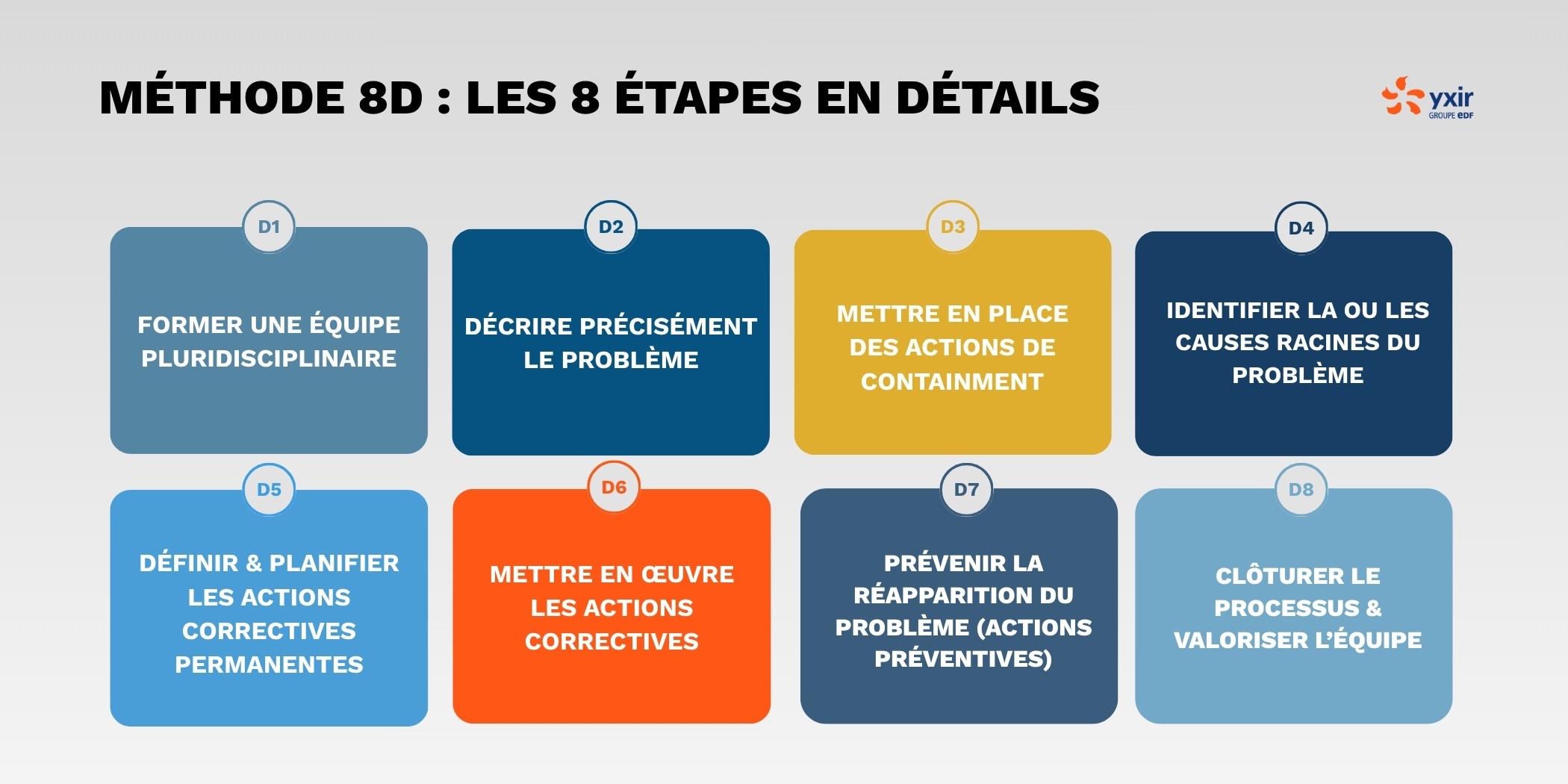
D1: Form a multidisciplinary team
The first step of the 8D method commits to establishing a team dedicated to solving the problem 👏
This is not a minor detail: the success of the analysis depends on the richness of the viewpoints.
The team must be multidisciplinary, with profiles coming from production, quality, methods, maintenance, supply chain or even the engineering department.
By combining field, technical and organisational expertise, we ensure a comprehensive understanding of the problem.
The role of leadership is also essential here.
Management must clearly designate an 8D leader or facilitator, set objectives and provide the necessary resources.
Without active involvement from leadership, the resolution process risks lacking efficiency and legitimacy.
The Yxir solution facilities this phase via centralised management of roles and responsibilities, accessible to all members from the platform.
You have a collaborative space to quickly mobilise your teams and monitor their involvement throughout the quality process.
D1 is the foundation: a well-formed team will make every step of the 8D method smoother, quicker, and above all, more grounded in reality.
D2: Describe the problem precisely
The second discipline of the 8D method consists of formulating clearly and objectively the problem to be solved.
This is often where errors begin... 😱
A poor initial understanding leads to false causes and ineffective actions.
Here, classic problem-solving tools are used, such as:
The 5Ws and 2Hs: Who? What? Where? When? Why? How? How much?
The fact diagram to structure elements validated by data
The anomaly sheet or the 8D sheet, used as a basis for collective work
The objective is to neutralise emotional or hasty interpretations. The description must be factual, measurable and verifiable.
Avoid vague wording like "quality problem detected on line A": we would prefer "product X, batch 45621, was detected non-compliant at the control station, diameter outside tolerance by 0.35 mm".
This first level of rigour secures the subsequent steps.
Our Yxir platform guides you through a structured form, with mandatory fields and dynamic suggestions, to guarantee a complete and structured description. AI helps fill in missing information.
Thanks to this, you start on the right track for the entire 8D process.
D3: Implement containment actions
Once the problem is defined, the third step aims to contain its immediate effects.
The objective of containment actions or temporary securing actions is simple: protect the customer and avoid any propagation of the defect, internally or externally.
These actions do not resolve the root of the problem, but they act as a quick stopgap while in-depth analyses are conducted.
Some common examples:
Stopping or isolating a suspect production batch
Reinforcing quality control at the end of the line
Implementing double visual checks or a specific gauge
Differentiated handling or client logistics hold
These measures must be immediately applicable, limited in time, and closely monitored to avoid any side effects.
The 8D method dictates total responsiveness here: the customer must be informed that concrete measures are underway to secure the situation.
Yxir allows to trace these actions in the 8D sheet, with dedicated fields for:
The description of the measures put in place
The start and end dates
The owner and resources mobilised
It is this operational transparency that reinforces customer trust, while flagging your structured quality approach.
D4: Identify the root cause(s) of the problem
Step D4 is the heart of the 8D method: root cause analysis.
Too often, corrective actions fail because they only treat symptoms.
This step therefore aims to understand in depth the real origin of the problem, not just what is visible.
Among the most used techniques, we find:
The 5 Whys: chaining the "Why?" questions to get back to the source
The Ishikawa diagram: mapping potential causes along several axes (manpower, machine, method, material...)
The Cause Tree method, more suitable for systems problems
This phase must rely on field observation, verifiable facts, and the involvement of those who experience the process daily.
This is where artificial intelligence, integrated into our Yxir platform, gives a real advantage.
Thanks to the automatic aggregation of quality data, we help teams cross-reference history of anomalies, identify frequent correlations and explore resolution paths.
You save time, gain relevance and, above all, make the 8D method more reliable by eliminating unproven assumptions.
This is the step that transforms a complex problem into a managed diagnosis.
D5: Define and plan permanent corrective actions
Once the root cause is validated, the priority is to implement a durable solution.
Step D5 of the 8D method is used to define, select and plan permanent corrective actions.
A good corrective action:
Tackles the root cause directly
Is technically feasible within a reasonable timeframe
Does not generate new problems
Is validated in a test or pilot before its full deployment
This step often includes collaboration with methods, purchasing or suppliers if an external part or process is involved.
The effectiveness of a solution is also measured by its ability to last over time. This is why a risk assessment or complementary FMEA can be useful.
Yxir allows you here to assign actions to owners, document milestones of the correction plan, and track statuses in real-time.
Our tool automatically alerts you in case of delay or drift.
In short, you structure the 8D method with rigour, while maintaining execution agility.
D6: Implement corrective actions
Defining an action is not enough: it must be implemented effectively in the field.
Step D6 puts the 8D method into practice, moving from is plan to action.
This requires precise coordination:
Clear communication of the changes to be applied
Training of the operators and managers concerned
Updating reference documents (instruction, control plan, etc.)
Field monitoring to guarantee that the solution is operational
At this phase, management is essential. Because any execution discrepancy can compromise the resolution of the problem.
At Yxir, we facilitate this implementation with an actions dashboard, complete traceability of interventions, and automatic notifications if differences appear.
You thus guarantee that each correction defined in step D5 is really applied, verified and sustainably adopted.
This is the condition to secure the customer, make the process reliable and prove to the audit that the problem resolution is concrete and documented.
D7: Prevent recurrence of the problem (preventive actions)
Once corrective actions are implemented, there remains a step often neglected but essential: preventing the problem from returning.
The objective of D7 is to lock the system to avoid any recurrence. We are talking here about preventive actions, distinct from corrective ones because they modify the standards, not just the execution.
Concretely, this can involve:
Updating work standards
Evolution of quality procedures or manufacturing routings
Integrating a new control point into the process
Targeted training of certain operators or departments
But what makes the difference is the ability to capitalise on the experience gained.
It is not just about correcting the error locally, but reinjecting this feedback into the entire organisation.
This phase can be facilitated by a digital tool, with a reference framework management module that allows automating the distribution of changes, alerting the teams concerned and tracking prevention actions in a documented framework.
You then transform each treated anomaly into a lever for continuous improvement, and you strengthen the quality maturity of your company.
D8: Close the process and recognise the team
The final step D8 consists of officially closing the 8D process, ensuring that all actions have been completed... and highlighting the work accomplished.
This is a key phase for anchoring the improvement dynamic, but also for recognising the efforts of the teams involved.
Here are the actions to conduct:
Perform a global review: effectiveness of actions, met deadlines, customer impact
Capitalise on lessons learned in a knowledge base or a tool for post-project reviews
Communicate internally on the success of the process: what has changed, measured benefits
Thank and recognise the 8D team, because it is they who drove the resolution
This step is often underestimated, yet it reinforces collective commitment. By showing that efforts bear fruit, we encourage a proactive culture of problem solving.
On our Yxir platform, you can automatically generate a closing report, document key lessons and share a didactic summary to the entire company.
A good D8 is more than a final bullet point: it is a solid brick in building a sustainable quality system.
Pros & cons of the 8D method
Why implement the 8D method?
The 8D method has established itself as an essential standard in industrial quality processes, particularly in demanding sectors like automotive, aerospace or pharmaceuticals.
And for good reason: it structures problem solving around a factual and collective approach
Furthermore, it pushes to go beyond superficial treatment, by tackling root causes.
Next, this method promotes continuous improvement by capitalising on feedback
Finally, the 8D methodology is perfectly documentable to meet customer and audit requirements
Implementing the 8D method means establishing a culture of rigour, shared responsibility and sustainable performance.
At Yxir, we see each 8D not as a constraint, but as an opportunity to make a process more reliable and to raise the level of collective mastery.
Limitations or deployment errors
But beware, an incorrectly applied 8D method can become counterproductive.
Here are the main pitfalls we observe in the field:
Too much theory, not enough field work: an 8D must be based on concrete facts, observed by those who live the process.
Bad definition of the problem in D2: the whole rest of the approach relies on it. An imprecise formulation misleads the analysis.
Sloppy treatment of root causes: jumping too quickly to the solution leads to ineffective corrections.
Lack of monitoring of actions: without rigorous pilot tracking, plans are not executed and the problem reappears.
Another crucial point: the perceived heavy burden of the method.
Some teams consider it too administrative.
This is why it is essential to digitalise and simplify step management, as proposed by Yxir, to make it fluid, guided and collaborative.
Comparison with other quality tools
The 8D method does not live in a vacuum. It coordinates with other analysis and continuous improvement tools:
The Ishikawa diagram (or cause-effect) is often used in D4 to map potential causes.
The 5 Whys are integrated into the identification of root causes.
The DMAIC method (Define, Measure, Analyse, Improve, Control), arising from Six Sigma, shares the same logic of in-depth analysis, but concentrates more on optimising stable processes than on managing one-off non-conformity.
FMEA (Failure Mode and Effects Analysis) can complement steps D5 and D7 to evaluate residual risks and anticipate potential failures of the corrected system.
The important thing is to choose the correct tool for the context, and to combine them intelligently. 8D excels in quality crisis or customer non-conformity situations. For more strategic or preventive approaches, other tools can take over.
*****
Today, manufacturers no longer have the luxury of "treating" quality problems lightly.
They must resolve them sustainably, and draw value from them. This is exactly what quality 8D offers.
Not only does it allow correcting a non-conformity with rigour, but above all it allows eradicating its fundamental causes, and preventing its recurrence in a robust manner.
It helps you secure your deliveries, restore a customer's trust, and avoid wasting time and resources on ineffective solutions.
Well applied, the 8D method transforms each incident into an opportunity for continuous improvement, while structuring the collective learning of the organisation.
It is a driver of progress, but also an indicator of quality maturity.
For this, it still needs to be made into a real living process, shared by all your teams, integrated into your company culture and not just a simple sequence of boxes to tick.
At Yxir, our belief is clear: the 8D method or 8D analysis has never been more relevant — but it must evolve.
With new industrial challenges, the acceleration of production cycles, compliance pressure and the complexity of flows, it is imperative to intelligently equip your problem solving.
Continue reading
The latest innovations in Industry 4.0


