The true hidden cost of poorly documented non-compliance
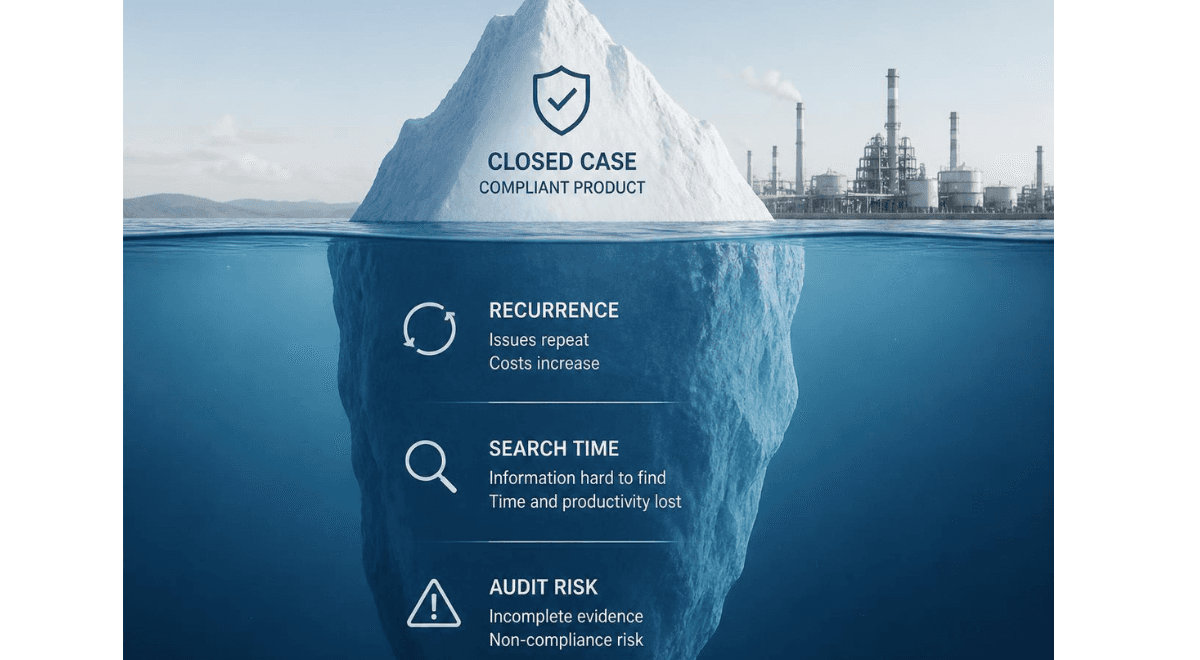
A poorly documented non-conformity costs nothing the day it is closed. It costs a lot the day someone needs it and cannot find it.
The file exists, the obligation is met, everything seems in order. The true cost of a poorly documented non-conformity always reveals itself elsewhere, and later.
A poorly documented non-conformity costs nothing at the time. The product is processed, the discrepancy is closed, production resumes. This is precisely what makes this cost invisible: it is never seen at the moment it is created. It is paid for later, elsewhere, often by someone other than the person who filled out the file in a hurry. That cost does not appear on any dashboard, and that is exactly why it ends up weighing heavily.
The cost you don't see coming
Documenting a non-conformity correctly takes time. Under production pressure, with a line stopped or a customer waiting, the natural reflex is to take the shortest route. Probable cause noted in one line, corrective action briefly described, file closed. None of this blocks the product. The file exists, the documentary obligation is met. But what should have been understood was never really analysed.
The first cost: the same mistake returning
A poorly identified root cause does not disappear, it moves. The symptom is treated, the cause remains, and it resurfaces later, sometimes on another product, another site, under a different formulation. Without usable documentation, no one makes the connection between the two occurrences. Each recurrence is then treated as a new case, with the same analysis time spent a second time, a third time, without the organisation ever really learning from the first.
The second cost: the accumulating search time
Faced with a discrepancy that seems familiar, the reflex is to check if a similar case has already been processed. On a poorly documented file, this search fails silently. Either the file does not appear in the results due to a lack of identical formulation, or it appears but does not contain enough information to be truly useful. The time spent searching, not finding, and then starting an analysis from scratch does not appear in any indicator. Yet it is very real, and it is repeated with every new discrepancy of the same type.
The third cost: the risk revealed during an audit
This is the latest cost, and often the heaviest. An insufficiently documented file holds up as long as no one reopens it. In an audit, it no longer holds. A root cause that is too vague, a corrective action without proof of effectiveness verification, a decision without clear justification: all points that transform a once-closed file into an audit non-conformity. The product may have been perfectly processed on its merits. The file, however, does not prove it, and in an audit, what is not proven does not exist.
The fourth cost: the next decision, made without a solid basis
A well-documented non-conformity becomes data for the future. Poorly documented, it is of no use to anyone, including the person who must later decide on a preventive action, validate a similar deviation, or justify a supplier choice. The decision is then made without backing from the organisation's actual experience, by guesswork, even though this experience exists somewhere, just unusable.
Why this cost remains invisible in dashboards
None of these costs appear in a traditional quality indicator. We measure the number of open non-conformities, the closure time, sometimes the recurrence rate when it is detected. We never measure the time wasted looking for a case already processed, nor the cost of a poorly identified root cause that resurfaces elsewhere in another form. What is not measured is never prioritised, and that is precisely what allows this cost to accumulate without ever triggering an alert.
What difference a usable documentation makes
The solution is not to document more. It is to document in such a way that the information remains usable later, by someone else, in a different context. An AI that reads the quality history and automatically matches similar cases changes the very nature of this risk. It does not replace the expert's analysis, but it prevents a case already resolved elsewhere from starting from scratch, and it flags files whose justification remains too weak to hold up in an audit, before the audit takes place.
A poorly documented non-conformity is never expensive on the day it is closed. It is expensive on the day someone, later, needs it and cannot find it.
Continue reading
The latest innovations in Industry 4.0